The Freedom 250 organization is the Trump-organized, Hillsdale College/PragerU-powered perversion of America 250, the group Congress created to nonpartisanly celebrate the nation’s 250th birthday. Freedom 250 has been expropriating America 250’s funds to stage pro-Trump propaganda like the concert-cum-rally that most performers have abandoned.
Freedom 250 aptly summarizes its commitment to cheap fake history with its “Founders Museum“, a display of Founding Fathers, signers of the Declaration of Independence, and four “Ladies of the Revolution”. Instead of assembling authentic public-domain portraits of these historical figures, Freedom 250 appears to have asked a chatbot to churn out pictures of Button Gwinnet, Carter Braxton, Dr. Benjamin Rush, and revolutionary friends in largely identical garb and silly face-fingering poses:
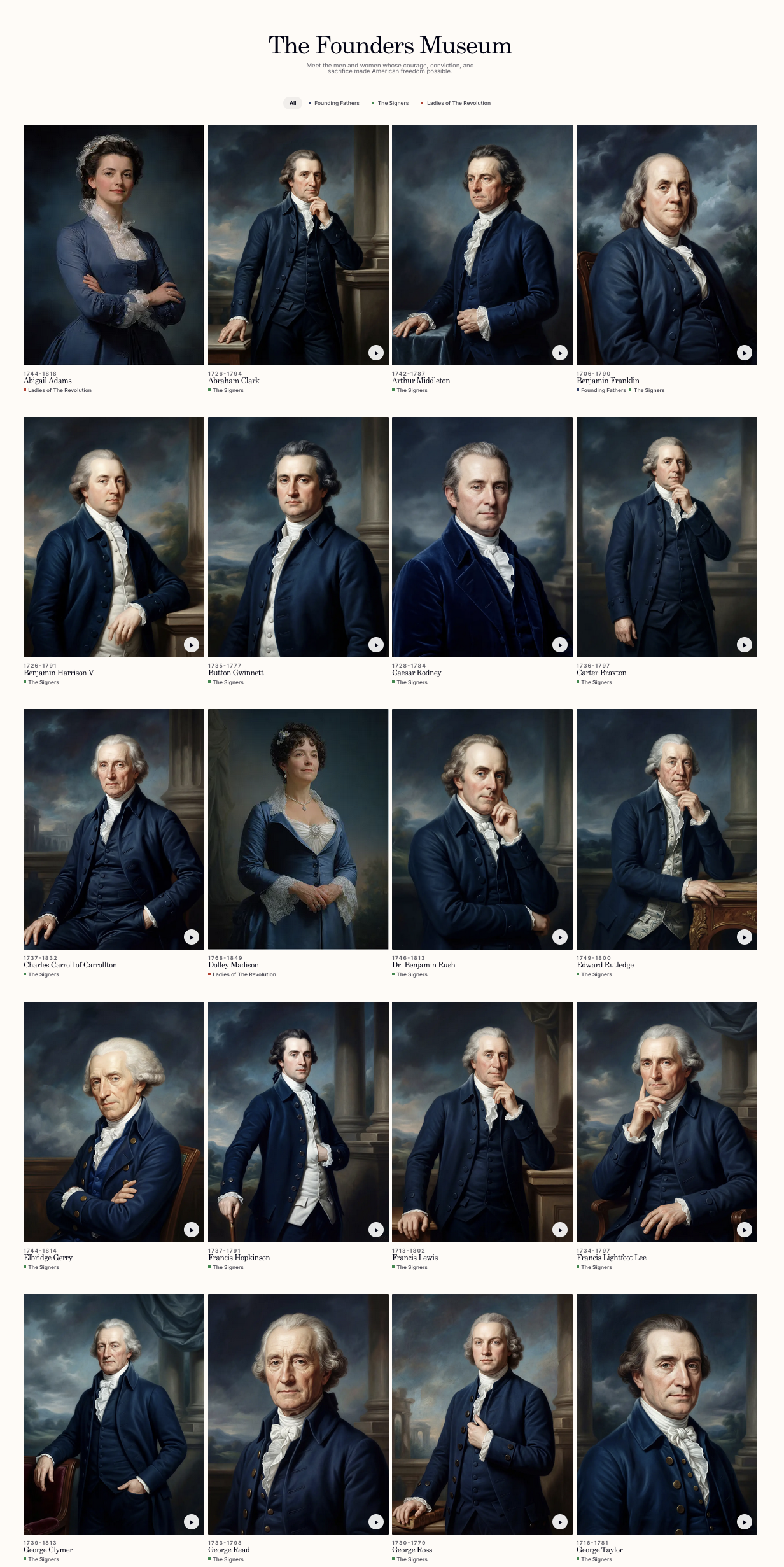
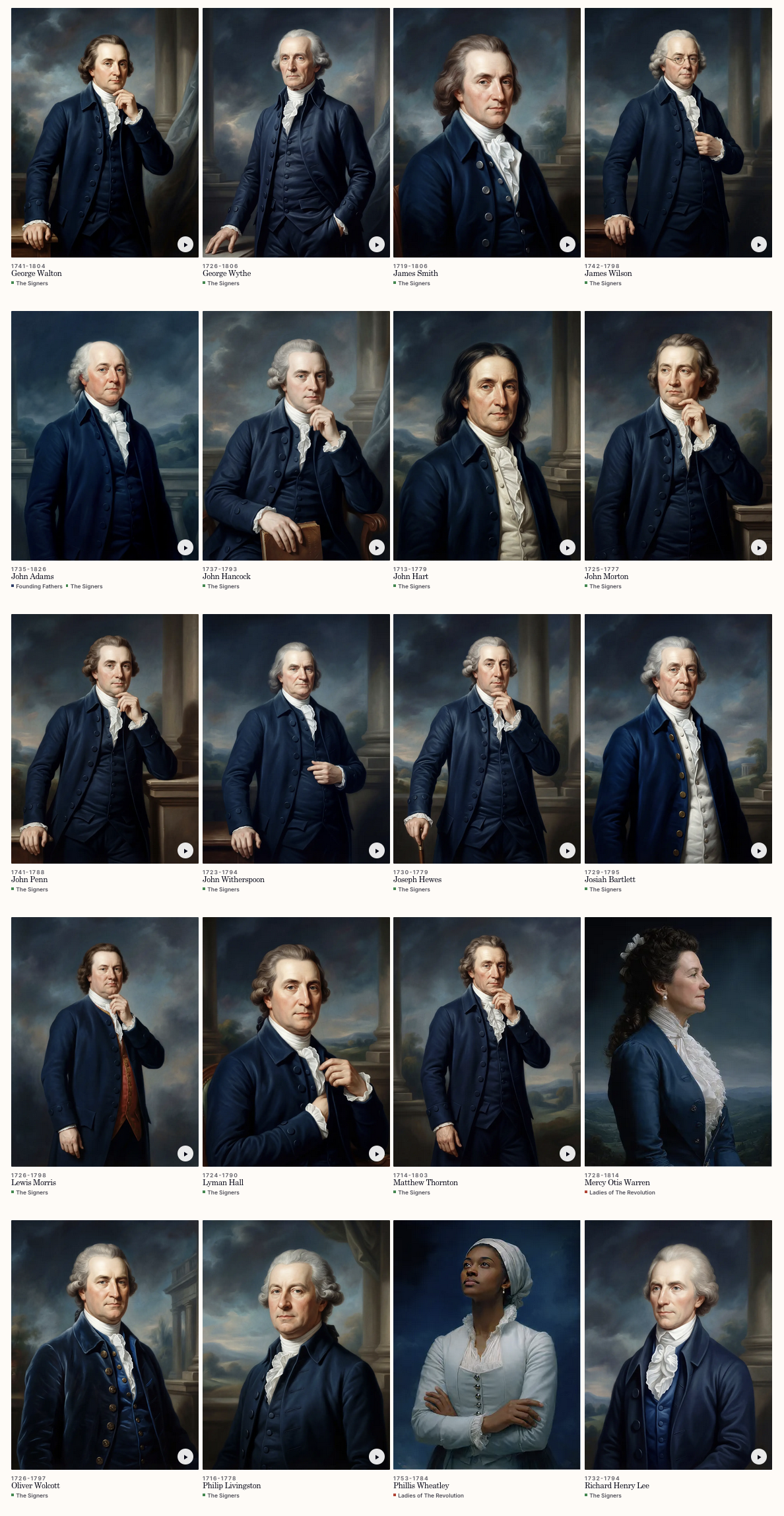
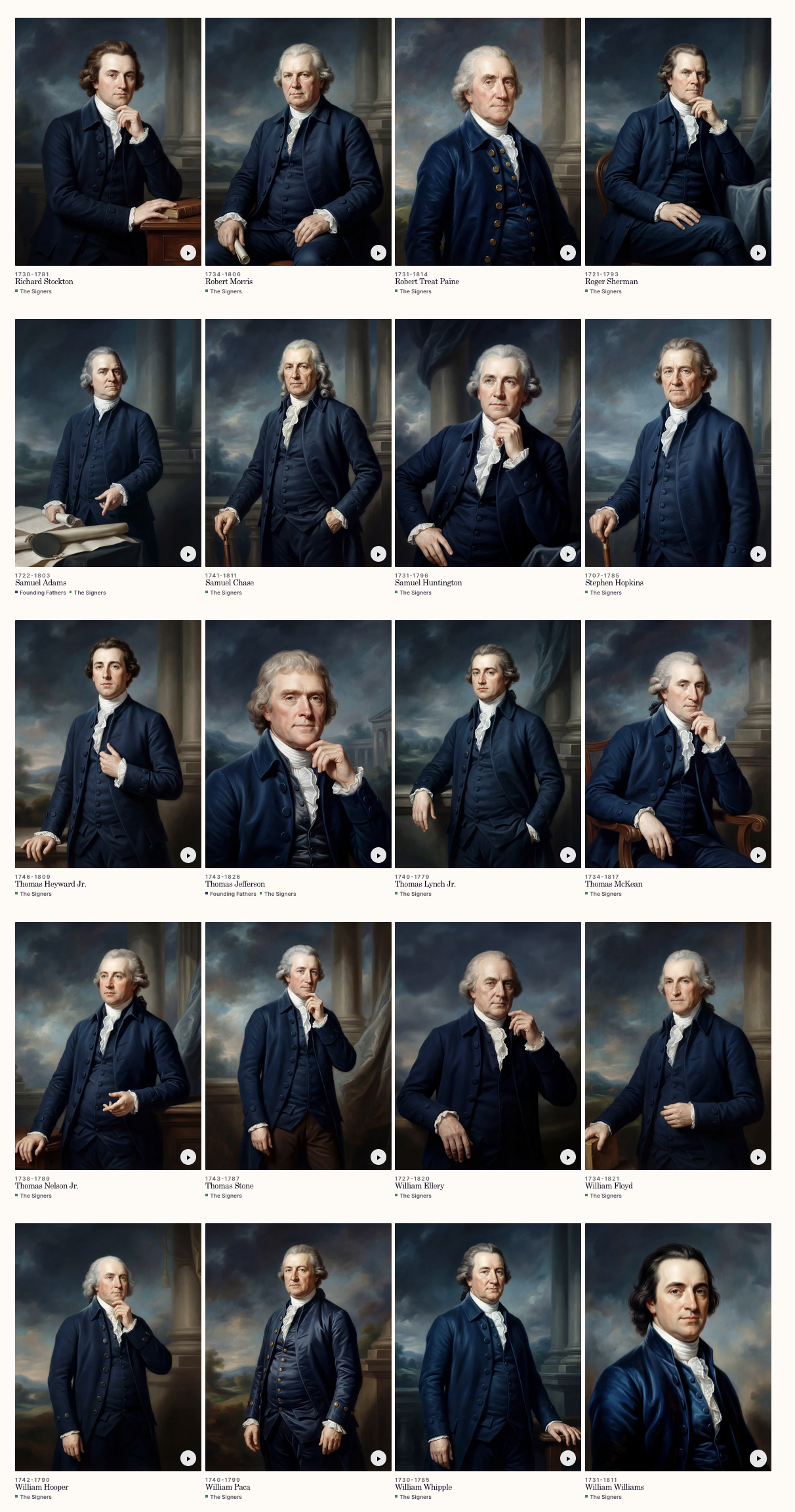
Freedom 250’s men are all in blue coats with similar collars and buttons and white ruffles at the throat. They all appear before the same cloudy blue background. Most have the same one or two columns behind their left shoulders and indistinct landscapes to their right, with either the horizong sloping upward or obscured by Roman ruins. Freedom 250 depicts 21 of the founders with their hands tenderly placed by their chins. I dislike this pose—a reporter once managed to snap a picture of me in such a position and published, and I felt it made me look passive and weak. Worse here, the hand-to-chin pose appears alien to 18th-century historical portraiture. I scan a Google search that produces hundreds of images of Thomas Jefferson, and I don’t see a single one that shows Jefferson in the pose Freedom 250’s chatbot casts him in.
Pioneering writer Phyllis Wheatley is often depicted with one contemplative hand to her chin and the other hand holding the pen that poured forth her contemplative words, but Freedom 250’s chatbot ignores that historical imagery and poses Wheatley and Abigail Adams with arms folded across their chests, a pose used rarely if ever in any period portraits of those two women or any of their male compatriots, perhaps because the pose signals a defensiveness or defiance that might have been viewed as inappropriate to gentle ladies of the time.
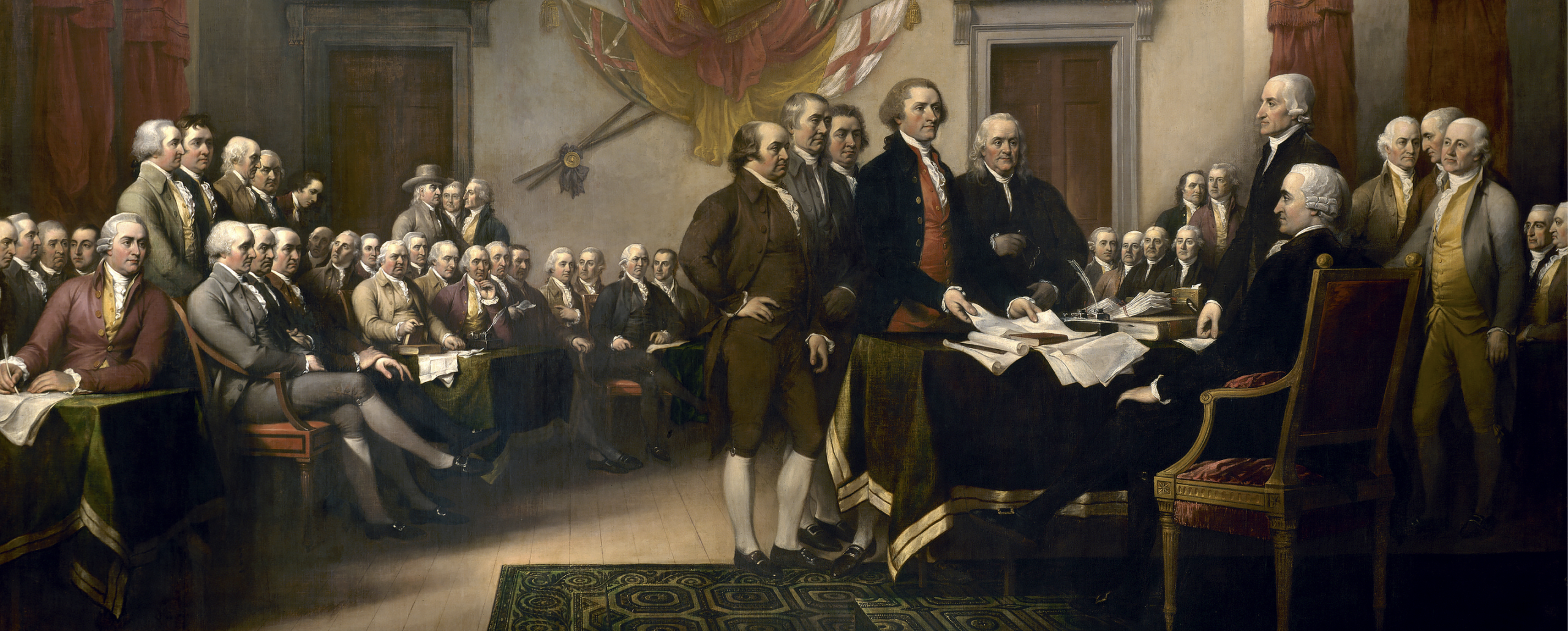
Consider John Trumbull’s famous natural-intelligence depiction of the signing of the Declaration of Independence: you’d expect an artist to use a variety of poses to enhance visual interest, but Trumbull shows nobody with arms crossed. He shows only one man, Elbridge Gerry, seated in the front row, with his hand to his chin. Freedom 250 shows Gerry with his arms crossed.
Freedom 250 appears to have used a different chatbot or different prompts for its four female portraits. While the men’s portraits have similar antique feel, the women’s portraits all have a strange photo-realism that creates a jarring, anachronistic effect when viewed amidst the stream of dusty old men. I might think that Freedom 250 is trying to give these historical women more life than their male contemporaries, but with a cage-fight on the White House lawn Sunday, we all know better than that. Trump’s toadies just rushed a few prompts through a chatbot with no regard for historical authenticity.
Freedom 250’s mostly bland, repetitive images of the Founders epitomize the generic, unimaginative style we can expect from robots. Freedom 250’s lazy fakery also provides a fine metaphor for the broader and pervasive fakery the Trump Administration uses to twist everything, including a landmark July 4th celebration, into a prop for his own agenda.
I despise AI. Anything can consume; fire, rodents, bacteria, or even just time. Overcoming danger and difficulty by our own effort is part of what makes us human. By voluntarily surrendering our ability to create, and choosing to only consume, we become functionally closer to bacteria than people.
And this might not be popular on this site, but as a Christian, I do believe that humans were created different than animals. It’s frustrating when people who claim to be Christians want to refuse that difference and choose mindless consumption instead.
It is sad or maybe the founders all bought their suits on sale day at the Krass brothers.
Symbolism of a refusal to deal with these great men as they truly were; MGGA, who may only hold one simple thought at a time, needs to spruce up the lot just a bit.
I suppose I should be happy 1) that none are wearing MAGA caps and 2) Trump is not included in the lot.
I wonder if they’re all wearing the same shoes.
The Trumbull painting is not a depiction of the signing of the Declaration of Independence. It is a depiction of the presentation of a drafting committee’s draft version (mostly from Jeffereson) of the Declaration of Independence to the Second Continental Congress on June 28, 1776. Trumbull spent a lot of time with Jefferson to probe his memory of that event. Before he bagan the painting he had sketched the interior of the hall where the Congress met so he could recreate the details (although the painting was done in 1818 and the details may have changed a bit. He also had some previous portaits of the delegates, though not necessarily at the ages they were whent he Congress met in 1776.
There was no formal signing event at the time the Declaration passed Congress. on July 4. Many signed engrossed documents later. Some did not sign.
Postmodernism posits that you cannot trust the image. That has been true throughout history, though we can really understand that in recent years. Trumbull had the benefit of beiing close to the the drafter of the Declaration, doing some pretty detailed research and trying hard to get the details right, at least a right as someone doing a painting nearly fifty ears after the event can.
Face-fingering be damned. All those fellows look to have the same barber.
In one year, we have more bogus cartoons coming from computers than we’ve had in eons. This is going to be a problem, gentlemen.
Sam, Christian perspectives are welcome here. Pope Leo would also draw a connection between distinguishing humans from animals, rejecting mindless consumerism, and resisting the surrender of the creative act to machines.