Attorney General Marty Jackley’s call for public comment on his draft title and explanation of the first citizen initiative proposed for the 2028 election cycle has drawn little public response, and predictably, what little comment he did get was statutorily irrelevant.
SDCL 12-13-25.1 gave citizens ten days, until August 3, to comment on Attorney General Jackley’s language explaining Brenda Anderson’s proposed deregulation of raw milk and other homemade dairy products. That public comment period, enacted by 2021 Senate Bill 123, calls for citizens to respond not the initiative itself but to assess the clarity, concision, simplicity, and objectivity of the language the Attorney General has proposed to accompany the initiative petition and to appear on the ballot if the initiative goes to the voters.
Like almost every commenter on AG titles and explanations since the enactment of 2021 SB 123 (see here, here, here, here, here, here, here, and most recently here), the lone respondent to Jackley’s call for comment on his title and explanation failed to comment on his title and explanation. Kendra Paulton of Custer County says not one word about what the Attorney General proposes to say about her neighbor Anderson’s homemade-dairy deregulation; instead, Paulton’s July 28 e-mail to Jackley just expresses her support for the initiative:
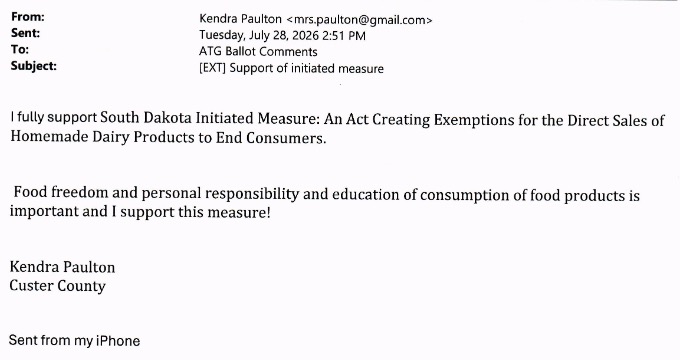
That’s nice, but individual support for or opposition to a proposed ballot measure has nothing to do with helping the Attorney General determine whether he has fulfilled his statutory duty to accurately explain the proposed ballot measure.
2021 SB 123 thus continues to offer little if any real benefit to the initiative process. It’s only objective effect is to delay the circulation of most initiative petitions by 20 days—ten days for the A.G. to take mostly irrelevant public comment, then another ten days for the A.G. to consider that comment and produce the final version of his title and explanation. The only way to avoid that delay is for citizens to submit their initiative proposals ridiculously early, as Brenda Anderson, two and a half years before the general election and six months before petitioning can begin.
The public comment period on A.G. titles and explanations is doing far more harm than good for the process. We shouldn’t delay petitioning for legally irrelevant commentary. The 2027 Legislature should repeal this public comment requirement, or at the very least reduce the time the Attorney General gets to publish his draft titles and explanations from 60 days to 40 days, thus eliminating the extra delay caused by this mostly useless statute.
I’ll take up the question of public comments on the AG explanation, but first we have to deal with the real issue, which you have ignaored. There shouldn’t be an AG explanation at this stage in the initiative process in the first place. It is that issue that needs to be addressed, but if it is not, then the public comment period needs to remain.
The AG explanation is forced government speech (illegal under the First Amendment) and an executive branch incursion into a legislative function (illegal under separation of powers) First, the AG explanation is supposed to be provided to those people signing the petition by the sponsor and the petition circulator. Uh, No. The AG has no constitutional authority to force me to hand you a piece of paper having his views on a subject I am collecting signatures on in order to petition the
government as I’m exercising my constitutional rights to free speech.
Second, the initiative process is a legislative process. Where in the Legislature’s process is the AG explanation for every bill that is drafted before it is introduced into the Legislature? The answer: it doesn’t exist, because it would be a massive unconstitutional intrusion into the Legislative process. What if legislators had to circulate an AG explanation to every potential co-sponsor on their bills? It would go to court and be struck down as an unconstitutional intrusion into the legislative process.
If the AG explanation is unconstitutional the required public comment period on this explanation would be illegal.
There is an argument that the LRC, a legislative institution, would be a more constitutional place for the explanation to be written, but then you still have the first amendment problem to deal with.
Now, let’s say the AG explanation remains. Does anyone really think that one person ought to have dictatorial unchecked power to write an explanation about an important issue that is going to the public for consideration? Shouldn’t the public be able to be given the opportunity to correct any misunderstandings in the AG explanation?
I can tell you from personal experience that there used to be, and maybe still is, a lot of secret communication between lobbyists and the AG to insert certain words and phrases into his explanation. We found this out during one of our mining initiatives. Those words and phrases had been focus group tested to give a positive or negative slant, so that they could be subsequently quoted in glossy mailings and TV ads. Don’t citizens have a right to weigh in and correct these abuses of power?