Anderson Offers South Dakota Dairy Food Freedom Act to Address Dairy Decline
Published 2026-07-28 by
Cory Allen Heidelberger
Via her Busy Ewe Farm & Fiber website, initiative sponsor Brenda Anderson offers this four-page brief on what she is calling the “South Dakota Dairy Food Freedom Act”. The brief indicates that the primary motivation of Anderson’s proposed initiative to deregulate the sales of homemade dairy products is to reverse the decline and consolidation of small dairies:
The purpose of this act is to allow producers, especially small and family-scale farmers, to sell the products that they can produce without the extensive and price prohibited permitting infrastructure required under current SD law. South Dakota’s milk cow inventory reached 215,000 head as of January 1, 2025 (up 117% over the past decade, leading the nation). Further growth is expected into 2026. Large-scale operations drive this expansion, while small farms bear disproportionate regulatory costs. Sources: USDA NASS reports; South Dakota Governor’s Office of Economic Development (GOED) press release, February 13, 2025.
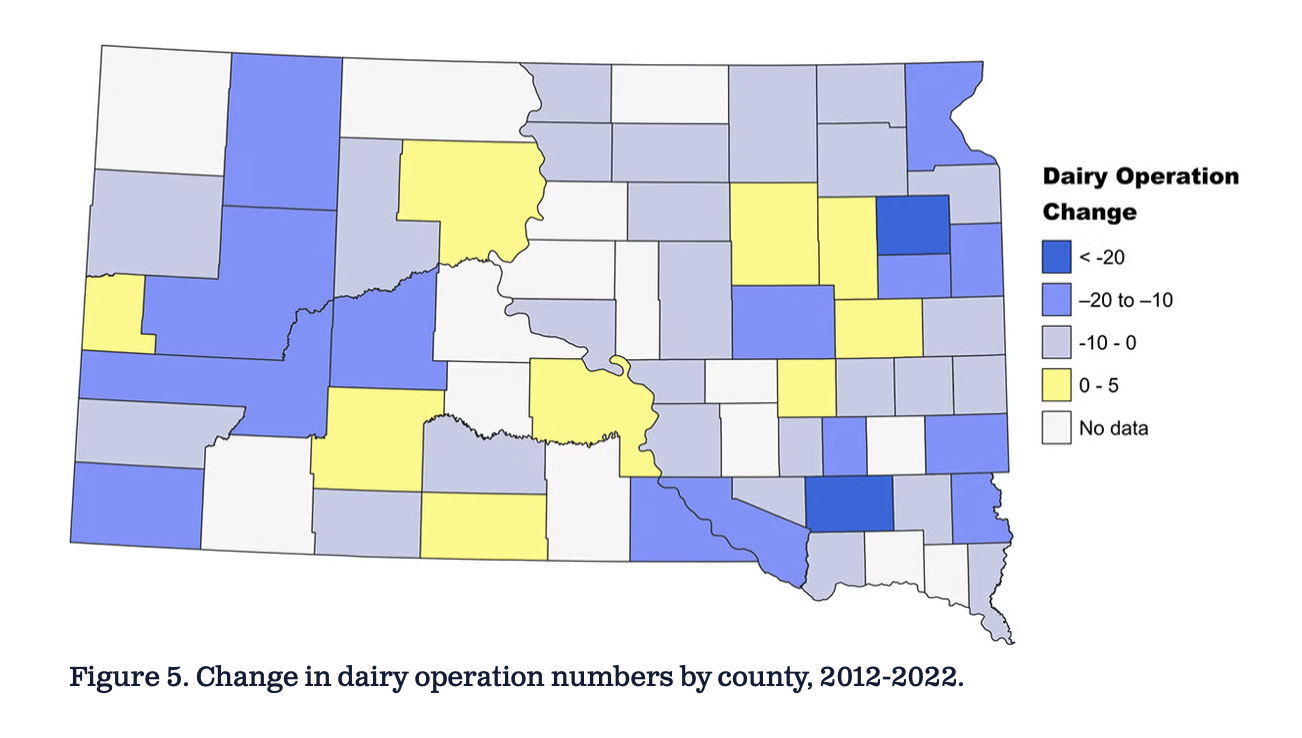
Dairy farm numbers continue to decline due to consolidation: ~134 licensed dairy farms as of early 2025, with sharp exits among small and extensive operations (especially in western South Dakota). Between 2012–2022, most counties experienced declines in dairy operations even as statewide inventory grew. Sources: SDSU Extension “Dairy Production in South Dakota: Growth and Consolidation” (September 12, 2025); Dairy Star (March 8, 2025); USDA NASS data.
…Existing rules require an annual permit (~$50 + $50 inspection fee), yearly inspections, frequent testing, specific labeling, temperature controls, and major infrastructure upgrades. These disproportionately burden small/family dairies:
A permit often requires a $60,000+ milk parlor (or up to $600,000 for a new barn with running water). The same standards apply whether a producer has 1 cow or 7,500 cows—no tiered exemptions exist [Brenda Anderson, “South Dakota Dairy Food Freedom Act Supporting Background Information,” retrieved from BusyEweFarmFibers.com 2026.07.28].
Anderson cites SDSU Extension’s 2025 report “Dairy Production in South Dakota: Growth and Consolidation” to support her point that factory dairies are increasing South Dakota’s cattle inventory but decreasing the number of dairy operators:
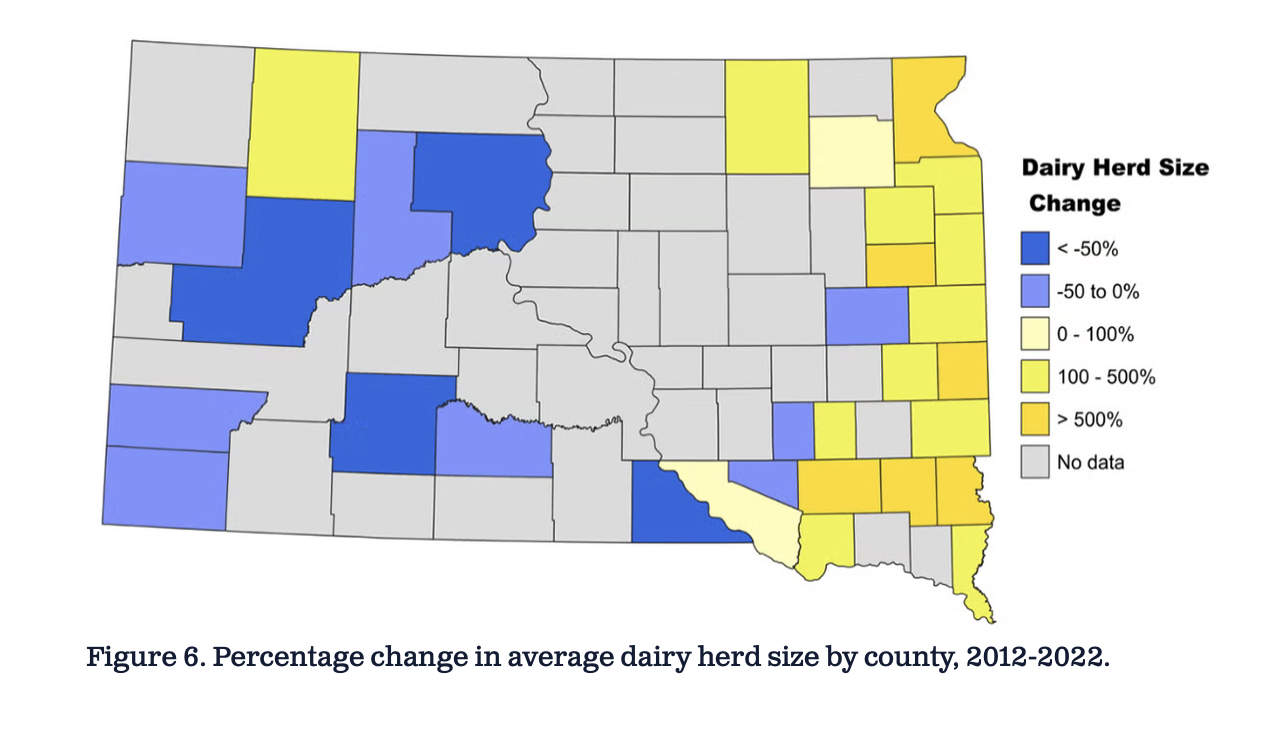
Across the state, we can see large reductions in dairy cow operations for almost every county over the past decade, except for a few counties that have only minor increase in operation numbers (Figure 5). The reduction in dairy operation in tandem with the increase in dairy inventory indicates the consolidation of dairy operations (Figure 6). Such change could be due to the economies of scale and technological innovations in recent decades. As the small-scale diary operations on extensive systems are gradually exiting, while the large operations have increased dramatically, the intensive system has become the predominant system in dairy production Tong Wang, “Dairy Production in South Dakota: Growth and Consolidation,” SDSU Extension, 2025.09.12].
Even in the I-29 corridor, where big dairies have been building with the vigorous blessing and subsidy of the state, the actual number of dairies has dwindled.
Anderson states that advocates of small dairies and food freedom must resort to the initiative process because the Legislature has refused to take action:
This initiated measure is a democratic tool to address legislative gridlock, consistent with voter sovereignty under Article III of the South Dakota Constitution.
Legislators have repeatedly failed to ease raw milk restrictions. For example, HB 1121 (2026)—a modest bill to allow raw milk sales at farmers’ markets and producer-owned retail stores—was deferred to the 41st legislative day, effectively killing it without full debate or vote.
…Similar efforts have faced committee roadblocks, industry/health opposition, and procedural delays. A citizen-initiated measure is the only viable path forward [Anderson, retrieved 2026.07.28].
Check that bill reference: 2026 House Bill 1121 was sponsored by Speaker Jon Hansen (R-25/Dell Rapids), but Speaker Hansen withdrew HB 1121 before it could be scheduled for a hearing before House Agriculture and Natural Resources. HB 1121 thus never received a vote. The Legislature has passed a couple of “food freedom” bills this decade dealing with homemade baked goods (Rep. Nancy York’s 2020 House Bill 1125 and Rep. Marli Wiese’s 2022 House Bill 1322, But the Legislature hasn’t done much with raw milk since it passed the Department of Agriculture’s Senate Bill 45 in 2015. That law opened the door for dairy producers to sell raw milk directly to consumers at their farms but explicitly forbade selling raw milk at farmers’ markets or retail stores not located at the producer’s farm.
Anderson will be able to start circulating her petition for her South Dakota Dairy Food Freedom Act on November 7. Under current law, she will have until May 2, 2028—18 months—to collect the thousands of signatures necessary to put the initiative to a statewide vote.
Reminiscent of the Good the Bad and the Ugly.
She could invite Minocquae brewing to the state and Hansen could play there.