Our teachers are plenty handsome, but…
South Dakota is less attractive to teachers than any of its neighboring states except for one—Minnesota! So said the Learning Policy Institute in 2024:
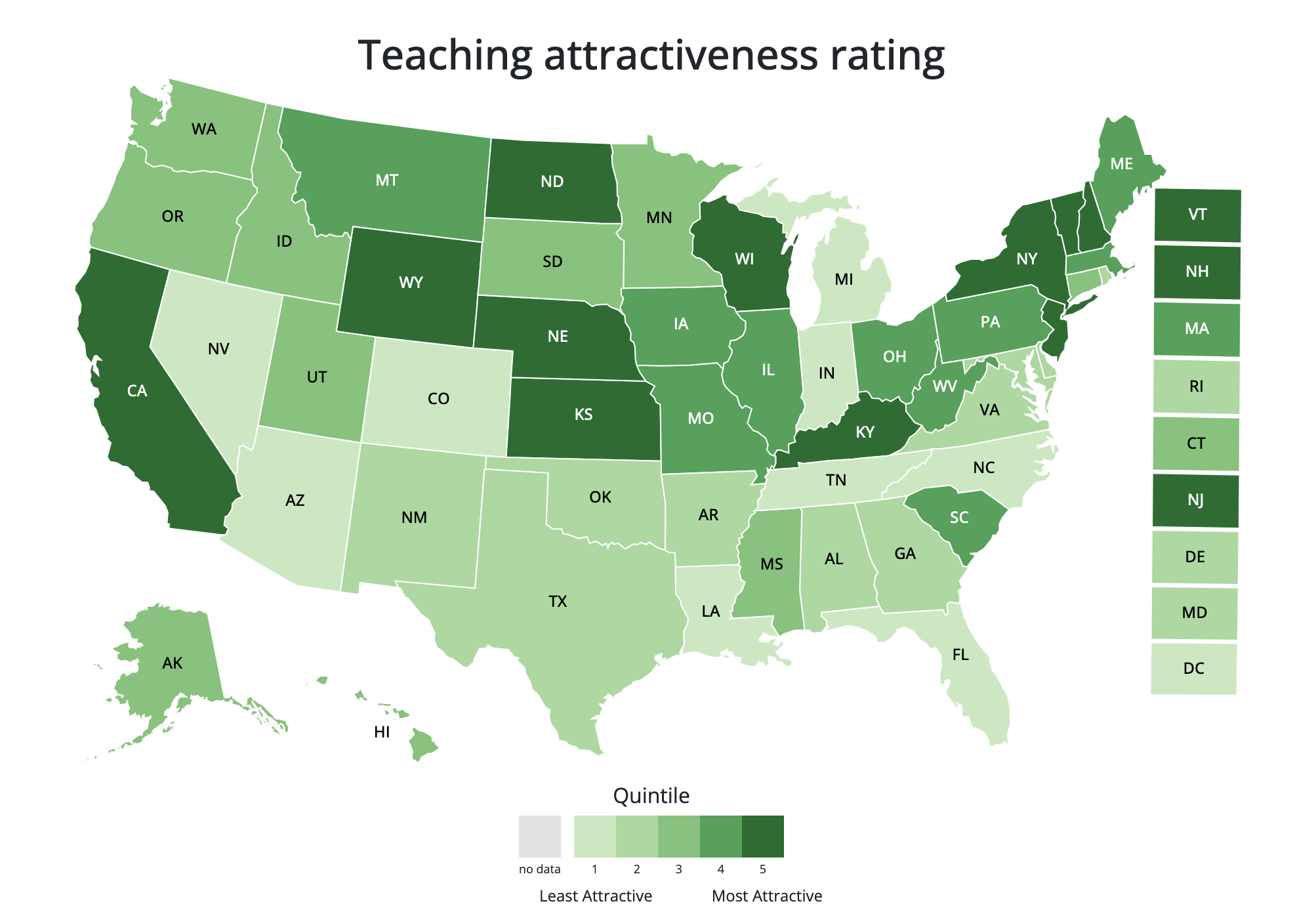
LPI’s complicated distillation of teacher pay, working conditions, school resources, turnover and hiring, qualifications, and (don’t tell Trump!) equity produces a rating of 3.2 out of 5 for South Dakota, just ahead of Minnesota’s 3.1. Best in the region and tied with New Hampshire for best in the nation are North Dakota and Wyoming at 3.8. The least attractive state for teachers is Florida at 1.7 (probably even lower now that Floridians have the lowest flu shot rate in the country and plans to get rid of childhood vaccine requirements).
This map and other data popped up in a consultants’ pitch to Senate Education yesterday morning. Consultant firm Vital Network told Senate Ed that they can help South Dakota address its high teacher turnover rate:
“Almost 10% of your educators leaving in a given year is alarming, but I think also something that we can address,” Vital Network CEO Nathan Eklund told the committee.
According to a study by the consulting group, more than 1,000 South Dakota teachers– nearly 10%– left their jobs last year. Most were employed by another school district in the state, but 17% left education altogether, 16% retired, 15% relocated and 5% were employed by out of state school districts [Gracie Terrall, “10% of South Dakota Teachers Left Their Job Last Year,” KELO-TV, 2026.01.15].
To my surprise but perhaps to the relief of K-12-budget-flatlining Governor Rhoden, Vital Network says pay drives turnover less than working conditions do:
However, Erin Robb, chief strategy and impact officer at Vital, said from its research in North Dakota, teachers who left teaching were going to jobs with lower salaries, but other benefits outweighed the pay.
“Sixty six percent of teachers who left the profession said work-life balance was better,” she said. “Almost 60% of teachers who left said their workload was more manageable in a new job, and that teachers with unsupportive administrators, they’re more than twice as likely to leave their school” [Terrall, 2026.01.15].
But the Learning Policy Institute says you can’t leave teacher pay out of your recruitment and retention strategies:
Another recent analysis found that teachers are three times as likely as all workers in the U.S. to report having multiple jobs. These challenging conditions are prompting policymakers in Mississippi, New Mexico, and elsewhere to raise teacher compensation as one of many important strategies to build a strong and diverse teacher workforce. Raising teacher pay both addresses the immediate crisis and can help to stabilize the profession for the long term. As Antonio Castanon Luna, the Executive Director of the Mississippi Association of Educators, described his state’s pay increase, “It’s an investment in the future of Mississippi…. We will be able to recruit teachers to our classrooms now and for years to come” [Susan Kemper Patrick and Desiree Carver-Thomas, “Teacher Salaries: A Key Factor in Recruitment and Retention,” Learning Policy Institute, 2022.04.14].
Research from the University of Washington agrees—raise teacher pay, lower turnover:
Pay bumps appeared to significantly reduce teacher turnover in all districts—between 3 and 5 percentage points—in the first year after treatment. Effects were especially strong for teachers with eight years of service or above. Hiring patterns showed largely null effects, except for a small but statistically-significant increase of .08 percentage points in hiring of so-called “junior teachers” (those with 4 to 7 years of experience) for every $1,000 increase in base salary post-treatment [Jeff Murray, “Teacher Pay Increases and Their Impacts on Salary Level, Hiring, and Turnover,” Thomas B Fordham Institute, 2024.01.16].
I don’t have specific data handy, but I’m pretty sure that increasing teacher pay will retain more teachers than raising consultant pay.
Republican is not just another word for Earth hater it’s another word for misanthrope.
I am beginning to loose faith in finding a solution for education. As an entity that spends tax money, it is hated automatically by many conservatives; as the entity to instill citizen values in our youth, it is hated by other groups conservative and liberal; as an institution that has to have rules of student conduct to operate, it is hated by some parents and rebellious youth; as the silver bullet for economic success in a time when the economy has been corrupted by wealth hoarder, it is hated by students who do not see increased opportunity and the business who want only unskilled labor (at unskilled labor cost); at a time it is seen as a potential source of revenue stream, it is hated by privateers; as the institution that has students observe and critically evaluate it’s hated by those in power being challenged.
Public education is the greatest good this nation has produced. Committed educators must spend time defending the institution’s very existence on top of doing their job within it. Who has the energy enough for that?
Teachers can screw themselves too. I live in Florida and one year my son had a great art teacher at Pine View in Sarasota county. The advanced placement school. She did a great job with the program. Soooo an older teacher liked it and bumped her the next year. Why would any young teacher work hard to build any program when you can be bumped by any teacher with more time put in?
I’m still totally in favor of public schools. How else can you prepare those students to deal with life after school. Sure lets just all educate our kids by homeschooling.. They should be better more knowledgeable students with no idea how to interact with others. Your choice.
There is nothing wrong with our public schools that teachers can’t fix. If teachers were consulted once in a while, allowed to use their expertise, and promoted on an equal basis to be in administrative positions, our schools would be in grand condition.
As long as politicians are ignorant about social skills and lack knowledge in poli sci and history, our schools will struggle with them at the helm. Most politicians would flunk a unit in “Character Counts” and good luck with the National Teachers Exam on the social sciences.
Most teachers would rather have tests on student knowledge based on authentic assessment rather than a paper and pencil multiple choice exam. Let’s adopt the Norwegian model and stop grouping kids by age and start monitoring student growth individually instead of comparing them to other students.
So many ways to improve but not in SD.
Mary Hart was a teacher in your state and I found her highly attractive.
Mark, administrators assign teaching positions — not teachers. Your tragic example sounds like a problem of poor leadership.
Larry Rhoden and Jon Hansen are competing for the exact same voters so a cynical observer might suspect Howdy Doody Dusty is paying Hansen to stay in the primary.