Voters’ rejection of Amendment L at the polls last week was the third time in eight years that Republican legislators’ attempts to require than a simple majority to pass certain ballot measures has failed.
In 2018, the Republican Legislature offered Amendment X (2018 SJR 1), which would have required a 55% vote to enact constitutional amendments and revisions. Voters killed X with a 54.32% No vote.
In 2022, the Republican Legislature offered Amendment C (2021 HJR 5003), which would have required a 60% vote to pass any constitutional amendment, initiated law, or referred law that raised taxes or triggered $10M or more in state spending. Having failed to persuade the general electorate to support Amendment X, Republicans put Amendment C to a vote during the June primary, when they figured the only people voting would be Republicans friendly to their wishes. Boy, were they wrong! 2022 primary voters went 2 to 1 against C with a 67.43% No vote.
This year, the Republican Legislature tried Amendment L (2025 HJR 5003), which would have required a 60% vote to enact constitutional amendments. L was plainly stricter than X with its 5-point-higher threshold, but comparing to C is tricky: L applied to all constitutional amendments, not just fiscal measures, but L didn’t affect initiated laws and referred laws. L was at least less complicated than C. Maybe simpler language gave L an advantage over C. This year’s general electorate still booted L on a 57.59% No vote, nearly 10 points smaller than the No on C but more than 3 points bigger than the No on X.
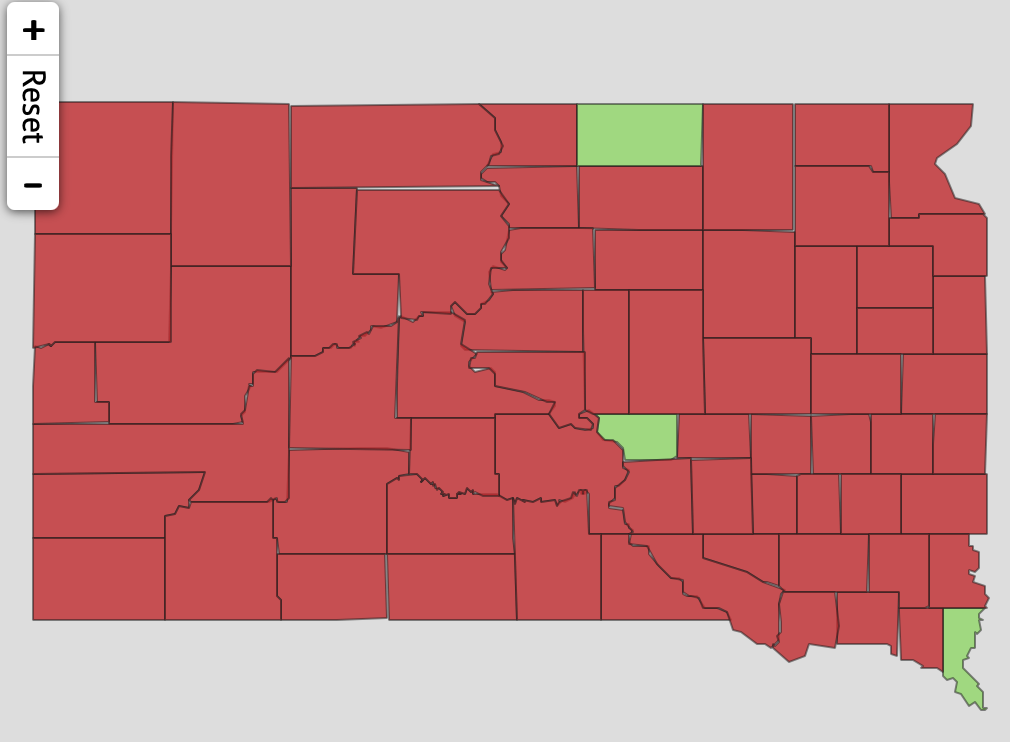
Republicans looking to spin their third loss on throttling voters’ right to amend their own constitution might point to the county-level results and say they are making progress in making their case that it should be harder to pass amendments. In 2018 only three counties supported Amendment X:
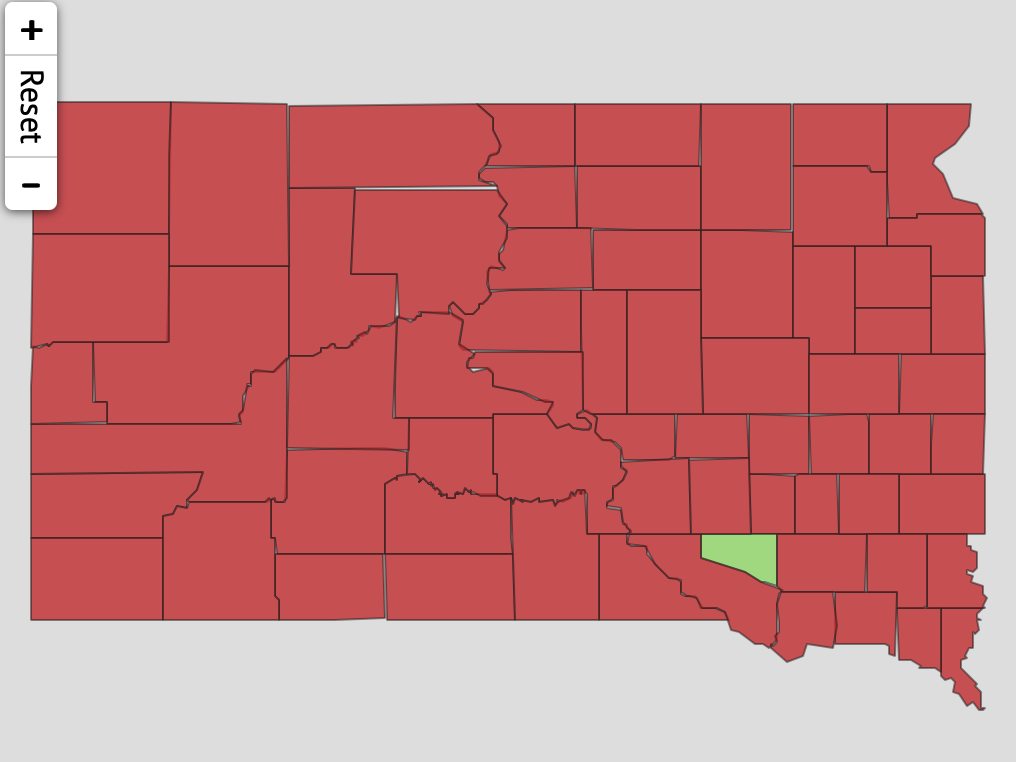
Republicans spinners would skip past the 2022 Amendment C map, on which only one county glows green in support of curtailing majority rule:
…and jump to the 2026 Amendment L map, which is surprisingly variegated:
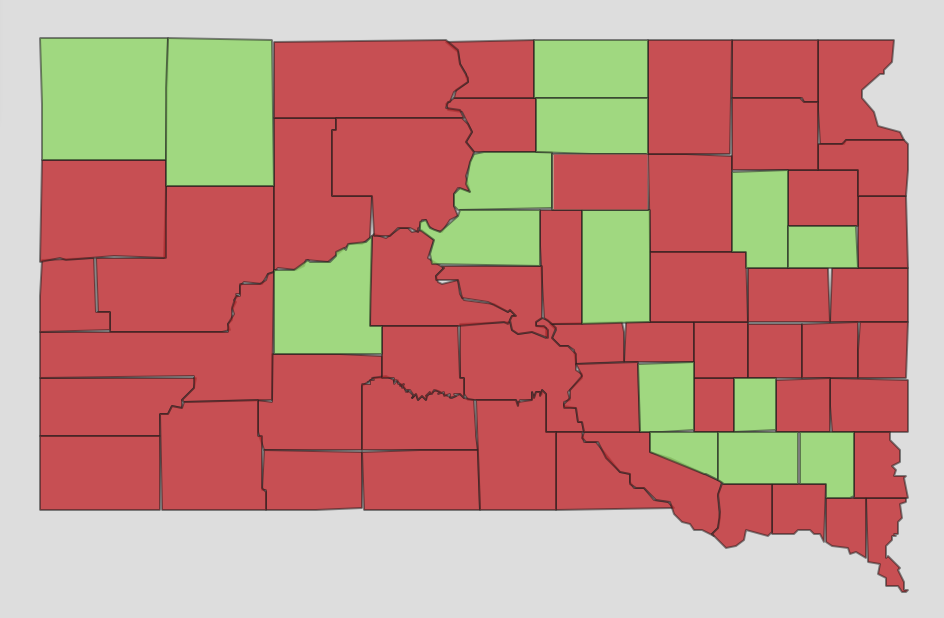
See? our democracy-hating Republican legislators could claim, gesticulating passionately at the greening map. Voters are coming around to our way of thinking! More voters want to give up their rights and restrict democracy! 12 more counties over eight years… by 2058, we’ll persuade darn near everybody!
Alas for our Republican democracy-haters, their persuasion trend is more complicated than more bright green splotches of county-level wins. The claim that county-level results bode well for future efforts to make it harder to pass amendments fails on multiple statistical points:
- Those 15 counties that supported Amendment L cast only 6.89% of the statewide vote. Minnehaha County alone canceled out the L-Yes counties’ 10,814 yeas and still had 27,541 nays to spare, enough to beat Minnehaha’s 26,575 yeas.
- The 18 counties that cast the most votes on Amendment L all rejected L. The 33 biggest-voting counties included just three L-Yes counties—Turner, Hutchinson, and Hamlin.
- The average Yes percentage in the 15 L-Yes counties was 52.77%. The average No percentage in the 51 L-No counties was 58.01%.
- Not only are the L-Yes counties too small to win a statewide vote, but the shift toward Yes votes from 2018 X to 2026 L is too weak and too concentrated in small counties to outweigh the shift toward No votes everywhere else. 35 counties saw higher Yes percentages for L this year than for X in 2018. But the 31 counties that saw higher No percentages on L than on X made up more than 83% of the participating electorate.
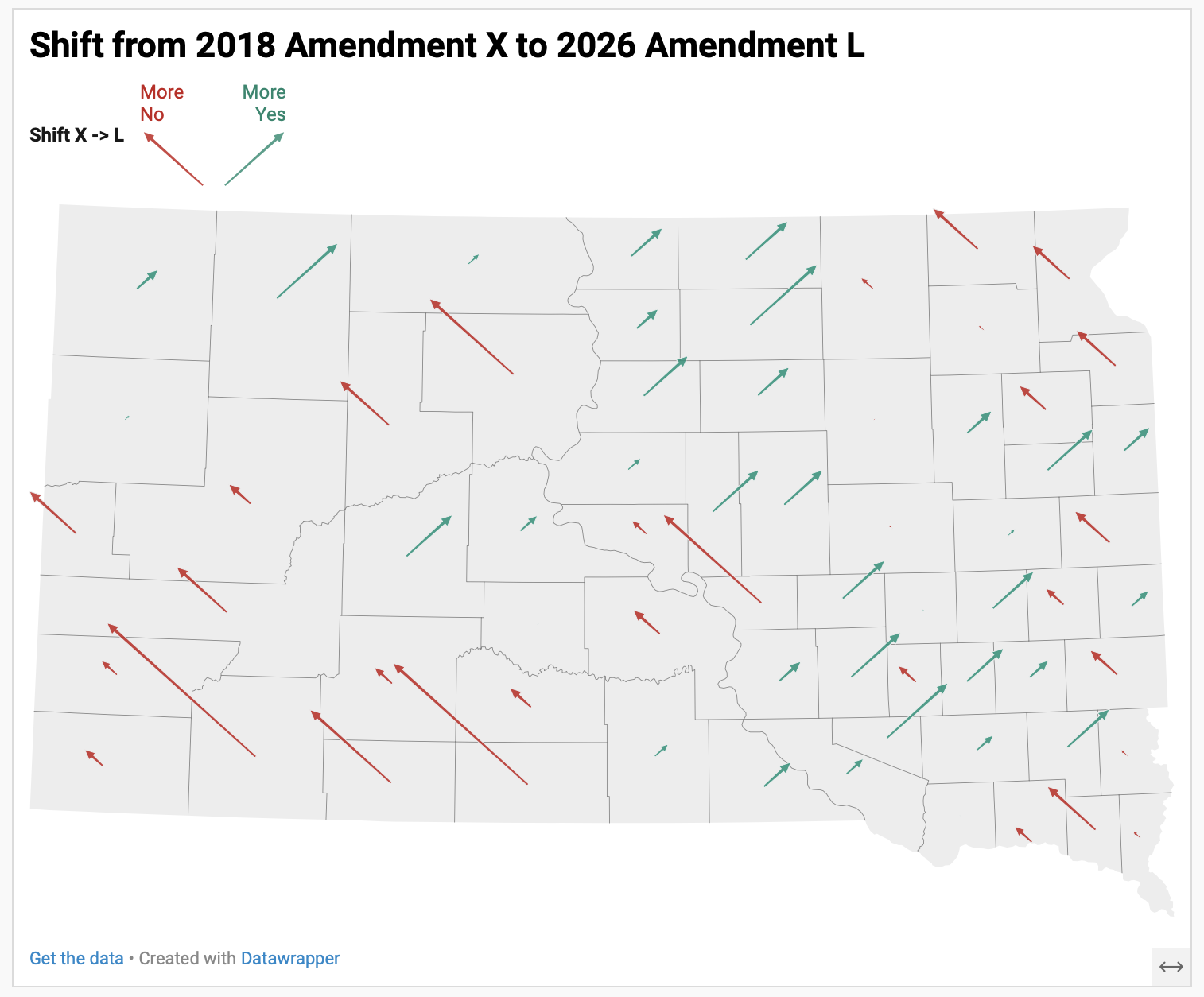
- All ten of the biggest-voting counties (Minnehaha, Pennington, Lincoln, Brown, Brookings, Lawrence, Meade, Codington, Yankton, and Hughes) have red arrows—i.e., voter harder against L than they did against X. Those ten biggest counties make up over 65% of the 2026 electorate.
Amendment L, the 60% vote threshold to pass constitutional amendments, polled better than Amendment X, the 55% threshold, in 35 of 66 counties. But those counties make up barely a sixth of the electorate that participated in deciding Amendment L.
Maybe those mostly rural counties shifting against majority rule are acting on the alarm sounded by Representative Spencer Gosch (R-23/Glenham) during discussion of Amendment L/2025 HJR 5003 in the 2025 Session. Rep. Gosch said he supported Amendment L as a way to protect his rural neighbors from the growing population and power of Sioux Falls. Maybe the 15 counties that voted Yes on L this year and the 35 that have shifted toward the minoritarian viewpoint since 2018 share Gosch’s fear of “urban” domination.
But that fear, if that’s what motivated the trends identified above, won’t do those rural counties much good. The percentages show that possibly fearful minoritarianism isn’t as strong in the less populous counties as the commitment to democracy and majority rule is in the more populous counties.
And just to confound the rural-vs-urban hypothesis, Buffalo and Ziebach counties, the first- and fourth-smallest voting counties in 2026, each voted 65% against Amendment L
In short, dear Republican legislators, give up trying to raise the vote requirement for passing constitutional amendments. You failed with X, with C, and now with L, and those votes show no clear trend that supports throwing another anti-democratic amendment at future South Dakota voters.