Even with health insurance, I avoid seeing a doctor unless I absolutely have to (bailed headfirst off my bike, ran myself over with a tractor…). But in general, people with insurance are a lot less likely to skip doctor visits due to cost than people without.
KFF’s reading of CDC data from 47 states shows that one out of eight Americans avoided seeing doctors in 2025 due to cost. Among Americans with health insurance, the costly-doctor-avoidance rate was 9.9%. Among uninsured Americans, that rate was 42.8%.
I would have thought that South Dakota’s Daugaardian frugality would have put us above average for avoiding the doctor. But it turns out South Dakota has the ninth-lowest percentage of adults dodging docs to save money, just 9.5%. We’re part of a cluster of plains-dwellers and New Englanders who are much more inclined to prioritize checkups over penny-pinching:
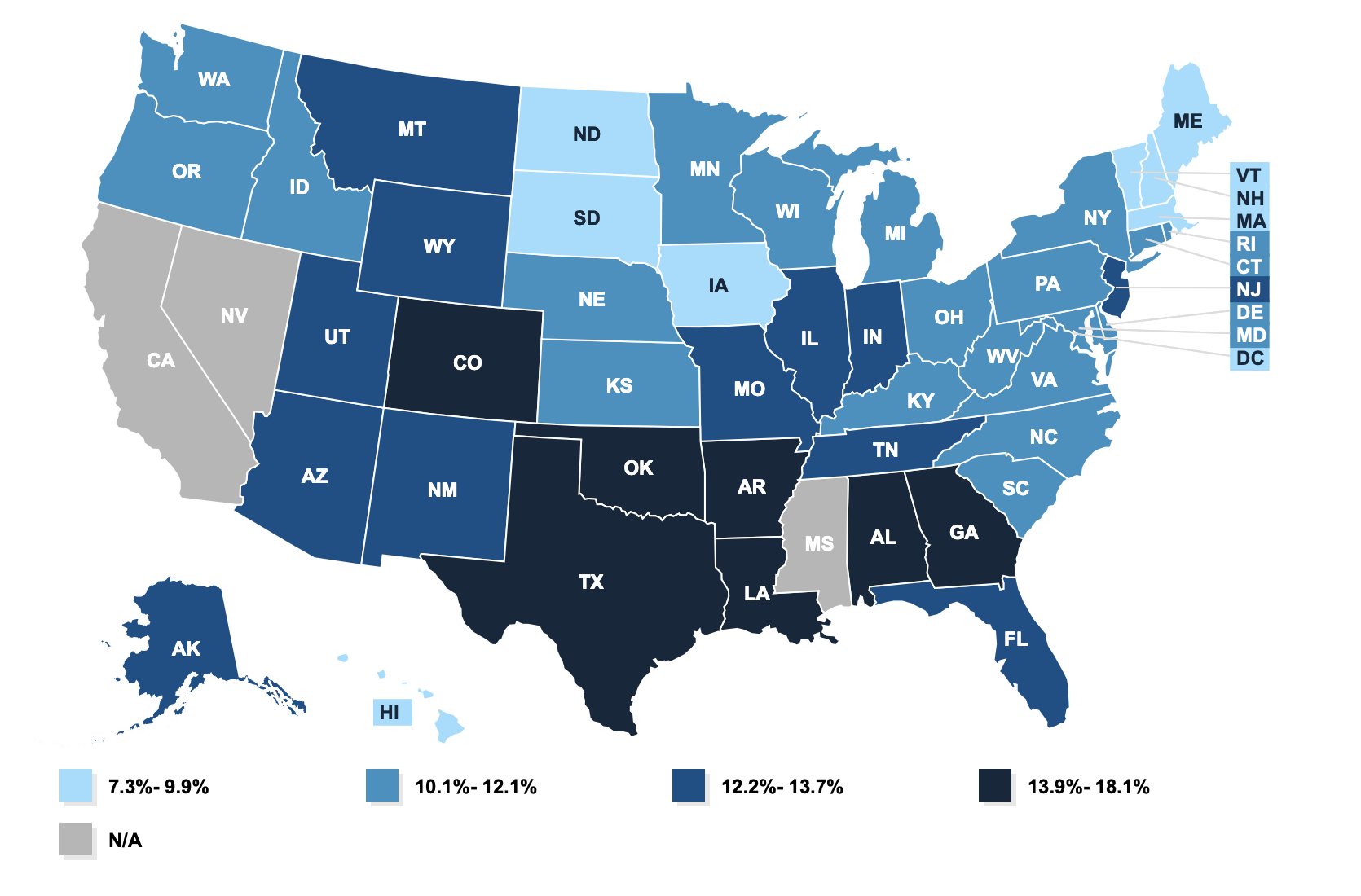
The highest rates of frugal doctor avoidance cluster in the Rockies (Colorado: 13.9%) and the South (Texas: 18.1%).
That pattern scrambles when we focus on uninsured Americans. Uninsured South Dakotans still report a below-average rate of avoiding doctors due to cost, with a 34.0% rate that is the fifth-lowest for uninsured state populations. But the states with even lower uninsured doctor-avoidance rates are all over the map: North Carolina, New Mexico, Pennsylvania, and, with the lowest rate in the nation, Hawaii (26.2%, the only state below 30%). On the high side, New Hampshire, Rhode Island, and Connecticut all have below-average overall rates of doctor avoidance but are in the top five, all above 50%, for uninsured residents avoiding doctors and doctor bills.
| Percentage of Adults Who Report Not Seeing a Doctor in the Past 12 Months Because of Cost, table from KFF, citing CDC 2025 data, retrieved 2026.11.28 |
|||
| Location | All Adults | Adults Who Are Insured | Adults Who Are Uninsured |
| United States | 12.8% | 9.9% | 42.8% |
| Alabama | 14.7% | 11.7% | 47.6% |
| Alaska | 12.2% | 10.4% | 34.9% |
| Arizona | 13.6% | 9.5% | 46.4% |
| Arkansas | 14.9% | 11.8% | 43.4% |
| California | N/A | N/A | N/A |
| Colorado | 13.9% | 10.5% | 45.2% |
| Connecticut | 11.7% | 8.4% | 50.7% |
| Delaware | 11.7% | 9.0% | 42.7% |
| District of Columbia | 8.9% | 7.7% | N/A |
| Florida | 13.7% | 10.0% | 45.2% |
| Georgia | 16.0% | 12.0% | 46.3% |
| Guam | 17.5% | 15.5% | 49.4% |
| Hawaii | 7.3% | 6.9% | 26.2% |
| Idaho | 11.9% | 9.3% | 37.4% |
| Illinois | 13.0% | 10.3% | 39.3% |
| Indiana | 12.3% | 9.8% | 44.3% |
| Iowa | 8.6% | 7.0% | 35.2% |
| Kansas | 11.5% | 9.1% | 43.2% |
| Kentucky | 12.0% | 9.7% | 47.5% |
| Louisiana | 14.6% | 12.5% | 41.5% |
| Maine | 9.9% | 7.8% | 41.0% |
| Maryland | 11.2% | 8.6% | 45.8% |
| Massachusetts | 8.9% | 7.7% | 46.7% |
| Michigan | 11.0% | 9.2% | 45.4% |
| Minnesota | 10.4% | 8.0% | 47.0% |
| Mississippi | N/A | N/A | N/A |
| Missouri | 12.5% | 9.9% | 44.3% |
| Montana | 12.6% | 10.0% | 44.2% |
| Nebraska | 11.3% | 8.5% | 39.4% |
| Nevada | N/A | N/A | N/A |
| New Hampshire | 9.3% | 7.3% | 53.7% |
| New Jersey | 13.4% | 9.9% | 47.3% |
| New Mexico | 12.5% | 10.5% | 32.6% |
| New York | 11.2% | 9.6% | 39.2% |
| North Carolina | 11.0% | 8.6% | 33.5% |
| North Dakota | 9.3% | 7.6% | 38.9% |
| Ohio | 11.9% | 9.6% | 43.1% |
| Oklahoma | 15.1% | 13.0% | 35.3% |
| Oregon | 11.8% | 10.4% | 40.2% |
| Pennsylvania | 11.4% | 9.6% | 32.4% |
| Puerto Rico | 8.1% | 6.2% | 53.0% |
| Rhode Island | 10.9% | 8.4% | 50.8% |
| South Carolina | 11.7% | 8.4% | 41.2% |
| South Dakota | 9.5% | 7.7% | 34.0% |
| Tennessee | 13.3% | 10.7% | 42.1% |
| Texas | 18.1% | 13.1% | 45.1% |
| U.S. Virgin Islands | N/A | N/A | N/A |
| Utah | 12.4% | 10.0% | 37.0% |
| Vermont | 8.3% | 7.1% | 38.2% |
| Virginia | 10.1% | 7.4% | 44.9% |
| Washington | 11.7% | 9.2% | 42.4% |
| West Virginia | 12.1% | 9.5% | 52.1% |
| Wisconsin | 10.7% | 8.5% | 38.7% |
| Wyoming | 13.2% | 10.3% | 39.1% |
I can’t explain South Dakota’s below-average rate of doctor avoidance as a matter of more affordable health care. Consumer Affairs reports that in 2025, South Dakota had the second-highest cost of health care in the country, behind only Vermont:
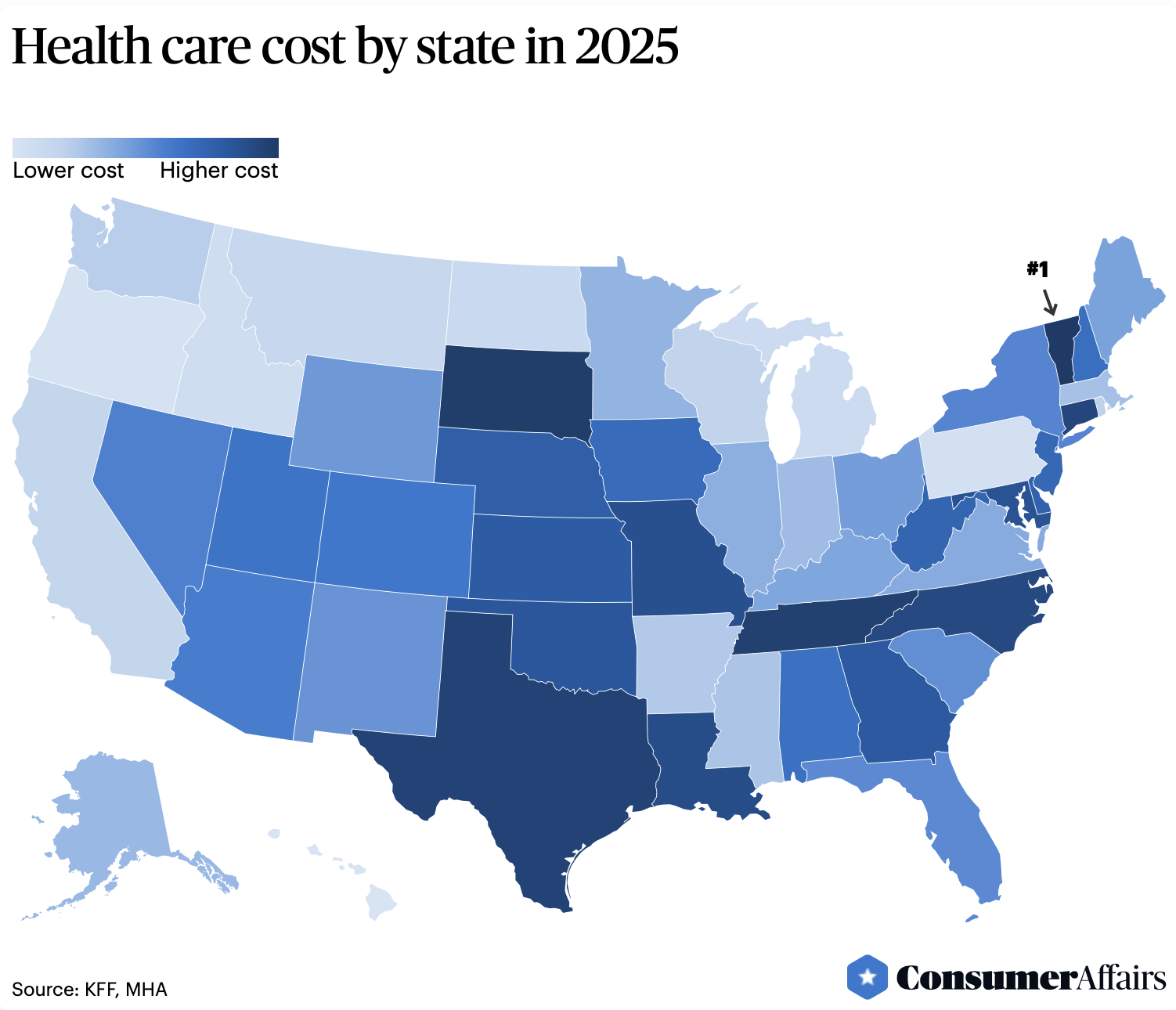
Readers, See if you can align those figures and other data with your own sociological observations to explain why relatively higher health care costs wouldn’t be deterring South Dakotans from seeing the doctor as frequently as folks in other states.