Bob Mercer reports that the Secretary of State’s office has moved down from the second floor of the State Capitol to the first. The move comes as outgoing Secretary Monae Johnson brings the Business Services division back under the dome alongside Elections and General Services.
Along with this physical move, the Secretary of State’s office also appears to be revamping its website. The redesigned webpages, largely an exercise in moving from line links to blocks, haven’t yet replaced the old layout; both versions of the SOS website are available:
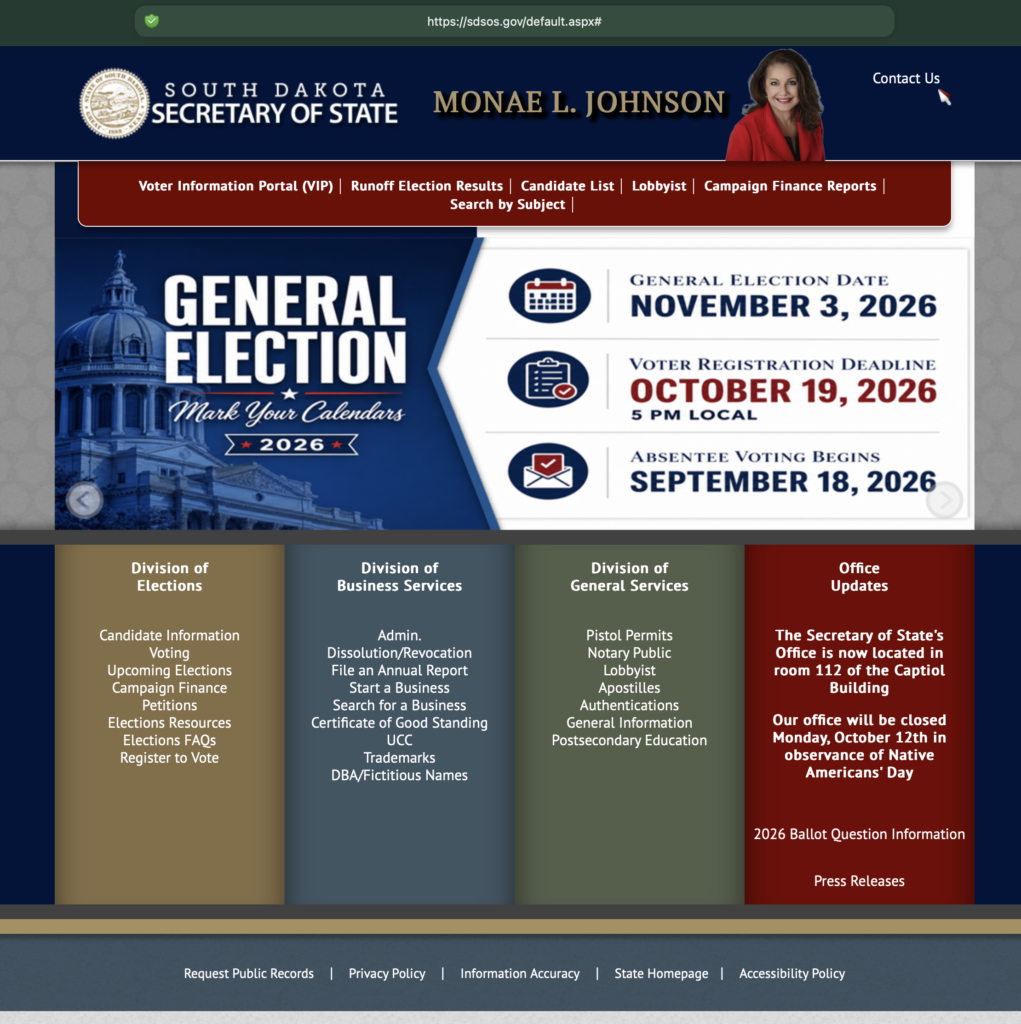
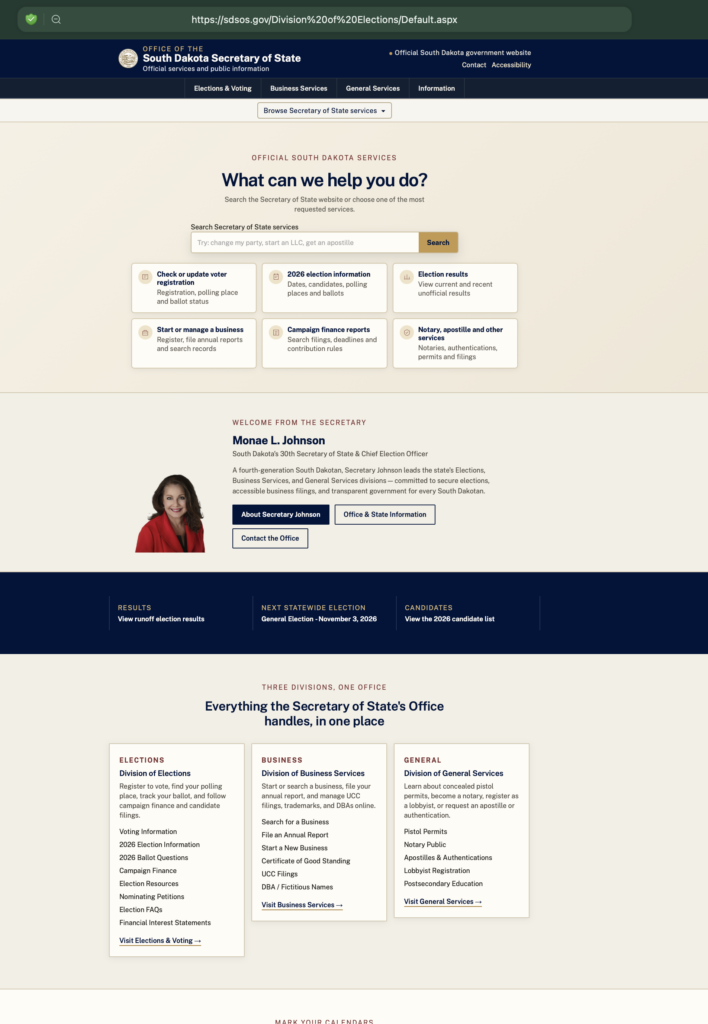
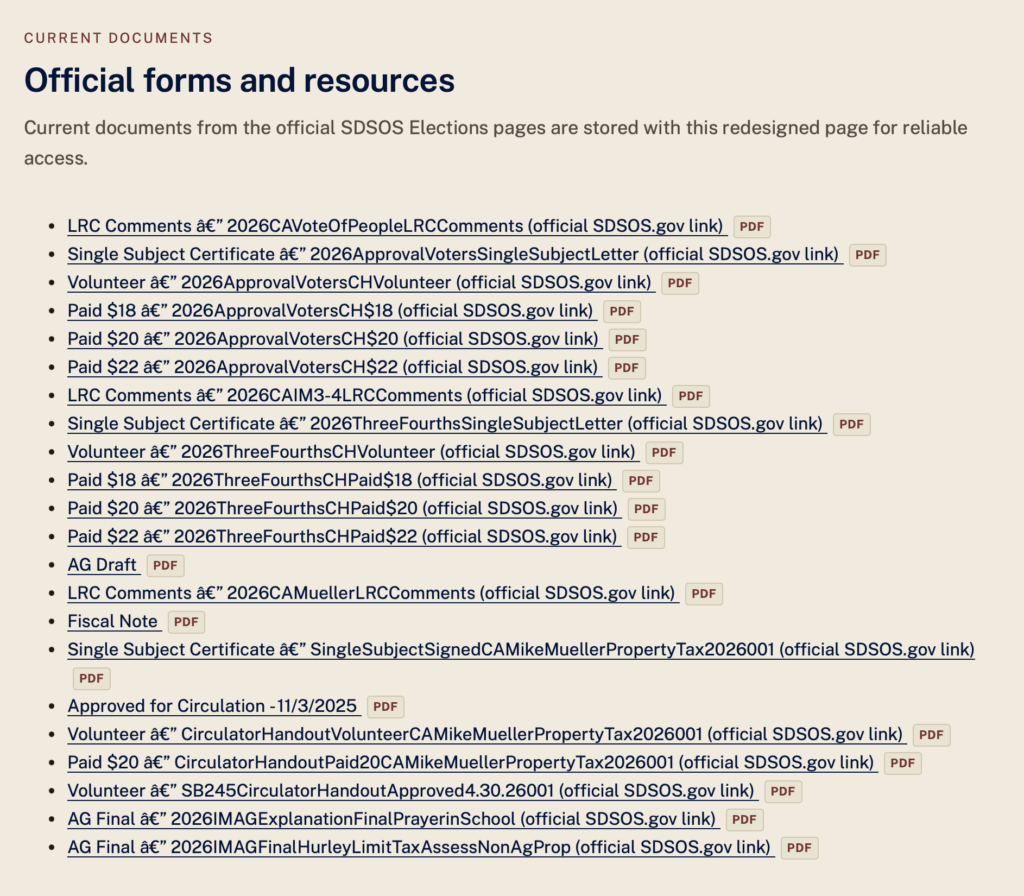
The redesign of the ballot question page is a mess. The old ballot question page shows the 2026 Ballot Question Pro-Con Pamphlet right at the top, along with the mellow audio version; whoever redesigned the ballot question page forgot to include that vital voter guidance. The redesign puts the now mostly irrelevant “2026 Cycle Basics” about the petition-circulation window for initiatives for this cycle at the top (while failing to mention the referendum process); one has to scroll down to see the measures the Legislature put on the ballot and the citizen measures that failed to qualify. The blocks assigned to each ballot measure include the Attorney General’s explanations—both draft and final—and the petitions for citizen initiatives and referenda. The other vital documents for citizen measures—Legislative Research Council comments, fiscal notes, single-subject certificates, approved circulator forms—are all jumbled together in a pile at the bottom of the page, with titles pulled directly from URLs that often don’t indicate which measures they are associated with:
Neither this sloppy redesign of the ballot question page nor the original version make any mention of the 2028 ballot question cycle, which began in May. Secretary Johnson continues to ignore the pending raw-milk initiative that has gone through both LRC and AG review. The only state resource offering voters information about the pending initiative appears to be the Attorney General’s August 10 press release on his final text explaining the measure. Neither version of the SOS offers citizens clear information on how to circulate ballot question petitions for the 2028 election, a complicated process that serious activists will want to be working on right now.
Secretary Johnson, I know you’re busy unpacking in the new downstairs office and planning your transition back to private life (not to mention planning your appearances at campaign events for the man you hope will replace you, Terrence Davis), so if you need some help fixing the ballot question page, let me know. I’ll be happy to explain to your web gurus how ballot question information should be organized and prioritized to best serve the people of South Dakota.
Retiring the old design from The Gant is past due. Good on Ms. Monae for not just coasting to the out door next to her freshly painted new office.
Sorta relevant and kinda long but Kathy Tyler posted the following from her Faceberg page.
“All of the Constitutional Amendment votes need a ‘No.’ Here’s a one post summary of the amendments:
The first is Amendment I which repeals Medicaid Expansion if federal funding goes below 90%.
Those who cared started fighting for Medicaid Expansion at its inception in 2010 (2014). Since the SD legislature wouldn’t pass approval of the expansion that would provide health insurance for thousands of people below a certain poverty line, a citizen led petition drive with thousands of signatures got the issue on the ballot in 2022 where it passed with 56.21% of the vote. Since the legislature thought that the citizens didn’t know what they were talking about, they voted to place Amendment I on the 2026 ballot.
So…here we are again.
I’m against the Amendment change for these reasons and am very willing to discuss. From the SOS’s website:
“A vote NO would keep the South Dakota Constitution
unchanged and preserve Medicaid expansion as approved
by South Dakota voters in 2022.
Medicaid expansion provides health insurance to adults
with incomes up to $1,835 per month (about $22,00 per
year) for a single individual or $3,142 per month ($37,700
per year) for a family of three. Before expansion, many
low-income South Dakotans had no affordable way to see
a doctor or fill prescriptions.
A vote NO would allow approximately 30,000 South
Dakotans who receive insurance through Medicaid
expansion to keep their insurance and access the care
needed to stay healthy, support their families, work, and
contribute to their communities.
A vote NO would ensure that changes in federal funding
do not automatically take health coverage from South
Dakotans.
Statement from Deb Fischer-Clemens, RN, BSN, MHA”
———————————————–
Kind of boring, but so important #2–Constitutional Amendment J.. “clarifying that an individual must be a citizen of the United States to be eligible to vote.”
Again, submitted by the legislature.
This rule is already established in South Dakota as stated on the South Dakota Secretary of State’s website:
“12-4-1.2 Voter Registration form – Certification.
The voter registration form must include a certification of voter eligibility by which the applicant attests, under the penalty of perjury, that the applicant:
(1) Is a citizen of the United States;
(2) Will be eighteen years or older on or before the next election;
(3) Is a resident of the state of South Dakota;
(4) Has not been judged mentally incompetent;
(5) Is not currently serving a sentence for a felony conviction; and
(6) Authorizes the cancellation of a previous registration, if applicable.”
And, Article VII of the state’s constitution states the same:
” § 2. Voter qualification. Every United States citizen eighteen years of age or older who has met all residency and registration requirements shall be entitled to vote in all elections and upon all questions submitted to the voters of the state unless disqualified by law for mental incompetence or the conviction of a felony. The Legislature may by law establish reasonable requirements to insure the integrity of the vote.”
Waste of time and not necessary.
————————————————————-
Kind of boring #3–Constitutional Amendment K.
This amendment establishes a trust fund for the unclaimed property fund. Here is the AG’s explanation.
“Under South Dakota statute, intangible property is presumed to be abandoned if it remains unclaimed by the owner for more than three years after it became payable or distributable. Examples of intangible property are traveler’s checks, money orders, bank deposits, refunds, stocks, funds owed under a life insurance policy, and property held in a safe deposit box. Abandoned intangible property is transferred to the State Treasurer to hold while waiting for the owner to claim it. The State Treasurer must provide public notice of the abandoned property. This proposed constitutional amendment establishes a trust fund where unclaimed abandoned property’ will be deposited. Portions of the interest and from this fund will be distributed into the general fund for the benefit of the state. This proposed amendment requires the Legislature to determine the amount to be distributed that promotes the growth of the trust fund and the distributed amount.”
At the surface this sounds pretty good, but legislation such as this should be written and endorsed by the legislature in the form of legislation, a law, not a constitutional amendment. What happens if down the road, a glitch is found? The only option to change the constitution is via a state-wide ballot initiative.
The legislature passed this unanimously. Why? I have no idea. If there was that much support, legislation would have passed.
——————————————–
Constitutional Amendment L is probably the most egregious of all the ballot questions. It mandates a 60% majority for an amendment to be passed by the people via the ballot.
Let’s look at the history of this amendment proposed by the legislature.
Getting a referred law or constitutional amendment on the ballot for a vote can be done two ways—petitions with LOTS of signatures or Legislative mandate for constitutional changes. (See picture). It takes LOTS of work.
I think it all started with the minimum wage law referendum in 2014 which raised the minimum wage to $8.50. But the legislature didn’t think the public knew what it was talking about, so it changed the law. It was referred again in 2020. This was the start of the legislature changing/killing referred laws. This led to petitioners referring constitutional amendments instead of laws even though the number of signatures is basically twice as much. Constitutional amendments cannot be changed by the legislature. It also led to numerous new rules governing the petition process..some okay; most not. But that’s another topic.
So, now, the legislature wants to change it so that a 60% majority of voters is needed to pass a constitutional amendment. A simple majority will no longer rule. The reason given basically is that “we want to make sure the public knows what it really wants.” (That’s a translation from a candidate page.) Amendment L is an insult to voters; it’s a punishment for the petition process; and it’s a cop out for legislators who think the public doesn’t know what it wants.”