South Dakota’s farm-industrial complex brags that it feeds the world. Yeah, right—according to a new assessment of the state’s food and nutrition security, they aren’t even feeding South Dakota.
The South Dakota Healthy Nutrition Collaborative, a combo of several public and private organizations, has published a “South Dakota Food Landscape Assessment” that finds lots of South Dakotans getting by on mere crumbs of America’s breadbasket:
In South Dakota, 1 in 8 people, and 1 in 5 children, have limited or uncertain access to enough food, and only 1 in 8 people eat enough fruits and vegetables each day [Kassandra N. McFarland, Jennifer N. Folliard, Darla S. Biel, Olivia A. Husmann, B. Bruggeman, Jason Simon-Ressler, and Christine W. Hockett, “South Dakota Food Landscape Assessment,” South Dakota Healthy Nutrition Collaborative, 2026, p. 4].
In the SDHNC survey, almost 30% of community members indicated they skip meals to stretch their budgets…. High prices are predicted to continue. 2026 grocery inflation is expected to rise 3.2%, and vegetable inflation specifically by 4.8% [p. 12].
Participants described food cost and nutrition as deeply linked, noting fresh produce, healthier foods, and better-quality options are valued, and harder to afford. They shared how they would like to eat healthier but perceived those choices were not within reach, stating, “Unless something is on a really good sale, I’m not buying fresh food.” …These sentiments corroborate research which finds people are aware of which foods are unhealthy and healthy, and have access to produce at a variety of stores in their communities. However, a healthy dietary pattern costs, on average, $1.48 more per person, per day [p. 14].
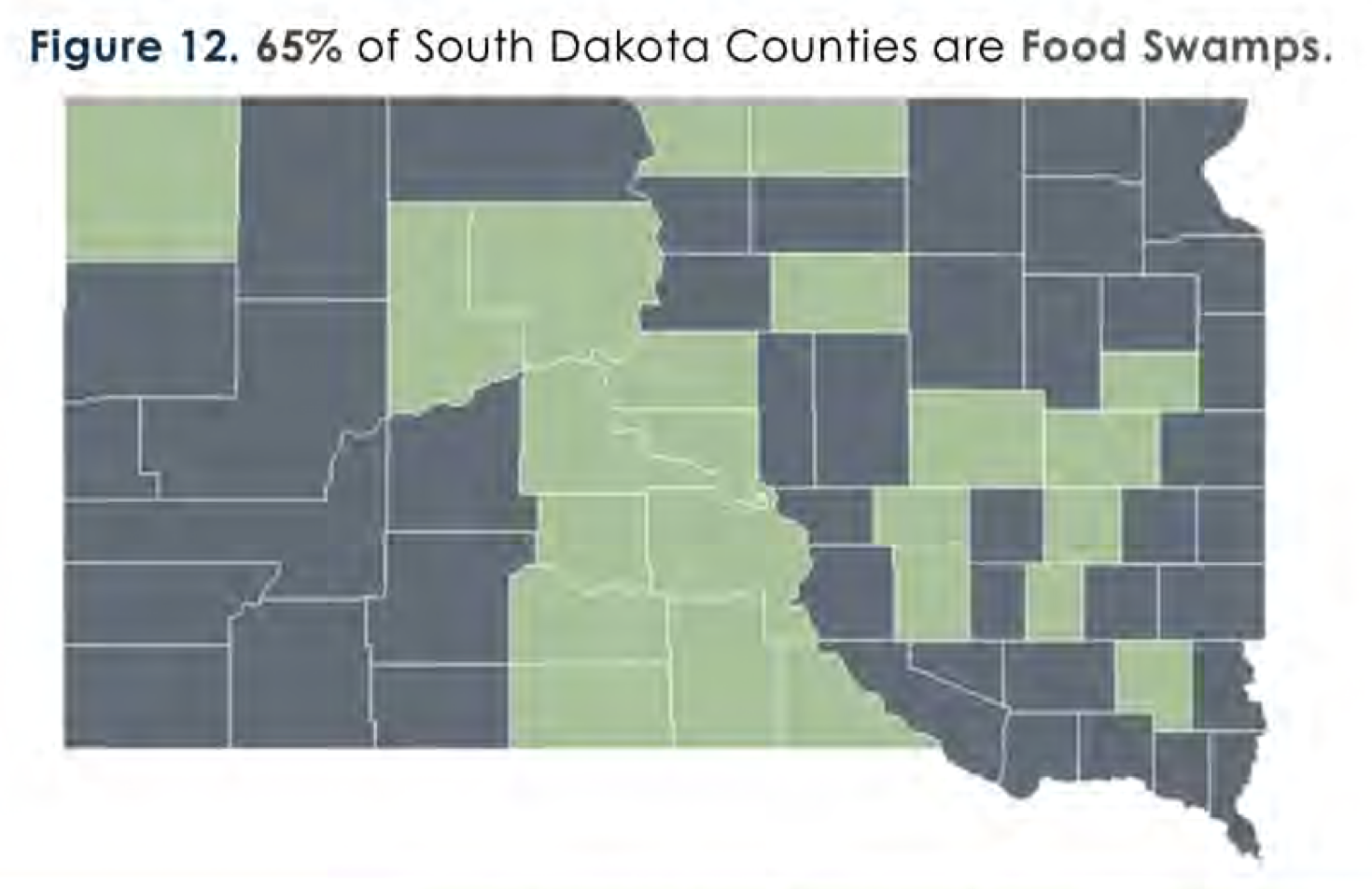
We’ve mentioned food deserts here on the blog; the SDHNC assessment introduces a new term to South Dakota’s nutrition landscape—food swamps—to emphasize that South Dakota’s problem isn’t simply a lack of places to buy food but more often a predominance in the local marketplace of places that sell mostly junk food:
Food swamps are areas where stores that typically sell very little whole foods, such as dollar and convenience stores, outnumber grocery stores. While food deserts focus on the absence of grocery stores, food swamps focus on the overabundance of less healthy options compared with healthier ones. Food swamps may be a stronger predictor of obesity than food deserts because they combine high exposure to inexpensive, convenient, less nutritious foods with limited access to healthier choices. In South Dakota, 65% (43/66 counties) are food swamps where counties have more dollar and convenience stores than grocery stores [McFarland et al., 2026, p. 28].
Those food swamps include our most populous counties:
South Dakota farms could drain those swamps by producing more local food, but the industry and ag policies don’t support that kind of production:
The amount and type of crops grown are largely determined at the Federal level by the Farm Bill…. Commodity crops, like corn, soybeans, wheat, and hay, are produced in large amounts and primarily used to make ethanol, livestock feed, and ingredients for packaged foods.
The commodity crop industry is thriving in South Dakota…. 87% of the state’s land area is in agricultural production. Yet much of the food grown in South Dakota does not stay in the state, with the proportion that directly feeds South Dakotans too small to ensure that everyone has enough nutritious foods to eat. Commodity crops are often not produced with the intention of staying local or promoting access to whole foods….
Local foods are often specialty crops like fruits, veegtables, tree nuts, honey, maple syrup, and herbs. Although they often promote health and the local economy, specialty crops are funded and subsidized at 1/50th the rate of commodity crops. This makes entry and longevity in the specialty market more difficult for local farmers. Out of South Dakota’s 28,299 farms, only about 359 are considered specialty operations [McFarland et al., 2026, p. 32].
Senator John Thune could use his alleged power as Senate Majority Leader to boost local foods in the languishing Farm Bill and reduce the swampiness of South Dakota’s food landscape. But to make such changes, we need to get him (and Senator Mike Rounds, and Representative Dusty Johnson, and every other farm-state Congress critter) to read this food report and recognize that policy is driving South Dakota farmers to feed factories elsewhere, not their friends and neighbors right across the road.
Four things:
1. Frozen fruits and vegetables are nutritionally comparable to fresh. Most frozen vegetables are cheap and easy to prepare. (Source: Look up “Vitamin retention in eight fruits and vegetables.”)
2. Food access doesn’t explain diet. Giving low-income households the products and prices available to high-income households closes maybe one-tenth of the nutritional gap. It’s called bad preferences and bad habits. Just be real about the reasons why people’s diets suck. (Source: Look up “Food Deserts and the Causes of Nutritional Inequality.”)
3. Grocery stores in remote communities have bad economics. Labor, transportation, refrigeration, and spoilage costs are unusually high. There are 11 SD communities with a Walmart. There are ~7,000 available housing units for rent or sale in the counties containing those 11 communities. (Source: ACS.)
4. Food assistance for people who need it is very important. But let’s be real about the underlying dynamics here and not pretend like people wouldn’t 90% make the same shitty choices even if a Whole Foods came to their town.
As of 2024 SD is the eighth most obese state. It’s because your poor people eat mostly carbs. Potatoes, white bread, cheap pizza crust, Navy beans, etc.
More choices, anyone?
Porter,
I always eat twelve grain bread, but the rest of that stuff tastes
pretty good.
Edwin,
Those things plus spaghetti noodles are as addictive as tobacco. (12 grain bread often has more carbs than white bread)
Just try quitting them all for a year and you’ll see what I mean. I ate almost zero carbohydrates for three years and lost 131 lbs. The cravings for mashed potatoes and bread were pretty strong for a full year, just like tobacco.
Edwin,
Those things plus spaghetti noodles are as addictive as tobacco. (12 grain bread often has more carbs than white bread) Of course they taste good. You’re hooked on ‘em.
Just try quitting them all for a year and you’ll see what I mean. I ate almost zero carbohydrates for three years and lost 131 lbs. The cravings for mashed potatoes and bread were pretty strong for a full year, just like tobacco. I’m hoping to live longer, though at 180 lbs.
I believe the problem is ultra processed foods as opposed to the carbs themselves. Ultra processed foods are a horse of different color compared to even foods that are simply processed.
BAH! Potatoes are a vegetable and you can’t even begin to get a solid breakfast without gravy taters and biscuits
Well, I like to eat all those things but my wife makes me an excellent protein drink every day. I eat healthy after that. It all tastes good too. That’s the important part.
Should have done it much earlier. After my six bypasses I went through the Ornish lifestyle business. The food was so awful it would put you into depression. The rest of it is thievery from others. There are better ways around then that program for sure. You have to do what you have to do.
Porter,
I don’t know a thing about tobacco, so I have no experience
to compare to.
Porter,
I once read or heard that some researchers fed mice nothing but
white bread. The mice starved to death.
They should have had the treatment mice with bread soaked in brown gravy, Mr. Arndt. grudznick is still unclear why it is bad to be swamped with food.
That’s right about the mice, Edwin. Twelve grain is way more nutritious than white bread. It’ll still make you fat and shorten your life, though. Do you know anything about beer and whiskey being addictive? Carbohydrates are in that category, too.
grudzie: Do you ever go for a medical checkup?
All grudznick knows, Mr. Lansing, is that a battery of doctors tell me that 131 pounds is about the right weight for my close personal friend, Lar, but borders on the low end of scrawney. You lost your scrawney, Mr. Lansing. Have another donut.
grudzie … I’m on the GLP1 donuts. Semaglatide eases the anxious mind. And the Donald made it Medicare eligible.
Liz and I know we are lucky. We have a food flood—full-sized grocery stores, including Whole Foods, within walking distance. But then Ii you walk the aisles of each of these stores you find that even at Whole Foods, they are selling a lot of unhealthy food;
We have a small farmer’s market, also within walking distance. It sells mostly good food from the beginning of May to the end of October. We try to buy as much of our food , especially produce, locally and in-season at the farmer’s market. One of the grocery stores in our neighborhood sources as much of their produce, cheese and meat from local sources, as well.
My county is a food desert and food swamp. The smaller towns around here have no grocery store but do have a gas station/convenience store. We have 2 grocery stores, a Family Dollar and Dollar General, plus 3 gas stations/convenience stores. On the 10th of the month, those who don’t have EBT stay home because people who do use EBT are hurting as they run out of food before the 1st sometimes. Many come from west river and east river small towns as well. The majority of customers are elderly and single parent families.
We are at the end of the road, so the fresh fruits and veggies look bad, are too expensive and are hard to get. Very similar to the days of covid when I shopped for several people however, the supply chain is starting to break, not just stretch.
SD grows corn for fuel for our cars — not food for our people.
https://www.mediaite.com/media/podcasts/trump-cabinet-official-boasts-about-six-million-americans-losing-snap-benefits-im-really-proud/
\
felon/rapissed and crew have a brain cell desert.
I live 15 miles from the nearest grocery store so I guess that counts as a food dessert.
Funny thing about these rural food desserts. The fruit grows on trees. Mulberries ripen first, then the cherries, elderberries and plums, followed by apples, and finally, the grapes, which grow on vines, not trees. Except the vines climb the trees.
If I want tomatoes, green beans or zucchini, I have dirt for that. Asparagus grows in the ditches
That’s the thing about rural communities. Plenty of dirt for everybody.
Walmart.com will ship you all the canning supplies
Josh is absolutely correct: go talk to the volunteers at your local food pantry.
It’s appalling. The people they serve want CRAP.
One thing they are always short on is “Hamburger Helper.”
It’s pure garbage. Overpriced garbage. I don’t care how desperate the food pantry is, I am not donating garbage. If I won’t feed that crap to my own family why would I donate it to the food pantry?
In fact, after the last interaction I had, I am going to stick to donating things like dried beans and rice. Hungry people need to learn how to cook real food.
Maybe I should have said “tell me you have never visited a food pantry to make a donation without saying you’ve never donated to a food pantry.”
There is a reason the poor are overweight and unhealthy. There’s a reason they run out of EBT benefits before the end of the month,
If you saw what they CHOOSE to eat, you would understand .
VM, the pumpkins look great. Lots of vitamin A and potassium, and the seeds are loaded with zinc, which will boost the immune system going into the cold and flu season.
OMG, you say , “you mean I have to cook something??? I have to put a whole pumpkin in the oven for an hour to soften it up so I can easily scrape out the pulp?
I have to spread the seeds on a cookie sheet and bake them?? ”
So much work…
Yesterday I picked half a dozen apples off a tree. It was very labor-intensive. Didn’t even need a ladder as the fruit weighs the branches down so much they almost touch the ground
The wild grapes are getting sweeter by the day. it’s advised to wait until after the first frost, though. Then I will make jam.
If you go looking, you can often find Jerusalem artichokes in the ditches ready to be dug up. They are a decent source of complex carbs, iron, potassium, magnesium and vitamin c
Black Hills Mushrooms was ousted from the Black Hills Farmers Market following closed-door board meetings in mid-August 2026. This decision directly involved Earth hater Heather Maude, the high-profile co-owner of Maude Hog and Cattle, who serves as the President of the Black Hills Farmers Market Board of Directors.
Accusations of vendor favoritism and market “gatekeeping” quickly surfaced, with patrons pointing out conflicts of interest regarding how booth spaces and product rights are allocated by the board. Vendor fees for the Market range widely from $51 to $612 per season depending on the length of the agreement and the specific type of space or vendor category.
Maude Hog and Cattle has been providing product to Wall Meats which is heavily subsidized by the USDA and Charles Maude has received some $300,000 in ag subsidies since 1995. Heather Hamilton Maude is a Wyoming native and her parents are Trump supporting Earth haters, too. She writes an occasional column for the right wing rag, Tri-State Livestock News.
I have patches of aspersions around my garden spot. I have apple trees. I raised a number of onions this year. I give the asparagus, apples an d most of the onions away. I have donated items and money to local food banks. I have used the food bank in the past because as being disabled I automatically qualified . I haven’t used it in years, but I am glad it is there for people who need it.
ps there are mulberries galore, elderberries, wild raspberries, one cherry tree and numerous black walnut trees.
I am well taken care of, yet there are many others that are not. We are 100 miles away from a food pantry and there is an income requirement for Feeding S.D. If you’re suggesting mothers dig their veggies from the local ditches, sorry, that’s hay for the cattle. During dry times too many tumble weeds, Russian thistle, or burrs take over. Do you think EBT recipients should eat those instead because they’re free?
I guess my point is that people are on fixed incomes but groceries, gas, sundries are not fixed prices. A person cannot continue to pay more when they don’t make more, something has to give.
Electricity, propane, natural gas, car insurance, supplemental insurance, phone service, internet, utilities (water, trash). rent, car payments, vision care, dental care, etc All of these services are raising prices faster that 25 cents an hour raise can cover.
Income is not keeping up with inflation for most of the people around here. Only those working government jobs or in the medical profession’s heads are above water.
My opinion is that this situation is worse than during covid because there is no relief in site.