South Dakota Searchlight prints Nina Luz’s write-up of Dakota Institute fellow and Northern State University economist Dr. Aaron Scholl’s June analysis of housing affordability in South Dakota. The unpleasant conclusion: South Dakota can no longer claim much of an advantage over neighboring states.
Luz presents two charts to illustrate rising median home prices in the five-state area and trends in loan-to-income ratio:
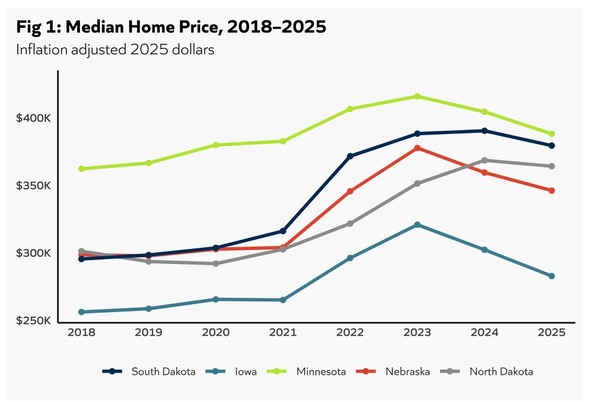
Housing prices boomed everywhere after the pandemic. But after 2023, median house prices slid significantly in Iowa, Nebraska, and Minnesota. In both Dakotas, that median kept rising in 2024 and ticked down only a little bit in 2025. The $66K/18% discount one could get in 2018 by buying a median house in South Dakota instead of Minnesota has mostly disappeared, dwindling to just $9K/2%.
South Dakota’s meager advantage in how much homebuyers have to borrow versus how much they earn has also evaporated:
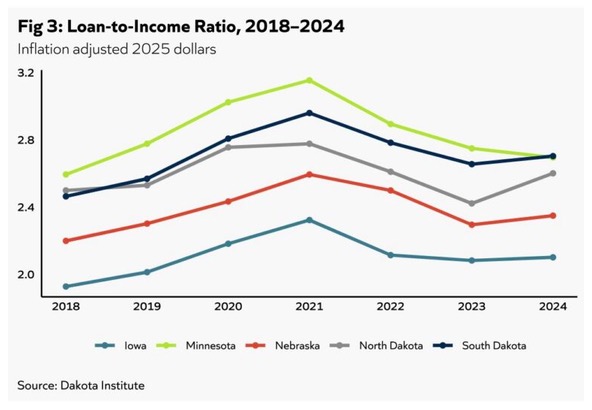
Dr. Scholl notes that the problem here isn’t weak income growth—South Dakota has seen the biggest good bounce in income in the region—but increasing loan amounts. And that may not be an actual affordability problem but an indication that banks are letting South Dakota homebuyers take out larger loans than banks in other states feel comfortable giving.
But the fact that a South Dakota bank may let homebuyers borrow more only means South Dakota homebuyers will be saddled with higher mortgage payments each month. Luz notes that those higher payments aren’t getting South Dakotans more house:
If houses had become larger, better finished or better located, part of the price increase would have a reasonable explanation. The data doesn’t support that. The median square footage of homes sold in South Dakota remained unchanged between 2018 and 2024. The average number of rooms did too. Buyers are paying more to get the same space [Luz, 2026.08.29].
South Dakota homebuilders haven’t failed completely; they’ve just failed to keep up with demand:
And of particular interest to those following the local political debate, building more homes didn’t solve the problem. South Dakota leads the region in new construction per capita. For example, in 2024, it issued 6.49 building permits per thousand residents, compared to 5.22 in Nebraska, 3.88 in Iowa and 2.92 in North Dakota. And yet prices rose. This happens because construction takes time, and a permit issued today may result in a home becoming available months or years later. So, in that window, demand grew faster than supply could keep up.
That doesn’t mean building more houses is irrelevant; it means that construction alone, without measures that also address demand or directly guarantee affordable housing, has clear limits. Candidates who promise to fix the problem through construction alone face the uncomfortable fact that South Dakota already did so more than any of its neighbors, yet housing costs still went up [Luz, 2026.08.29].
The Dakota Institute’s conclusion that South Dakota has lost its advantage in housing affordability is supported by the latest cost-of-living figures from the Missouri Economic Research and Information Center, which reports that in Quarter 1 of this year, South Dakota’s cost of housing, while significantly lower than the national average, was the highest in the region:
- South Dakota: 88.2% of the national average
- Minnesota: 79.5%
- Nebraska: 78.1%
- North Dakota: 77.2%
- Iowa: 75.6%
MERIC also reports that South Dakota’s overall cost of living is the highest in the region:
- South Dakota: 94.1%
- Minnesota: 93.4%
- Nebraska: 91.3%
- North Dakota: 90.7%
- Iowa: 88.6%
So if you’re trying to decide where to buy a house, you won’t find much of a financial advantage in picking South Dakota over Minnesota.
so?
I still wouldn’t want to live over there