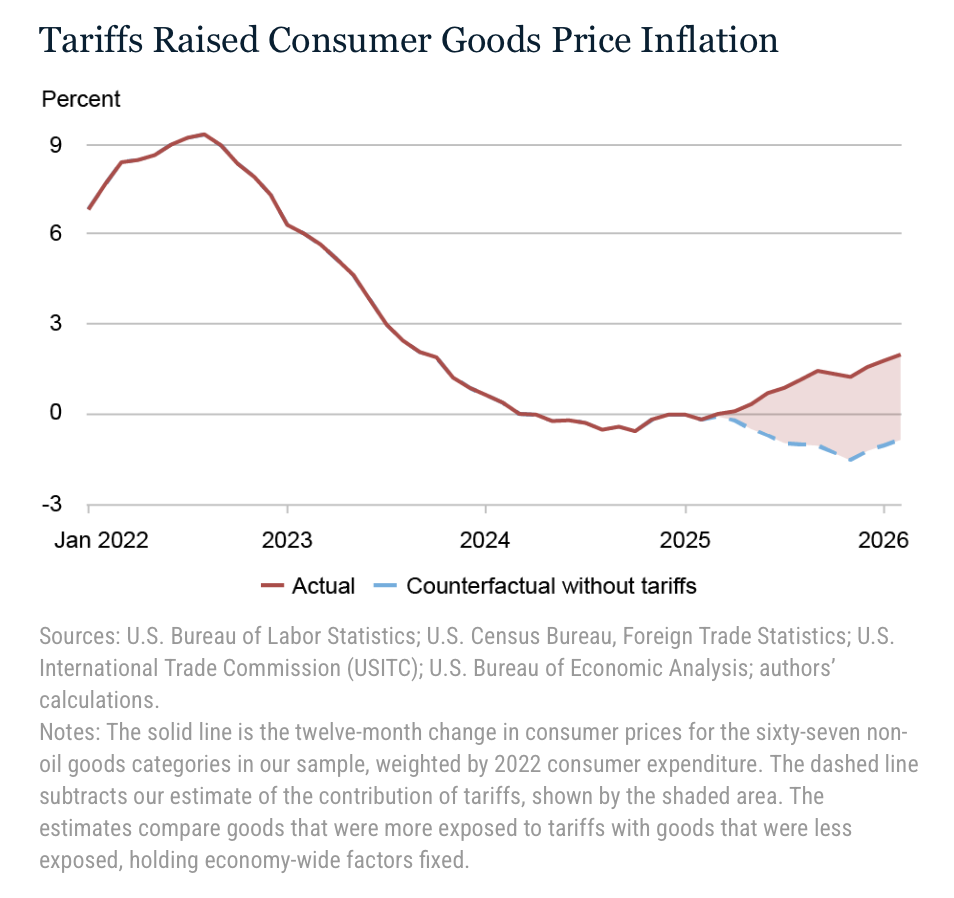
Blame Donald Trump’s tariffs for all that persistent inflation. A new analysis from the New York Federal Reserve finds that if Trump hadn’t hammered us with tariffs, prices on consumer goods would have gone down:
In the chart below, the solid line shows the twelve-month change in consumer goods prices, and the dashed line shows the counterfactual without tariffs. Goods price inflation was back near its slightly negative pre-COVID average for most of 2024 and began to edge up late that year, before the new tariffs were introduced. It then picked up through 2025. Our estimates attribute this increase to the tariffs: by February 2026, tariffs had contributed 2.9 percentage points to goods price inflation, and without them goods prices would have fallen slightly [Mary Amiti, Sebastian Heise, and David E. Weinstein, “How Fast Do Tariffs Pass Through into Consumer Prices?” New York Federal Reserve: Liberty Street Economics, 2026.10.06].
Trump tariffs didn’t just prevent discounts on goods we buy from Canada, Europe, and China; his one-note trade policy also prevented us from getting lower prices on American-made products:
Tariffs also affect the prices of goods made in the U.S. This happens in two ways. First, many U.S. producers rely on imported parts and materials, so tariffs raise their cost of production. For example, a tariff on steel makes it more expensive to build a car in the U.S. We refer to this effect as the marginal cost channel. Second, when tariffs make imported goods more expensive, U.S. producers of competing goods face less pressure to keep their own prices down. We refer to this effect as the strategic complementarity channel. We find evidence that U.S. producers increased their prices at the factory gate because of both channels, and the marginal cost effect is the larger of the two [Amiti, Heise, and Weinstein, 2026.10.06].
Just imagine: no tariffs, no inflation.
If Trump hadn’t declared his trade war, if he’d acted like a Reagan Republican, if he’d read American history right and chosen free trade over tariffs, he could say, honestly, “Check it out—stuff is cheaper!” and the single biggest issue dragging his party down in the midterms, affordability, would be gone, or at least taking a backseat to everything else Trump is screwing up for Americans and for his party.
But no. Because Trump wanted to play William McKinley, you get higher prices… and Republicans lose the House and the Senate.
Creighton University’s Ernie Goss follows the economies of ten midwestern states including South Dakota’s where the manufacturing sector lost about 800 jobs over the last year or 1.8% of its manufacturing base, ag workers still face severe stressors and a mental health provider shortage affects at least 62 of South Dakota’s 66 counties.
Goss noted that in September the overall reading fell below growth neutral for the fourth time in the past six months and 79.0% of banksters reported that the Trump tariffs levied a negative impact on the agriculture and livestock economies where persisting pessimism is dooming Republican candidates even in red states.