Expert in corruption and incompetence Jason Gant is now using his position as Charles Mix County auditor to mount one of the few cries of election corruption in this year’s elections… and fascinatingly, his election fraud claim comes not to defend some Trumpist yahoo but to give a sales-tax hike a second chance.
In a special election this week, Charles Mix County voters rejected a county sales tax that would have been used to pay for property tax breaks for homeowners. The referred tax ordinance lost by just eight votes.
Now Auditor Gant is insinuating that the margin of defeat came from voters bribed by Indians:
Charles Mix County auditor Jason Gant claims the Yankton Sioux Tribe was offering gas cards to people who voted on the measure in a now-deleted social media post. The post also encouraged people to vote no.
Charles Mix County State’s Attorney Steve Cotton said in KELOLAND interview that under South Dakota law it is a crime to encourage someone to receive something to vote or abstain from voting. It’s also a crime for someone to receive something for voting or not voting.
“It puts a question mark on the entire election about are these votes going to be real and is that what we really want?” Gant told KELOLAND News Friday. “State law is very clear that you cannot bribe someone to go out and vote.”
Cotton said the county commissioners believe that certain social media posts violate state law.
Cotton said he doesn’t believe there was malicious intent in the alleged actions. But, such alleged action can violate the public’s trust in an election and give the impression of election interference, Cotton said.
Gant says the county commission voted to file a lawsuit requesting an election contest. The county is asking a judge to allow another election sometime next year on the matter [Rae Yost, Karlee Phillips, and Eric Mayer, “Charles Mix County Auditor Claims ‘Bribes’ in Sales Tax Election,” KELO-TV, 2026.11.20].
Gant’s pal and brief patronage beneficiary Pat Powers claims to have a copy of the deleted social media post Gant cites. The Yankton Sioux Tribe has left up its November 3 post inviting tribal members who voted in the midterm general election to come get free gas:
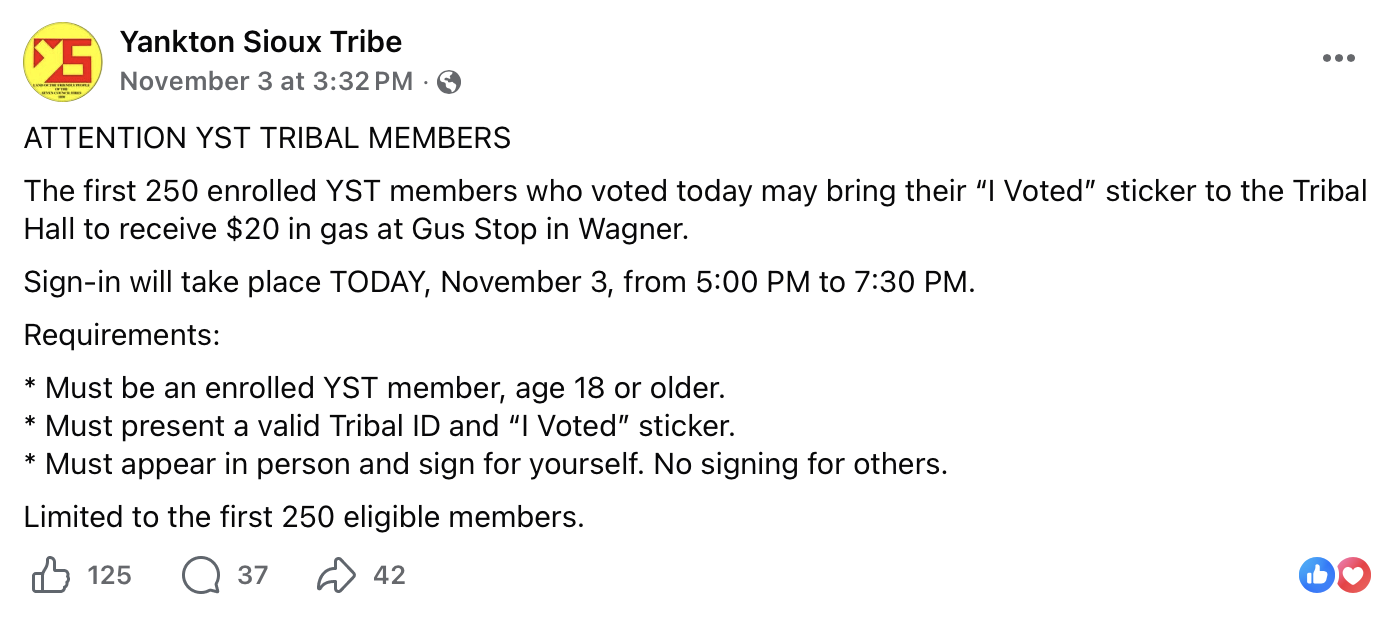
That midterm election offer and the post Powers presents violate the first provision of South Dakota’s election briberyu statute, SDCL 12-26-15:
12-26-15. Bribery of voter as misdemeanor–Acts constituting bribery.
It is a Class 2 misdemeanor for any person, directly or indirectly, by the person or through any other person:
(1) To pay, lend, contribute, or offer or promise to pay, lend, or contribute, any money or other valuable consideration, to or for any voter or to or for any other person, to induce the voter to vote or refrain from voting at any election or to induce any voter to vote or refrain from voting at any election for any particular person or to induce the voter to go to the polls or remain away from the polls at any election, or on account of the voter having voted, refrained from voting or having voted or refrained from voting for any particular person, or having gone to the polls or remained away from the polls at any election… [excerpt, SDCL 12-26-15].
State’s Attorney Cotton is going to raise some really interesting sovereignty questions if he tries hauling Yankton Sioux Tribe Chairwoman Chelaine Knudsen and her council in to white court for Class 2 misdemeanor charges of election bribery.
But he’ll face a more mundane statutory hurdle if he tries to file the election contest Gant says his county commission has voted to pursue. SDCL 12-22-3 says that a contest on a submitted question like the Charles Mix County tax referendum “may be instituted by any registered voter who was entitled to vote on a referred or submitted question….” Any county commissioner, or the whole lot of them, can file an election contest, but only as an individual registered voter. The county commission itself is not a registered voter and thus cannot act as plaintiff/complainant in an election contest.
If Cotton can find commissioners or other voters acting their individual capacity to carry the complaint, he’ll still face an evidentiary burden greater than one screenshot. To convince a court to take the extraordinary step of throwing out the result a properly conducted and counted election, Cotton will have to produce evidence that the Yankton Sioux Tribe’s offer of free gas to up to 60 tribal voters (a) actually changed voting behavior and (b) produced a net change of at least eight votes against the county ballot question.
Part (a) is a problem, because the complainants will have to find tribal members willing to testify that they voted only because they were offered a $20 gas bribe. Those tribal voters are likely not keen on rushing to the courthouse in Lake Andes to rat out their own tribal leaders just to help the white folks running the county. And folks whose only reason for voting is to save a little gas money surely aren’t going to make such an effort just to help Gant and his commission have another swing at raising their sales tax.
Part (b) is a problem, because the complainants will have to prove that bribed voters actually cast eight more nays than yeas. As we noted in Alaska’s pre-election challenge (which the Trump DOJ has now dropped), we don’t document how people vote. A Charles Mix County judge can’t look at the November 17 ballots and see which ones came from bribe-taking Yankton Sioux and which ones came from white homeowners who want their Indian neighbors to help offset their property taxes.
Even if Cotton can round up witnesses and evidence toward both of those points, case law may get in the way of a judge throwing out the November 17 vote. According to a 2001 South Dakota Supreme Court ruling on a 1999 Watertown referendum, an election contest must focus on “the election process itself”:
The purpose of an election contest is to challenge “the election process itself.” Larson, 262 NW2d at 753, n.1. The basic question in an election contest is whether the election, despite irregularities, resulted in a free and fair expression of the will of the voters. Id. (citing Green v. Ind. Consol. School Dist. No. 1, 89 NW2d 12 (Minn 1958)). Therefore, Contestants must show not only voting irregularities, but also show those irregularities to be so egregious that the will of the voters was suppressed [South Dakota Supreme Court, opinion, “In the Matter of the Election Contest as to Watertown Special Referendum Election of October 26, 1999 Pertaining to Referred Ballot Issues No. 1 And 2,” 2001.05.23].
Gant isn’t questioning the election process that he himself oversaw in Charles Mix County. I’m sure he’ll tell us that he met all the statutory requirements and printed and distributed and secured and counted ballots correctly. No voter suppression took place. Nobody who wanted to vote was denied access to the polls.
And a defense attorney for whoever has standing to resist the election contest could cross-examine any voter Cotton brings to the stand with one question: “Do you want your sales tax to go up?” If that voter/witness says “No”, counsel for the defense turns to the court and says, “See? No will of the voters was suppressed. There is no case for an election contest.”
Gant’s problem here isn’t that voters were kept away from the polls; it’s that he thinks voters he doesn’t like—Indians—came to the polls in numbers that thwarted his goals. He says they came because of voter bribery, which is bad, but Gant and Cotton have to prove in court that that bribery actually changed the outcome of the vote.
Proving something more actionable that Gant’s distaste for Indian voters may take a long time. Note the Watertown case I cite above: 17 months passed from the October 26, 1999, referendum vote to the South Dakota Supreme Court’s final ruling on May 23, 2001. In the time it would take State’s Attorney Cotton to maybe win an election contest, Gant and the Charles Mix County Commissioners could just put a new sales-tax/property-tax swap ordinance before the voters for another referendum. They could change the tax rate from the 0.5% that voters rejected Tuesday to anything under that half-percent cap (0.25%, 0.4%, 0.499%…) set by 2026 Senate Bill 96, enact it this month, and dare the voters themselves to refer it. Even if Gant and friends really want the exact same 0.5% ordinance, they only have to wait 12 months (SDCL 9-20-17) to refer that measure to another vote. Or Gant could put on his civilian hat, circulate the 0.5% county sales tax as an initiative, collect 5% of his voting neighbors’ signatures (276, 42% of the votes cast in favor of Tuesday’s referendum), and have the re-vote he wants before spring.
An election contest revolving around vote-bribery would be immense fun for lawyers and bloggers, but it’s a crapshoot for achieving the policy goal Gant and his Republican friends want (higher sales tax!), a policy they could achieve by surer and easier means.
p.s.: The Yankton Sioux Tribe was conducting its own tribal referendum vote on Tuesday, November 18, on six ballot questions dealing with proposed “law and order code amendments“. Gant does not appear to be contesting the results of the tribal election, in which all six ballot questions passed, by larger margins than the county referendum failed. If Gant were truly concerned about election integrity, he’d be challenging those tribal election results as well.
I believe I’ll stop waiting for my 5,000 dollar check from Trump.
Mr. Power’s “evidence”, as he chooses to label it, is legally hear-say. Won’t be admitted.
Do I want bribery in elections? No. However, I care about it across the board. Until Gant and his ilk care about it across the board, I don’t care about what they pick and choose to care about when it only serves their selfish interets.
These aren’t serious people. Their votes in this last election attest to that fact.
Picking on Jabba the Gant because he is against Indians committing bribery crimes is as disturbing as the old days of Mr. Gants high riding the horse of ineptitude as the State Secretary.
Shame on the bribers. Shame on Mr. Gant. Shame on Mr. H for picking on the weak and defending the corrupt. Shame.
I agree. Shame on the bribers. Even if they were just copying the Great White Father in Washington’s offer to Republican voters.