Incumbents and legislative aspirants looking to write good laws on data centers will want to read all 17 pages (and well-footnoted sources!) of the Legislative Research Council’s new draft Issue Memorandum on Hyperscale Data Centers. Presented Wednesday to the Legislative Executive Board, this research document provides the best primer a South Dakota legislator headed for Pierre in 2027 could ask for on this salient policy topic.
To define “hyperscale”, LRC turns to the International Energy Agency and the Congressional Research Service to put together these criteria:
- Using at least 100 megawatts of electricity (enough to power 80,000 U.S. households, or almost every residence in Sioux Falls);
- Containing at least 5,000 computer servers;
- Occupying at least 10,000 square feet.
LRC says no data centers in South Dakota have reached those criteria, although the current biggest data center, Big Watt Digital’s 30-MW crypto-mining facility in Sully County, is planning to expand to 300 MW. The only other known hyperscale facility in the works is the 500-MW Gemini project proposed for Sioux Falls.
The fact that we may not know what other data centers may be coming and how much power and water they may need seems to be of keen concern to LRC. As with all of its issue memos, this document is a research brief, not policy advocacy. While this issue memo avoids taking a stand on whether big data centers would draw so much power and water that they would harm other South Dakota utility users or whether data centers would offer net gains in jobs and economic activity, the LRC does include in its conclusion this clear call for transparency in data center proposals:
As community members, developers, and lawmakers continue to debate and work toward informed decision making, there appears to be a recognition that the best possible outcomes can be achieved only if there is an insistence on transparency regarding the impacts of data centers [Legislative Research Council, Draft Issue Memorandum: “Hyperscale Data Centers,” presented to Legislative Executive Board, 2026.08.26, p. 17].
Leading up to this conclusion, LRC notes that non-disclosure agreements between developers and local governments “prevent the public from accessing information about the projected resource demands, impacts, and scale of data center projects” [p. 5]. LRC cites a 2025 Harvard Law School study that found a lack of transparency in special power rate contract proceedings “result in data centers paying discounted rates” that could force residential rates up [p. 10].
LRC notes that the Legislature has already taken a step toward requiring transparency from data-center developers. 2026 Senate Bill 135, signed by Governor Larry Rhoden last March, includes requirements that operators report their projected water usage to local water providers and to the Board of Water Management prior to commencing operations and follow up with public, semi-annual water usage reports. LRC also cites similar water-reporting requirements approved this year by Utah and Virginia.
LRC includes numerous other examples of studies showing apparent positive and negative impacts of data centers and legislative actions taken by other states, but transparency is the only issue on which this memo cites examples and calls for action to achieve “the best possible outcomes.”
* * *
Other highlights and trivia from the LRC’s data center issue memorandum:
Reading the local press: The memo’s 192 footnotes show 48 non-legislative sources, which include nine articles from South Dakota media: four from South Dakota Searchlight and one each from the Argus Leader, South Dakota News Watch, South Dakota Public Broadcasting, Dakota Scout, and Newscenter 1.
Stranded assets: LRC raises a problem I haven’t thought or blogged about: stranded assets:
Often, infrastructure for electricity and water can last for thirty years. Residential ratepayers could end up paying for unnecessary infrastructure upgrades if data centers cease or reduce operations before the upgrade costs are recovered. In response to this concern, some utility providers have suggested adding financial-safeguard provisions related to stranded assets into written agreements with hyperscale data centers [LRC, 2026.08.26, p. 5].
LRC says Texas passed a law in 2025 setting standards for stranded assets and financial commitments for data centers [p. 12]. LRC does not mention the irony of Texas imposing big-government demands on the free-enterprisers building data centers.
Be cool: Cooling servers uses just about as much power as processing data. Data centers have three main ways to use water for cooling: evaporative cooling, chilled water loops, and liquid immersion. Evaporative cooling uses the most water, because it’s really hard to recover what sweats/steams away. The LRC says one data center using evaporative cooling would have a water usage rate ranging between that of Pierre and Sioux Falls. (Google’s data center in Council Bluffs, Iowa, uses water equivalent to the demand of four million households [p. 6].) Chilled water systems can loop and recycle their water, but they use more electricity to run the refrigeration cycle. Liquid immersion could use less water and less electricity, but LRC notes that it is an “emerging technology” that requires “specialized equipment”.
Charge up: LRC cites a 2025 Pew Research report which cites 2024 IEA data indicating that American data centers get 40% of their electricity from natural gas, 24% from renewables, 20% from nuclear, and 15% from coal.
Dirty data: The natural gas that data centers burn in their on-site generators could foul our air:
Some have argued that natural gas turbines used by data centers could exacerbate dangerous air quality, negatively impacting health and the environment. Additionally, many data centers use diesel generators for backup on-site generation. The air pollutants released by diesel generators include “fine particulate matter (PM2.5) and nitrogen oxides (NOx), linked to respiratory disease, heart disease, asthma and other serious health risks” [LRC, 2026.08.26, p. 8].
The issue memo mentions battery storage as one way to reduce that pollution; they fail to mention the thermal block storage that Poet Ethanol is installing at its Big Stone plant to store extra wind power.
Noisy data: LRC also shares concerns about noise pollution from natural gas turbines, backup generators, and cooling units. LRC cites a 2026 Tom’s Hardware article which cites a 2026 report on data center noise from the Environmental and Energy Study Institute which finds data centers rattling neighbors’ eardrums:
While individual servers are not especially loud, the compounding effect of thousands or tens of thousands of servers in a computing warehouse can raise noise levels to 96 decibels. This is a problem because some data centers are close to where people live, sometimes within 50 feet of homes.
Backup diesel generators are another source of noise pollution from data centers…. Noise levels from industrial-sized diesel generators can reach up to 105 decibels, as noisy as a jet flying overhead.
A third source of noise from data centers are dedicated onsite power plants…. In some data centers, like an xAI facility in Southaven, Mississippi, the roar from 27 natural gas-powered turbines is disturbing the sleep of nearby neighbors….
…Unlike emergency diesel generators that run only during testing or emergencies, off-grid turbines operate 24/7 to power the data center, which leads to uninterrupted noise in surrounding areas. Cooling towers, a major source of noise from gas-fired power plants, can emit up to 70 dBA within 400 feet [Miguel Yañez-Barnuevo, “Communities Are Raising Noise Pollution Concerns About Data Centers,” Environmental and Energy Study Institute, 2026.03.23].
LRC mentions [p. 8] acoustic barriers, backup generator insulation, zoning setbacks, decibel limits, and monitoring as ways to address data center noise pollution.
Data center jobs: Far be it from me to get anyone at LRC fired, but the preponderance of their sources lean toward the same thesis this liberal blog has advanced with evidence, that the jobs created by data centers don’t live up to the promises data center developers make:
Data center proponents claim the facilities create employment and investment opportunities, improve the economy, and expand digital access. Opponents argue that most of the jobs created by data centers are highly skilled construction jobs, which are temporary and could bring in workers from out-of-state rather than the local community. One study found that hyperscale data centers generally have fewer than one hundred fifty full-time employees. Moreover, data center jobs are typically low-wage and non-technical—e.g., janitorial, maintenance, and security positions—and “do not contribute to sustained economic growth or long-term career opportunities for local residents” [LRC, 2026.08.26, p. 5].
Tax incentives: LRC includes a map from the National Conference of State Legislatures showing that South Dakota joins California in a small minority of states not offering dedicated tax incentives to data centers:
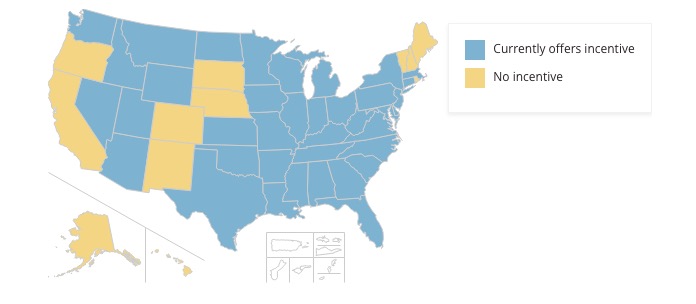
LRC blips the proponent argument for tax incentives while giving two evidenced examples of incentives not yielding positive returns and one state’s response with (gasp!) a new tax:
According to proponents, data center tax incentives contribute to local economic growth, resulting in better jobs and increased tax revenue. Opponents argue that tax incentives burden local communities because they actually reduce tax revenue and do not provide high-paying employment opportunities. For example, businesses and residents in Michigan were found to pay higher taxes and receive fewer public services as a result of data center tax incentives.
One review found that Virginia is one of ten states losing more than one hundred billion dollars annually due to data center subsidies. The Virginia General Assembly has since passed a 2026 budget bill containing a data center tax [LRC 2026.08.26, p. 15].
That evidence for pessimism about the value of tax incentives for data centers paired with the preceding evidence on poor job creation from data centers matches a brief MinnPost report posted yesterday (thanks, Sally Jo!) indicating that states get more job-creation bang for their economic-development buck from other industries:
Research from Virginia, a state with an established data center industry, found that projects there created one direct permanent job for every $54 million invested. In Iowa, a $576 million data center investment came with a requirement to create 31 jobs – about one job per $18.6 million. In contrast, across key sectors of the economy, a $1 million investment supports, on average, 17 jobs [Brian Arola, “Do Data Centers Have Low Rates of Permanent Job Creation Compared to Other Sectors?” MinnPost, 2026.08.27].
It doesn’t take 5,000 noisy servers and carefully curated prompts to Claude to derive a reasonable policy direction from that data.
* * *
As I said above, transparency is the only issue where LRC steps out and suggests its support for a particular policy direction. But even if we take this memo as LRC simply doing its job of providing evidence on which legislators may base their policy-making, this draft issue memorandum, as presented this week, offers a lot more support for folks looking to rein in or block data centers than for those looking to open South Dakota’s doors (and coffers) and invite them in.
So, calling us when they’re ready to flip all the breakers on is not enough transparency? Good to know.
I’ve read that they’ve been built in places with no notice, because they can. Legislature’s need to address that for sure.
Well, it’s a start, but it’s too lax. Hyperscale data centers should be banned. There should be statewide limits to the number of data centers based on electrical demand and water usage. No subsidies of any kind. South Dakota has to develop a regulatory program for noise limits, etc. There must be bonds provided to the state for payment of any stranded costs. There’s probably a lot more things to consider. All of this will take time to figure out, so a one year moratorium is appropriate.
We built safeguards into our democracy. Turns out they may have been too lax. The safeguards for AI should be up the wazoo.
https://www.axios.com/2026/08/29/openai-huggingface-hack-investigation-highlights
SD is and has been well behind USA in innovation. Wonder why?
* Business R&D: South Dakota ranked 47th nationally.
* Academic R&D: 50th.
* Total R&D was only about $345 million, compared with $10.8 billion in Minnesota and $4.1 billion in Iowa.
* Venture capital is especially weak: South Dakota attracted only about $6 million in VC in 2022, versus $256 billion nationally.
SD is and has been well behind USA in innovation. Wonder why?
* Business R&D: South Dakota ranked 47th nationally.
* Academic R&D: 50th.
* Total R&D was only about $345 million, compared with $10.8 billion in Minnesota and $4.1 billion in Iowa.
* Venture capital is especially weak: South Dakota attracted only about $6 million in VC in 2022, versus $256 billion nationally.
Maybe we’re ahead of the curve on this issue:
https://www.cpr.org/2026/08/26/xcel-data-center-pushback/
On the other hand, the right-leaning editorial board of the Colorado Springs Gazette seems pro-data center:
https://gazette.com/2026/07/28/editorial-beware-of-the-disingenuous-war-on-colorados-data-centers/
By January the issue will be tabled; judging by past legislative performance around the country. But until November, it’s a top topic nationwide for Dems. A losing topic but what else we got? NaDa
AI is bad! Very bad! *How ridiculous
How is it a losing issue if nearly 7/10 Americans oppose building new data centers in or near their community?
Who is in the data center?
> IBM
> HP
> EMC
> Cisco
> Verizon
> AT&T
> Sprint
> CIO
Just to name a few
Salaries:
> On call DC manager $150,000
> DC Project manager $250,000
> SWAT troubleshooters $300,000
> Union Teamster techs $150,000
If they keep data centers small and have reasonable limits on how much water and electrical power they are going to use I think they’ll be able to build some, but it’s going to take some time to work it all out. In the meantime a one year moratorium has been a common request from citizens around the country, and the smart politicians are beginning to catch up with citizens.
I could see these limits playing out somewhat like the acreage limit for surface gold mining. In this regard, the state could set up an auctioning system,. You could do it to make money, but I would rather auction it off to South Dakota companies who might be interested. One thing you want to prohibit is data centers going into the nuclear power area to get their power;