Last year Donald Trump sent Dutch immigrant and longtime Michigan politician Pete Hoekstra to Canada as our ambassador. A lot of Canadians want to send him back:
An official petition before Canada’s House of Commons has gained thousands of signatures in support of the expulsion of the United States ambassador, Pete Hoekstra.
The signature tally, as of Saturday, surpassed 171,000, far exceeding the 500 needed for the petition to be discussed before Canada’s legislature [staff, “Canadian Petition to Expel US Ambassador Gains over 170,000 Signatures,” Al-Jazeera, 2026.08.15].
The validated signature count as I check over breakfast this fine Sunday is 192,136.
Leanne Walker of Calgary drafted this petition last month; the Clerk of Petitions opened her proposal to signatures on the House of Commons electronic petition website on July 21. Here’s Walker’s full text:
Whereas:
- U.S Ambassador Pete Hoekstra has repeatedly made public statements undermining the Canada-U.S. diplomatic relations, including characterizing the 2025 Canadian federal election as “anti-American”;
- Ambassador Hoekstra has normalized the Trump administration’s threats to annex Canada as the “51st state,” describing such rhetoric as a “term of endearment”;
- Ambassador Hoekstra has accused Canada of interfering in U.S. domestic politics while himself making repeated interventions in Canadian political discourse inconsistent with diplomatic protocol;
- Ambassador Hoekstra has been linked to a Michigan-based voter identification app used by the Alberta separatist Centurion Project, while claiming no knowledge of its use; and
- The Alberta Prosperity Project met with U.S. State Department officials three times between April 2025 and January 2026, with Hoekstra claiming no knowledge of those meetings, raising serious questions about U.S. diplomatic interference in Canadian unity.
We, the undersigned, residents of Canada, call upon the Government of Canada to:
- Formally declare Pete Hoekstra persona non grata and request his removal as U.S. Ambassador to Canada;
- Raise with the United States the pattern of conduct by Ambassador Hoekstra inconsistent with the Vienna convention on Diplomatic Relations; and
- Direct a parliamentary committee to review U.S. diplomatic interference in Canadian domestic affairs.
[Leanne Walker, e-7531 (Foreign Affairs), petition to House of Commons, 2026.07.21]
Green Party Leader Elizabeth May will present this petition in Parliament this fall.
This petition to the Canadian House of Commons has no analogue in the American Congress, and it differs significantly from South Dakota’s citizen initiative process. Walker’s petition to boot Ambassador Hoekstra does not call for a nationwide vote, and it does not force the federal government to take the petitioned action. But it is a spectacularly easy way to put a matter before Parliament and require a government response.
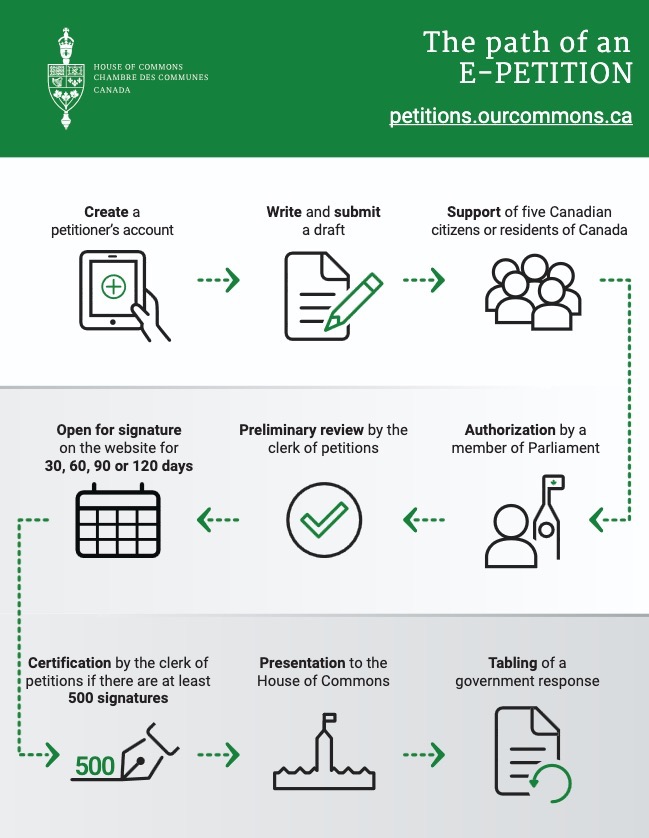
Any Canadian citizen or resident of any age may sign or start a petition. Petitions require the approval of just one member of Parliament to be opened for signatures. Canadians may petition the House of Commons electronically or by paper; while online petitions require 500 signatures, paper petitions require only 25 signatures.
Canada has over 41 million people. If we had a similar petition process south of the border and applied proportional signature thresholds, Americans could demand that Congress take up a proposal with 4,133 electronic signatures or 207 signatures on paper. In South Dakota, similar petitions could force a Legislative response with 11 online signatures or one paper signature.
Legislative action should not be the result of just one cranky dude. South Dakota’s relatively small population would make higher signature requirements—perhaps the same as Canada’s, 500 online, 25 on paper—perfectly reasonable. But the Canadian House of Commons offers its citizens a convenient avenue for petitioning their government and demanding real parliamentary action. The Canadian petition system invites everyone residing in the country to participate in government in collaboration with their elected representatives in a swift and responsive fashion relatively unhindered by dilatory bureaucracy. And the Canadians demonstrate that the government can host an electronic petition system for its citizens and use its data to validate signatures almost instantly to ensure the integrity of the process.
South Dakota should create a similar petition process to allow citizens, with the cooperation of at least one sponsoring legislator, to direct the Legislature to debate certain bills and resolutions. South Dakota could use such a Legislative-petition system to test a system for receiving and validating online signatures which could be expanded to support the state’s initiative and referendum process for statewide votes of the people on actual laws and Constitutional amendments.
South Dakota should create a similar petition process … – CAH
Hear, Hear.
Mayhap the idea needs a South Dakotan to bring it to South Dakota. Just sayin…
I think it deserves some consideration. In the first few US Congresses, it was common for citizen petitions to be sent to Congress, and Congress felt obligated to respond in some way, either by passing a bill or resolution. It got to be a favored way citizens brought concerns to Congress, but eventually Congress moved away from responding to such petitions. They became too numerous, I guess.
well there ya go: the cause of Canadian wildfires: paperless politics!!
If they were cutting down trees and making paper out of them, as God and nature intended, and circulated paper petitions, we wouldn’t be getting so much smoke down here.
If they are going to do all that electronic stuff, build the data centers in Canada too.