Yeah, I’ve got a bee in my bonnet. Petitions, public participation, personhood, and Legislative history and intent—how could I not get fired up?
On Wednesday, retired Rapid City attorney Scott McGregor convinced most of his fellow state Board of Elections members that the League of Women Voters and other regular folks aren’t persons and can’t legally petition their board or any other state rule-making body for changes to the state’s administrative rules, despite the fact that boards have regularly considered and acted upon such petitions in the past and continue to do so even after the Board of Elections’ surprise ruling against participatory democracy.
The Board of Elections’ narrow reading of one definition of “person” in SDCL 1-26-1 appears to contradict the spirit, intent, and practical implementation of a host of other laws related to rule-making, not to mention common sense. Even McGregor admits that there must be some mistake, albeit one the Board of Elections is powerless to change:
The definition of a “person” able to petition a state board for a rule change only includes political subdivisions or agencies of the state, board member and retired Rapid City attorney Scott McGregor said.
…McGregor spoke with the Secretary of State’s Office and its legal counsel earlier this week to confirm his interpretation. Deputy Secretary Tom Deadrick told McGregor that other agencies have accepted rule petitions from individuals.
“Even if other agencies have done it,” McGregor told Searchlight,” that doesn’t change the law.”
McGregor told board members he was “shocked” by the limitations.
“That may be an oversight, but that’s all that’s in there,” McGregor said during the meeting.
…McGregor told South Dakota Searchlight that the law should be reviewed legislatively.
“There is a certain unfairness to it,” McGregor said [Makenzie Huber, “Petition to Clarify South Dakota Proof of Citizenship Law Shot Down over Technicality,” South Dakota Searchlight, 2026.07.08].
There is definitely an oversight, a 34-year-old Legislative drafting error that no one noticed until now.
* * *
1966 House Bill 674/Session Law 159 created the modern statues governing the state administrative rule-making process, SDCL Chapter 1-26. It defined “person” thus:
(6) “Person” means any individual, partnership, corporation, association, governmental subdivision, or public or private organization of any character other than an agency; [1966 House Bill 674/Session Law 159]
The original intent was to distinguish persons and agencies:
(1) “Agency’’ means each state board, commission, department, or officer, other than the Public Utilities Commission of the state of South Dakota, the legislature or the courts authorized by law to make rules or to determine contested cases; [1966 HB 674]
…a distinction envisioned in the 1966 law’s definition of “party”:
(5) “Party’’ means each person or agency named or admitted as a party, or properly seeking and entitled as of right to be admitted as a party; [1966 HB 674]
This 1966 law included the public’s right to petition for rule changes now found (amended) in SDCL 1-26-13:
Section 6. Petition for Adoption of Rules. An interested person may petition an agency requesting the promulgation, amendment, or repeal of a rule. Each agency shall prescribe by rule the form for petitions and the procedure for their submission, consideration, and disposition. Within 30 days after submission of a petition, the agency either shall deny the petition in writing (stating its reasons for the denials) or shall initiate rule-making proceedings in accordance with Section 3 [1966 HB 674].
Six years later, 1972 HB 642/SL 8 amended the definition of “person” found in SDCL 1-26-1:
(6) “Person” includes all political subdivisions and agencies of the State; [1972 HB 642]
Swing over to SDCL 2-14-2, which defines certain basic terms (like “person”!) for all chapters, and we see “includes” used inclusively, not exclusively, to emphasize that in addition to the ordinary sense of the word given force by SDCL 2-14-1, a given term includes specific things that might otherwise be debated or excluded. In 1972, SDCL 2-14-2 defined person pretty much as it does now (“‘Person’ includes natural persons, partnerships, associations, and corporations;’—”limited liability companies” was added by 1994 HB 1354/SL 351). 1972 HB 642 thus said, “yeah, person is those things, but for rule-making purposes, it also includes political subdivisions and agencies of the state.”
But 20 years later, it looks like the Legislative Research Council went nuts with some style and form changes that created the current unintended personhood mess.
1992 HB 1059/SL 8 is titled “An Act to clarify the authority of the state fair commission regarding rule-making and off-season fairground activities.” The bill doesn’t appear to contain any big change in the authority of the state fair commission. It certainly doesn’t touch the general rule-making process or the specific provision for public petition for rule changes. But the third and final section of this 1992 bill added one item to the list of things not included in the SDCL 1-26-1(7) definition of “rule”:
(i) policies governing specific state fair premiums, awards, entry and exhibit requirements adopted by the state fair commission pursuant to § 1-21-10; [1992 HB 1059/SL 8]
That exception is still there today, although now in sub (j), not (i). We keep making more exceptions….
But in 1992, when LRC got hold of this proposal and saw it touching SDCL 1-26-1’s definitions, they saw an opportunity to tighten up language… and here the record gets confusing.
The original 1966 law introduced its definitions with this phrase: “As used in this Act.” Each subsequent definition thus had to include its own verb: “‘Agency’ means…. ‘Contested case’ means…. ‘License’ includes….” The 1972 law changed the introductory clause to include a verb—”Terms used in this chapter, unless the context otherwise plainly requires, mean:”—thus allowing the drafters to strike each “means” from the definitions. But the 1972 drafters kept the “includes” where they appeared, including the one they added to “person”.
The 1992 session law suggests that each instance of “means” had snuck back into code. The 1992 session law also gives a confusing reading of what the introductory clause to SDCL 1-26-1 said and how 1992 HB 1059 was changing it:

I don’t see a clear record in the relevant session laws from 1972 to 1992 of how the text of SDCL 1-26-1 might have changed from 1972 HB 642 to the text indicated in 1992 HB 1059. And as far as I can tell, 1992 SL 8 incorrectly shows the previous text to include the word “content”, where the 1972 version uses the word “context”.
But whatever the record, Section 3 indicates that LRC thought they needed to strike every verb from the beginning of every definition. In addition to each “means” that was made redundant by the “means” in the introductory clause, LRC struck the “includes” found in the definitions of “license”, “licensing”, and “person”.
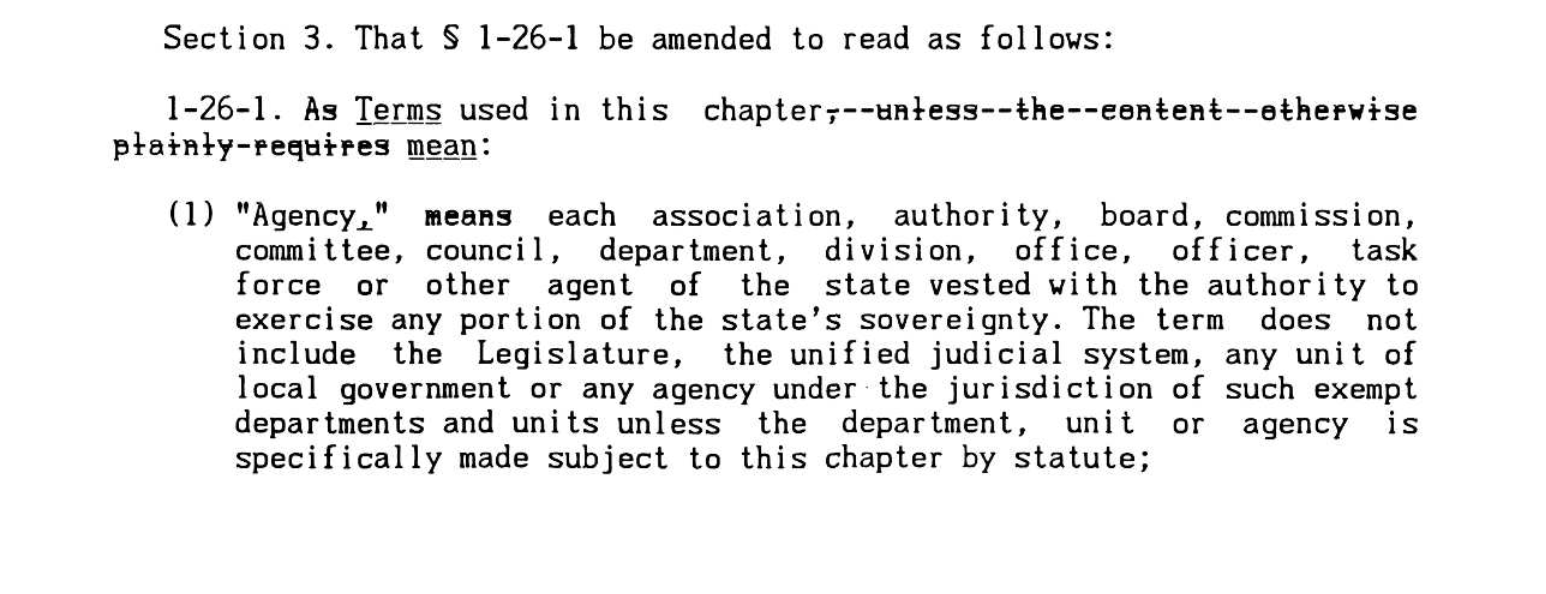
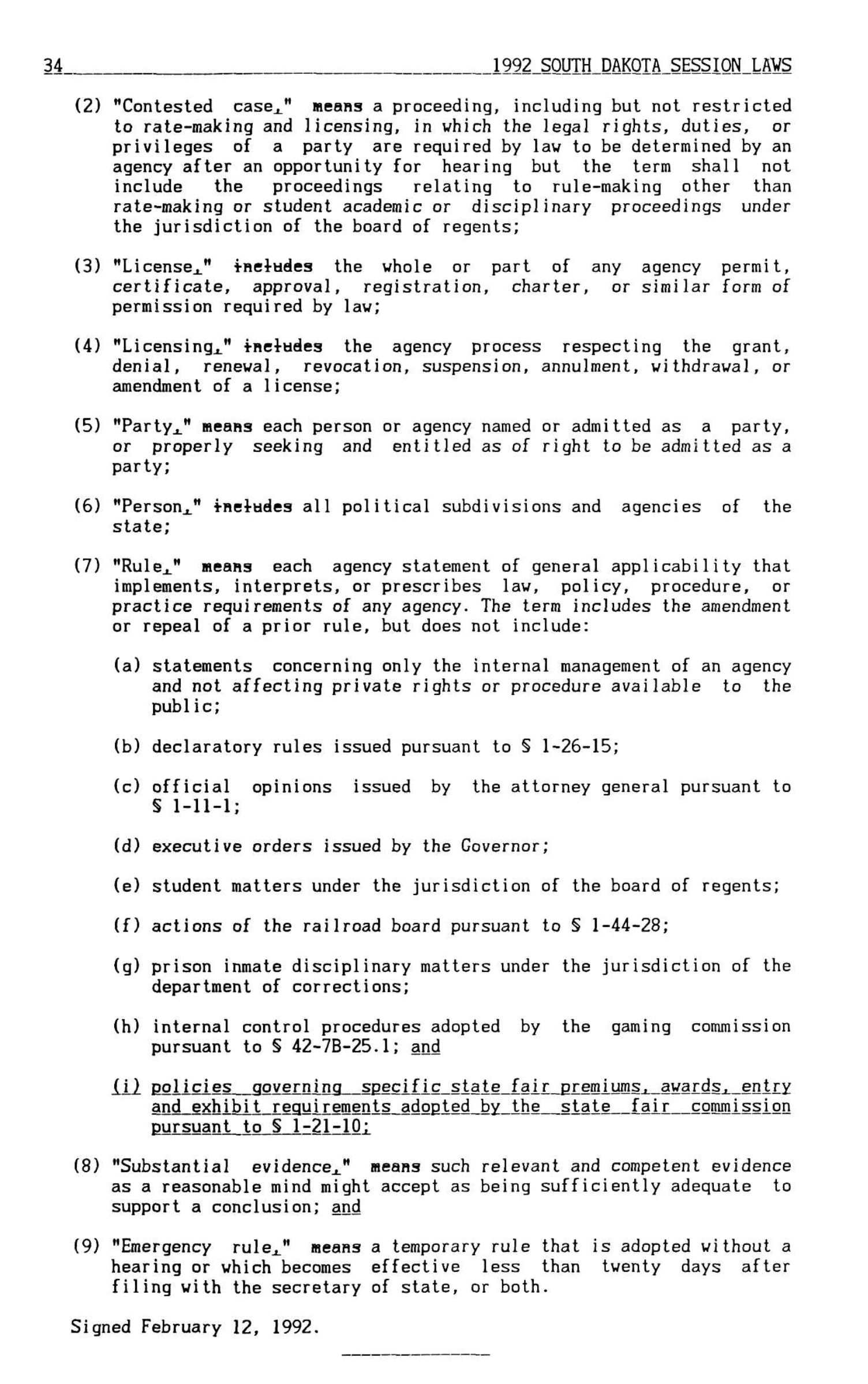
And there’s the problem. “Means” defines—literally, sets limits, says “the thing is this, period.” “Includes” broadens a definition, says, “the thing is also that.” LRC says so in its drafting manual:
Do not provide that a word or phrase “means and includes.” The former establishes that the definition is exclusive. The latter creates conflict by suggesting that the definition is merely illustrative [Legislative Research Council, Guide to Legislative Drafting, revised December 2025, p. 16].
When setting forth a list, do not follow the word “including” with the phrase “but not limited to . . . .” The plain definition of the word “including” is not exhaustive [LRC, p. 31].
LRC’s style and form changes in 1992 HB 1059 Section 3 inadvertently went beyond style and form and effectively changed definitions from inclusive to exclusive. That change didn’t matter on “license” and “licensing”, since the things “included” in previous law covered everything under those terms.
But that change matters enormously on “person”. The original 1966 law said “persons” were everybody, individuals and groups, except for state agencies. The 1972 law deferred to SDCL 2-14-2 to affirm that persons are everybody but clarified that for rule-making, “person” included political subdivisions and state agencies. LRC’s 1992 change severed the connection to the broad definition of “person” and declared only political subdivisions and state agencies to be “persons”.
That drastic limitation of personhood had nothing to do with the purpose of 1992 House Bill 1059. The folks who wanted to clear up the authority of the State Fair Commission did not want to declare that you and I and the League of Women Voters are not persons. The sponsors of 1992 HB 1059 did not want to repeal citizens’ right to petition any state rule-making body to change an administrative rule.
But in an innocuous attempt to clean up language, LRC removed one word, and poof! people aren’t persons, and we can’t petition our government to redress our grievances by changing South Dakota Administrative Rules.
* * *
The League of Women Voters and anyone else who’d like to continue petitioning South Dakota’s boards and commissions for sensible rule changes could probably take the Board of Elections to court and use this Legislative history and intent to knock down McGregor’s shocking limitation of personhood. The 1966 Legislature intended for members of the general public to be able to petition state agencies for rule changes. Subsequent Legislatures have affirmed that intent in multiple statutes. The 1992 statute on which McGregor’s novel interpretation hinges intended to clarify State Fair Commission authority, not end public participation in all state rule-making. One style-and-form error should not override clear Legislative intent. That argument would win in court.
But the 2027 Session is just six months away. Instead of lawyering up, it will probably be faster and definitely be cheaper to get on the horn to legislators, have them sponsor a bill to revert the rule-making definition of “person” to the inclusive 1972 version… and tell the LRC to be careful this time!
That was a hard long read for this person. I’m sure they will do the right thing. That was a joke folks. It was useful for them with their interpretation so why change it?
Sometimes figuring out how a law went wrong and opened the door to such a ridiculous, anti-democratic interpretation requires a hard long read. But this read should help any state board understand why the Board of Elections got the law wrong and why it is o.k. to keep inviting and considering citizen petitions for rule changes even before the Legislature fixes its 1992 technical error.
If McGregor’s interpretation is correct it could put in jeopardy federal money used to operate the state’s environmental programs, and perhaps other programs as well. Federal environmental laws are enforced at the state level under Memorandums of Understanding (MOU). Federal environmental law allows citizens to petition EPA for rules. State programs need to match that or they could be in violation of the MOUs, and thus ineligible for federal money. I am not familiar with non-EPA federal programs and their requirements for citizen proposals for rules, but there is the possibility that much of the state’s budget could violate federal law by not allowing citizen petitioning for rulemaking.
Interesting, Donald! I see the requirement for allowing citizen petitions in federal rule-making; can you point us toward text that shows the application of that requirement to states receiving federal money?
I’m not sure now that I can point to any specific language requiring states to allow petitioning for rules. It may be in MOUs between the state and EPA, rather than in federal laws or rules. During the Clinton years EPA was putting pressure on states to do more to include citizens in the rulemaking process. I do know that various environmental groups did petition for rules in the 1980s and 1990s. Mostly, of course, those were turned down. We used the regular rulemaking process to push for better rules, and we sometimes got better rules.
I doubt the Trump Administration would require or enforce anything approaching citizen petitioning for rules.