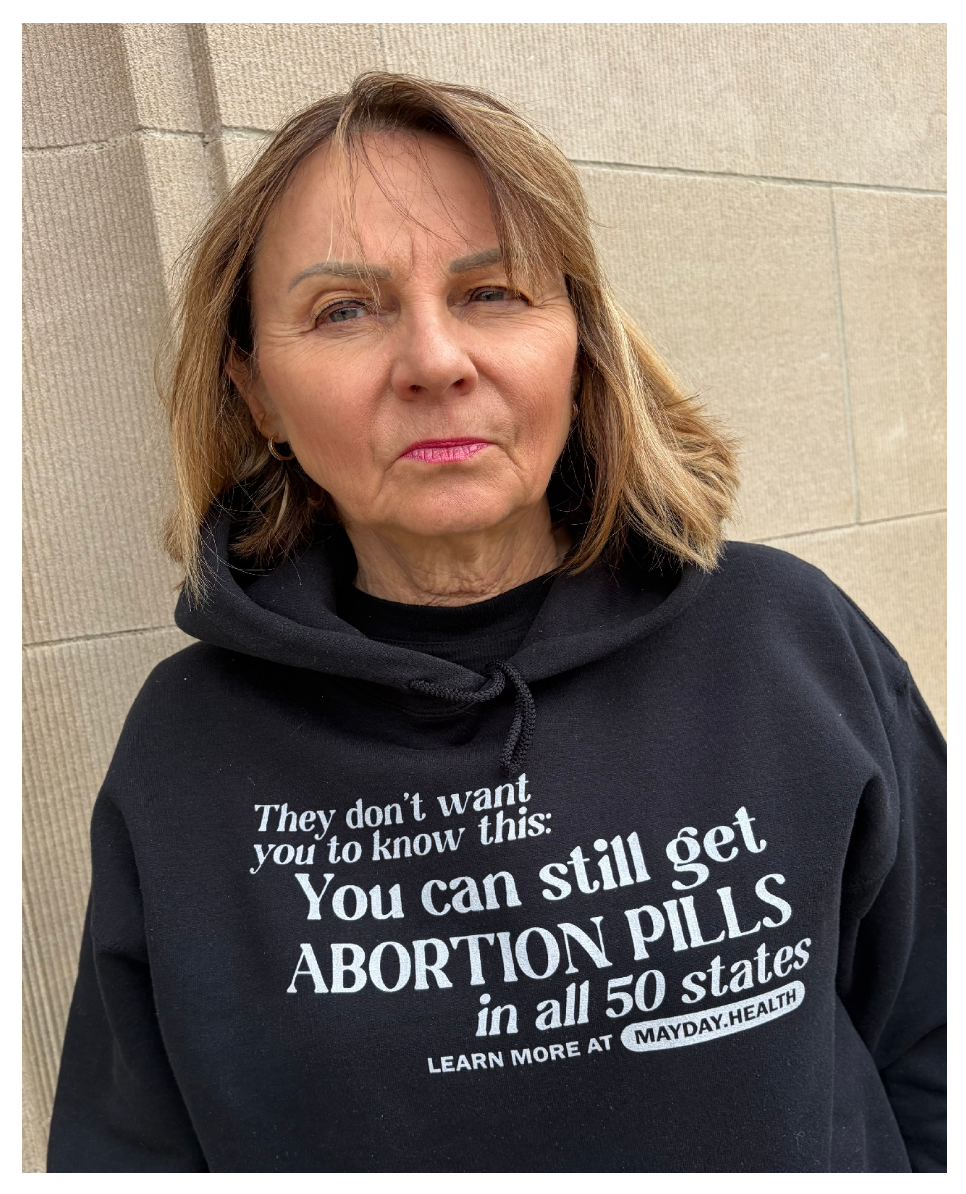
That’s not a mugshot; that’s Watertown lawyer Nancy Turbak Berry trying to avoid ending up in a mugshot at the Codington County jail come July 1 when South Dakota enacts its new law against “advertising” abortion pills or services.
Last March, the Legislature passed House Bill 1274, which will make it a Class 6 felony to “dispense, distribute, sell, or advertise… (1) an article or things designed, adapted, or intended for producing an abortion; or (2) an article, instrument, substance, drug, medicine, or thing that is advertised or described in a manner calculated to lead another to use or apply it for producing an abortion.” HB 1274 will also allow the Attorney General to seek a court injunction against anyone he suspects would do such a thing even before that person engages such dispensing, distributing, selling, or advertising.
When the House produced this violation of the First Amendment, I wondered if it would lead Attorney General Marty Jackley to take me to court for blogging about abortion pills. Nancy Turbak Berry wonders the same thing about the sweatshirt she bought from Mayday Health stating the plain fact that mifepristone is legally available to women nationwide.
And Turbak isn’t just wondering; she’s taking the state to court to find out if she has a right to wear her sweatshirt.
In a complaint and memorandum filed by Rapid City attorney Jim Leach in federal court Friday, Turbak and Mayday Health (the New York-based organization that settled a previous lawsuit against the state and whom I wrongly accused in March of backing away from the fight for women’s rights in South Dakota, which accusation I now withdraw and apologize for!) argue that the state’s past threats to punish Mayday Health for its advertisements to South Dakota women and the rhetoric that accompanied the passage of HB 1274 show that the state will treat selling and wearing the shirt Turbak models in the above photo as a crime. Turbak declares that threat will chill her free speech:
4. Because House Bill 1274 makes it a felony for anyone to “advertise” an abortion pill, and considering the State’s actions and arguments that are described in the Complaint, I believe that wearing my sweatshirt after July 1, 2026, will subject me to criminal prosecution for a Class 6 felony, a civil penalty of up to ten thousand dollars each time I wear it, attorney fees, costs, “and any other award the court determines is appropriate,” all as set forth in HB 1274 sections 2, 3, and 4.
5. Unless this Court determines that wearing my Mayday Health sweatshirt is protected by the First Amendment, I will censor my speech by not wearing it [Nancy Turbak Berry, declaration, Mayday and Turbak Berry v. Rhoden and Jackley, 2026.05.29].
Mayday exec Leo Raisner declares that the state’s past threats “chilled Mayday’s speech and deterred Mayday from carrying out its mission” and anticipates that HB 1274 will have the same effect, as the new law makes it “more likely than ever that South Dakota will bring criminal charges against Mayday, me, and others” [Raisner declaration, 2026.05.29, p. 10].
The plaintiffs point to the Legislative record to support their claim that the Legislature passed HB 1274 with the intent to prosecute Mayday:
On March 4, Hughes told the Senate State Affairs Committee: “You’re likely familiar with the Mayday Medicine case in which ads offering abortion pills are appearing on gas pumps in South Dakota convenience stores. We believe that gas stations and restrooms should stick to offering condoms and not be used to advertise abortion pills . . . This is reckless and dangerous commercial conduct for profit that poses a threat to the health, safety and even the lives of South Dakotans. HB 1274 criminalizes this conduct and gives our Attorney General and State’s Attorney’s the tools to prosecute, obtain injunctive relief, and pursue civil remedies.” Raisner Declaration Exhibit 18 at 3-4 (emphasis added) [Attorney James D. Leach, Memorandum in Support of Motion for Preliminary Injunction, Mayday and Turbak Berry v. Rhoden and Jackley, 2029.05.29, pp. 19].
Turbak and Mayday contend that HB 1274’s ban on “advertising” violates the First Amendment:
Abortion—when it should be available, to whom, and under what circumstances—is “a profound moral question” of great public interest. Dobbs v. Jackson Women’s Health Organization, 597 U.S. 215, 302 (2022). Mayday and Turbak’s speech goes directly to this profound moral question. Speech on matters of public interest is at the core of the First Amendment. Such speech “occupies the highest rung on the hierarchy of First Amendment values, and is entitled to special protection.” Snyder v. Phelps, 562 U.S. 443, 452 (2011), quoting Connick v. Myers, 461 U.S. 138, 145 (1983). “The most basic of [First Amendment] principles is this: ‘[A]s a general matter, . . . government has no power to restrict expression because of its message, its ideas, its subject matter, or its content.’” Brown v. Ent. Merchs. Ass’n, 564 U.S. 786, 790-91 (2011), quoting Ashcroft v. American Civil Liberties Union, 535 U.S. 564, 573 (2002) (alterations in original).
HB 1274 regulates speech based on its content, so it is presumptively unconstitutional. “It is axiomatic that the government may not regulate speech based on its substantive content or the message it conveys.” Rosenberger v. Rector & Visitors of Univ. of Va., 515 U.S. 819, 828 (1995). A law is “content based” if it “applies to particular speech because of the topic discussed or the idea or message expressed.” Reed v. Town of Gilbert, 576 U.S. 155, 163 (2015). HB 1274 applies to Mayday and Turbak’s speech because of the topic discussed, abortion, and the idea or message Mayday and Turbak express: that even after Dobbs, and even in South Dakota, a woman has a choice about whether to carry a pregnancy to term [Leach, Memorandum, 2029.05.29, pp. 10–11].
In support of their own First Amendment rights, the plaintiffs invoke the U.S. Supreme Court’s 8–1 ruling in Chiles v. Salazar that blocked Colorado’s attempt to criminalize therapists’ discussion of conversion therapy with minors:
In Chiles v. Salazar, 146 S.Ct. 1010 (2026), 2026 U.S. Lexis 1565, Colorado banned licensed counselors from talking with their clients about “conversion therapy,” meaning talking about changing their sexual orientation. Plaintiff objected to the law as applied to her. The Court struck it down as unconstitutional viewpoint discrimination. “The First Amendment envisions the United States as a rich and complex place where all enjoy the freedom to think as you will and to speak as you think.” 2026 U.S. Lexis 1565 * 14-15. “‘Viewpoint discrimination,’ as we have put it, represents ‘an egregious form’ of content regulation, and governments in this country must nearly always ‘abstain’ from it.” 2026 U.S. Lexis 1565 * 16.
Colorado’s law was viewpoint discrimination because it “trains directly on the content of [plaintiff’s] speech and permits her to express some viewpoints but not others.” 2026 U.S. Lexis 1565 * 29. HB 1274 as applied to Mayday and Turbak is viewpoint discrimination, because it trains directly on the content of their speech (abortion) and permits them to express the State’s viewpoint (e.g. that abortion is dangerous and morally indefensible) but not their viewpoint (that a pregnant woman should have access to information that allows her to consider her options, including abortion, and that abortion pills can be a safe, reasonable choice).
In short, “the people lose whenever the government transforms prevailing opinion into enforced conformity.” 2026 U.S. Lexis 1565 * 36-37 (cleaned up). The First Amendment is “a judgment that every American possesses an inalienable right to think and speak freely, and a faith in the free marketplace of ideas as the best means for discovering truth.” 2026 U.S. Lexis 1565 * 37. Just as Colorado thought that Chiles should not be allowed to speak about conversion therapy, South Dakota thinks that Mayday and Turbak should not be allowed to speak about abortion [Leach, Memorandum, 2026.05.29, pp. 12–13].
If the First Amendment protects our freedom from liberals trying to throw people in jail for telling gays they can turn straight, it must also protect our freedom from conservatives trying to throw people in jail for telling women they can choose to end their pregnancies.
Turbak and Mayday ask the court to enjoin the state from enforcing or threatening to enforce HB 1274 against them and to declare that HB 1274’s ban on “advertising”—not the whole law, just the part about advertising—is unconstitutional.
Mayday also asks the court to declare trying to hold Mayday responsible for the content on third-party websites to which it provides links on its website violates the Section 230 of the federal Communications Decency Act.
While public officials often decline to discuss ongoing litigation, Attorney General and, perhaps more relevantly, Republican candidate for Congress Marty Jackley quickly issued a press release declaring his pro-life chops and mischaracterizing this new lawsuit and its predecessor:
This session the South Dakota Legislature, in HB 1274, approved restrictions on abortion drugs mailed or distributed in South Dakota.
Attorney General Marty Jackley issued this statement after Mayday Health filed a new lawsuit regarding South Dakota’s law restricting the distribution of abortion pills in the state:
“The U.S. Supreme Court has made it clear that States have the right to protect life. As with Mayday’s previous unsuccessful lawsuit, I will defend innocent life” [Attorney General Marty Jackley, press release, 2026.05.29].
Marty’s misrepresentations:
- Jackley doesn’t mention local lawyer Nancy Turbak Berry; he wants to portray this lawsuit solely as an out-of-state organization threatening the South Dakota way of life.
- Turbak and Mayday aren’t challenging the restriction on distributing abortion pills in the state. They are challenging HB 1274’s restrictions on discussing abortion pills and other means of terminating pregnancies. Jackley needs his voters to hear “I love fetuses!” not “I hate free speech!”
- Mayday’s previous lawsuit wasn’t entirely “unsuccessful”. The federal court declined on jurisdictional grounds to intervene in state-level litigation, but before Mayday and the state settled that case, federal Judge Katherine Polk Failla said the First Amendment protects Mayday’s speech (and the plaintiffs quote Judge Failla to support their new lawsuit). In her February 11 oral ruling, Judge Failla peered over her jurisdictional restraint at South Dakota and said, “I trust that the South Dakota court will get it right“… and by “it”, she meant the First Amendment and Jackley’s misapplication of laws relating to commercial speech.
Jackley will need to speak more accurately about the nature of this lawsuit to Judge Camela C. Theeler, who will hear the case. HB 1274 takes effect July 1, so let’s hope for fast action to keep Turbak in her sweatshirt and out of jail.
There was a time when “speaking accurately” was a value cherished by liberal, politically neutral and conservative lawyers alike. Those days seems to have mysteriously vanished in the MAGA/Trump legal mind. Remember Bill Barr’s description of the Mueller report, as well as most of what comes out of Todd Blanche’s mouth these days. Marty Jackley’s MAGA/Trump-speak transformation is both surprising and extremely disappointing.
I look forward to seeing Jackley’s actual arguments against this lawsuit rather than his campaign-trail posturing. The state doesn’t have a winning record against First Amendment lawsuits.
CAH and BCB….two South Dakota treasures that don’t seem to be treasured enough. Did Jackley attend law school at Liberty U or Bob Jones U? Curious iowan would love to know.
The court will protect free speech. Marty wants us to believe this is about abortion it is not.
We need to protect free speech once we lose free speech we lose all our rights.
You’re beautiful, Nancy.
I want a shirt like that. Thank you, Nancy Turbak Berry, for carrying the torch.
This is unfortunately a battle of the sexes with Berry representing common sense and legal rights for women. And in the other corner of the ring is Jackley representing misogynists who believe women should not have the right to choose and are now offended by our 1st amendment right to print facts.
I’d like to take Jackley and zip his pants permanently, then zip his lips. Quit trying to control women.
Been on this scene my entire life. Jackley is full of it. I wouldn’t say he’s a self righteous a-hole, I don’t have too. Its sad that right wing minj-pricks want to control what you say or write about.
10. States that ban or punish women from tapping or going out of state for their medications or procedures is government overreach and are violating the Commerce Clause enumerated in the United States Constitution.
Legislators who push these bills remind me of computer hackers and telemarketers who scam people of money. If the computer hackers and telemarketers would use their skills for good, imagine what they could accomplish. Same things for these legislators, if they would use their time for bills that would solve real problems many South Dakotans face each day, imagine what could be accomplished in Pierre each legislative session. Instead, these legislators are after attention and seek political donations from extremist groups that push extremist legislation.
DIY abortions are about as sensible as DIY cancer treatment with Ivermectin. I don’t know why anybody on either side of the abortion issue thinks this is a good idea. But men can do online drug purchases to treat their ED without seeing a physician who might want to make sure there are no underlying medical conditions like atherosclerosis, Parkinson’s, MS, among other serious conditions that first present as ED. Do we care if people resort to self-diagnosis and treatment?
HCG-producing tumors can yield a false positive pregnancy test. Or a woman may not realize how far along she is. Or maybe that online pharmacy she is sending money to is fraudulent, and all they are shipping out is vitamins.
Advising women to buy abortifacient drugs online just strikes me as irresponsible.
We live in a state where the so-called strong Christian conservatives want to save the fetus. However, once a baby is born, they could really care less what happens. Look at all the legislators who voted against free market reduced cost school lunches. They have no problem starving the child. They have no problem making healthcare unaffordable. They claim to read the Bible, but they must not pay attention to the verses. Somewhere in the quest to rid this country of illegal immigrants, they have no problem making it impossible for someone to have basic needs met. Jackley likes to talk about all he does to rid the state of fraud, yet he has done absolutely nothing to Noem who pilfered $700,000 of taxpayer money for personal luxury travel.
3. Rich women have full reproductive rights while women at the lower income margins suffer chilling effects on those rights. Women in Texas, Wyoming and South Dakota who can afford it simply jump on a plane and fly to Albuquerque, Minneapolis, Denver or elsewhere for their procedures. Imagine a woman on the Standing Rock or Pine Ridge doing that.
Fascinating intersection since it’s likely Ms. Turbak hasn’t had sex for at least a decade.
bearcreekbat, we live in post-truth times. Say anything you want-even objective falsehoods. Courts used to be the place where we litigated reality, but even they have become assimilated. Honest, factual, and truthful are values of our past. Too few demand that of their internet research, social media, or AI production. We blend fact and opinion at will.
It can be only in that environment that decency dies. Greed and corruption dominate.
We are in the darkest timeline.
Thanks for laying things out accurately, Cory. You’re right, of course, to note that Jackley misrepresents both his office’s history with Mayday and the nature of the current lawsuit. (By the way, his action against Mayday last year showed remarkable incompetence: He sought an injunction in a case — and boasted about doing so —before be bothered to start the case. A first year law student would likely know better.) But don’t let other responsible lawyers off the hook. Proponents of this and other unconstitutional attacks on civil rights in this year’s Legislative session included lawyers Jon Hansen and John Hughes, who should know better than to promote unconstitutional laws in the first place.
thanks bear, reality is sobering!
When an AG tries to prevent people from putting up posters or ads about something he opposes, and thinks will win him more votes when he runs for Dusty’s House seat, that’s a violation of the First Amendment right to free speech.
BTW, Algebra, there used to be a lot of self-medicated abortions in the old coathanger days, and many women died. It was the main reason why people actually congratulated Reagan when he signed a bill legalizing abortion in California in 1967. Mifepristone has been thoroughly tested, and proven safe, especially when used in conjunction with misoprostol. They can also be life-saving. If a woman is having a miscarriage (and 1 in 10 women do in their lifetime of pregnancy), she might easily bleed to death without using these medications.
Finally, Larry – thanks for letting us all know that if a woman is above a certain age you can’t figure out why she should care about access to abortion rights for raped 12 year olds and women with ectopic pregnancies.
Turbak defeated Noem’s uncle, Dennis Arnold in a state senate race for the South Dakota legislative district representing Watertown back in 2006 then Republican Governor Denny Daugaard hired Democrat Turbak to cover up Brady Folkens’ wrongful death.
Well algebra, your comparison really isn’t a comparison but you know that.
Republican small gubmint would keep gubmint out of women’s reproductive decisions. magats idea of small gubmint is to have gubmint interfere at every level of women’s reproductive lives, then lie about it.
Common sense would tell you not to have an abortion if you don’t want one. A large portion of the population can’t figure that out and have decided women aren’t capable of making that decision.