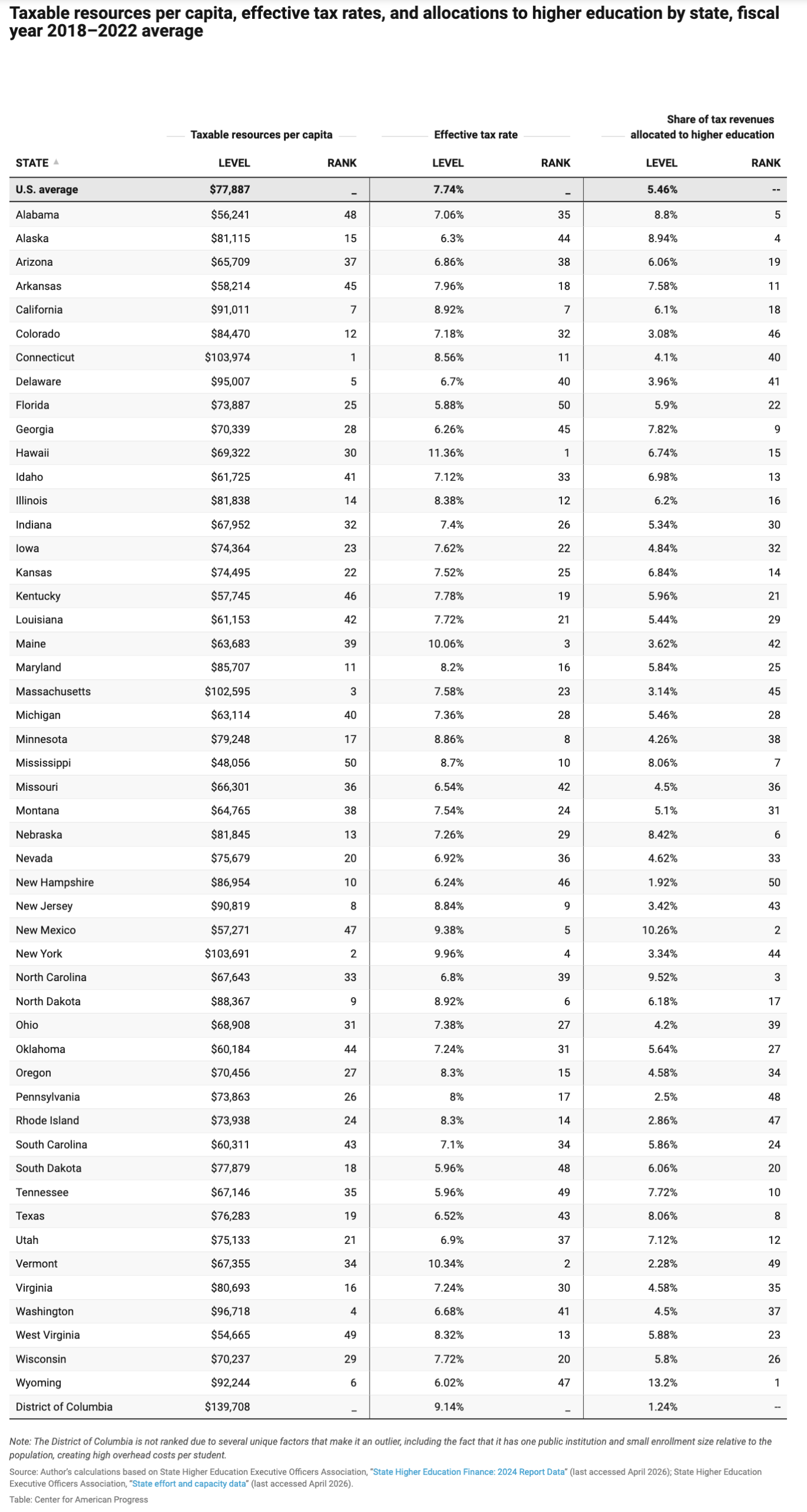
Down at the bottom of a Center for American Progress report on the impact of last summer’s federal big ugly budget reconciliation bill on state higher education budgets (nutshell: it’s not just that Trump is trying to gut academia and the troublesome expertise that flows therefrom; it’s that the huge federal cuts to food assistance and health care force more costs on states, which will have less room in their budgets to fund their colleges and universities), I find a table that compares each state’s taxable resources per capita, effective tax rates, and shares of tax revenues spent on higher education.
According to CAP, from 2018 through 2022, South Dakota’s taxable resources per capita averaged $77,879. That’s right around the national average of $77,887. South Dakota ranks 18th on that metric, right between Minnesota at $79,248 and Texas at $76,283.
But South Dakota is strongly disinclined to tap that wealth for public goods. South Dakota’s effective tax rate during the studied period was 5.96%, tied with Tennessee for the second-lowest in the nation. Only Florida had a lower effective rate, 5.88%. The national average was 7.74%. Minnesota had the eighth-highest rate at 8.86%, right behind North Dakota and California, both at 8.92%.
South Dakota still gives higher education a larger share of those meager tax revenues than the national average. Nationwide, states give higher ed 5.46% of their tax revenues; South Dakota beats that average by over half a percentage point, giving higher ed 6.06% of the taxes it collects. That ties South Dakota with Arizona for 19th-highest share allocated to higher ed. We’re right behind California (6.10%) and North Dakota (6.18%) and far ahead of Minnesota, which puts only 4.26% of its tax revenue toward higher ed. But we’re well behind Nebraska (8.42%) and national leader Wyoming, which spends more than one out of eight—13.2%—of its tax dollars on higher education.
We must thank Wyoming for all the educated geniuses they send out into America.
New Mexico ain’t doing too bad either.
New Mexico is 50th in average student debt, is tied for 49th in proportion of students in debt and offers free school breakfasts and lunches. New Mexico is also the third most diverse state in America while South Dakota is 37th and 46th in educational-attainment diversity according to WalletHub.
Neighbor Lynn was an on and off member of the National Education Association (NEA) while she taught for twenty six years, twenty of those at New Mexico’s oldest charter school. She told an interested party that what she liked about it was that staff and families made their own decisions and didn’t have to follow the whims of the Santa Fe Public School administration. But it wasn’t always easy to get the community involved so she believes charter schools make the most sense when they have a specific purpose—like those devoted to the arts or to science, technology, engineering and mathematics (STEM) have done.
https://www.krqe.com/digital-shows/insiders/how-is-new-mexico-paying-college-tuition-for-55k-students/
Toby Doeden wants to eliminate property taxes, which would either require a sales tax around 20% OR bankruptcy for South Dakota. And, if he won, he’d require being paid out of our tax dollars. This is such BS.