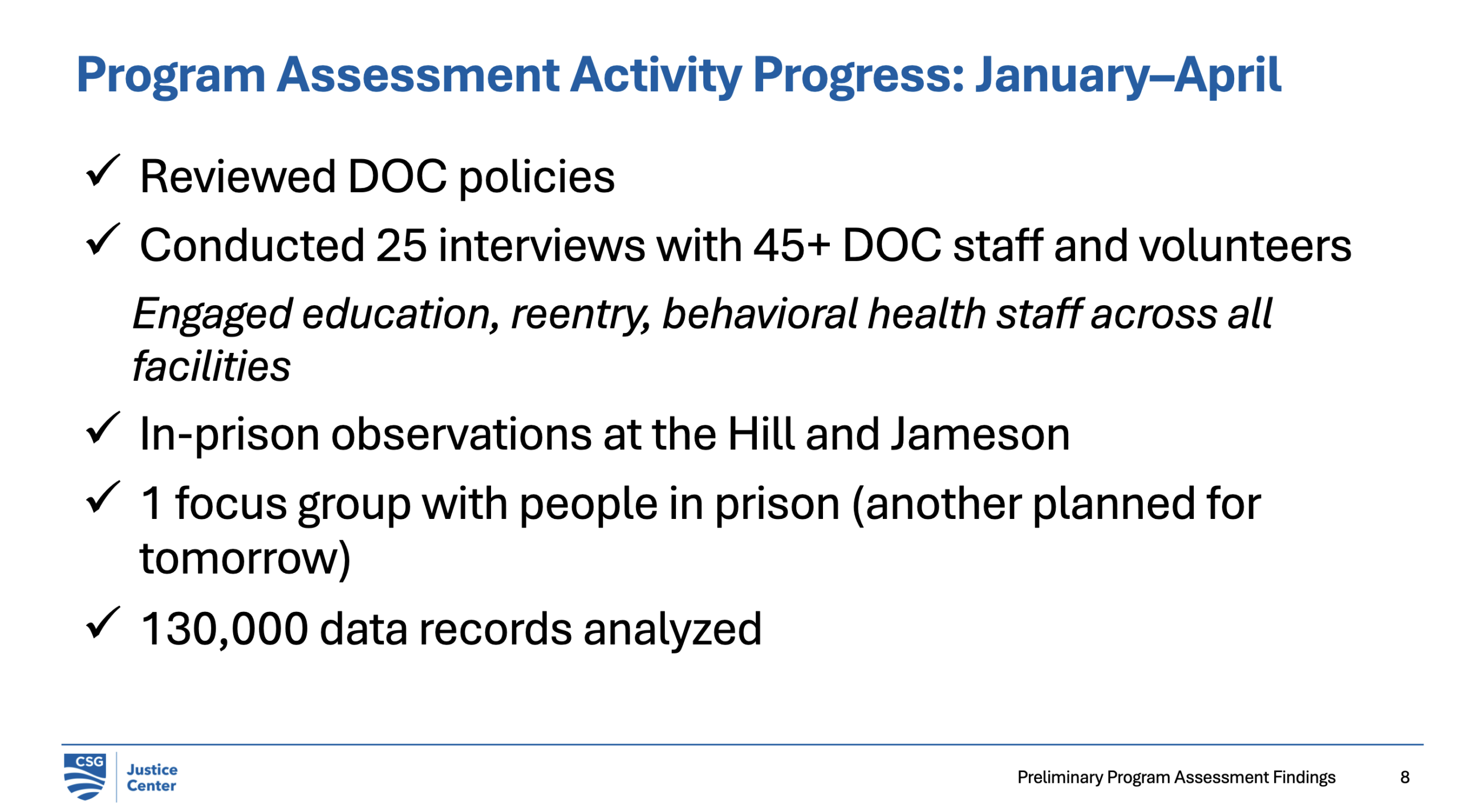
The Governor and the Legislature didn’t talk about criminal rehabilitation during the 2026 Session, but the Governor’s Correction Rehabilitation Task Force will get a lot to talk about at its third meeting today in Sioux Falls. The Council of State Governments Justice Center, which has been cranking out information about South Dakota’s prison system since before the task force’s first meeting last fall, has teed up preliminary program assessment findings based on their activity since January:
CSG Justice Center’s consultants report that the Department of Corrections increased the percentage of inmates receiving rehab programs from 43.1% in 2023 to 54.3% in 2025 [slide 10]. The lowest participation rates are at the three largest prisons: the state penitentiary and Jameson Annex in Sioux Falls and the Mike Durfee prison in Springfield. One can thus argue that the new Sioux Falls penitentiary, the groundbreaking for which this task force will attend before its meeting this morning, will improve the rehab participation rate by providing much better space for those programs.
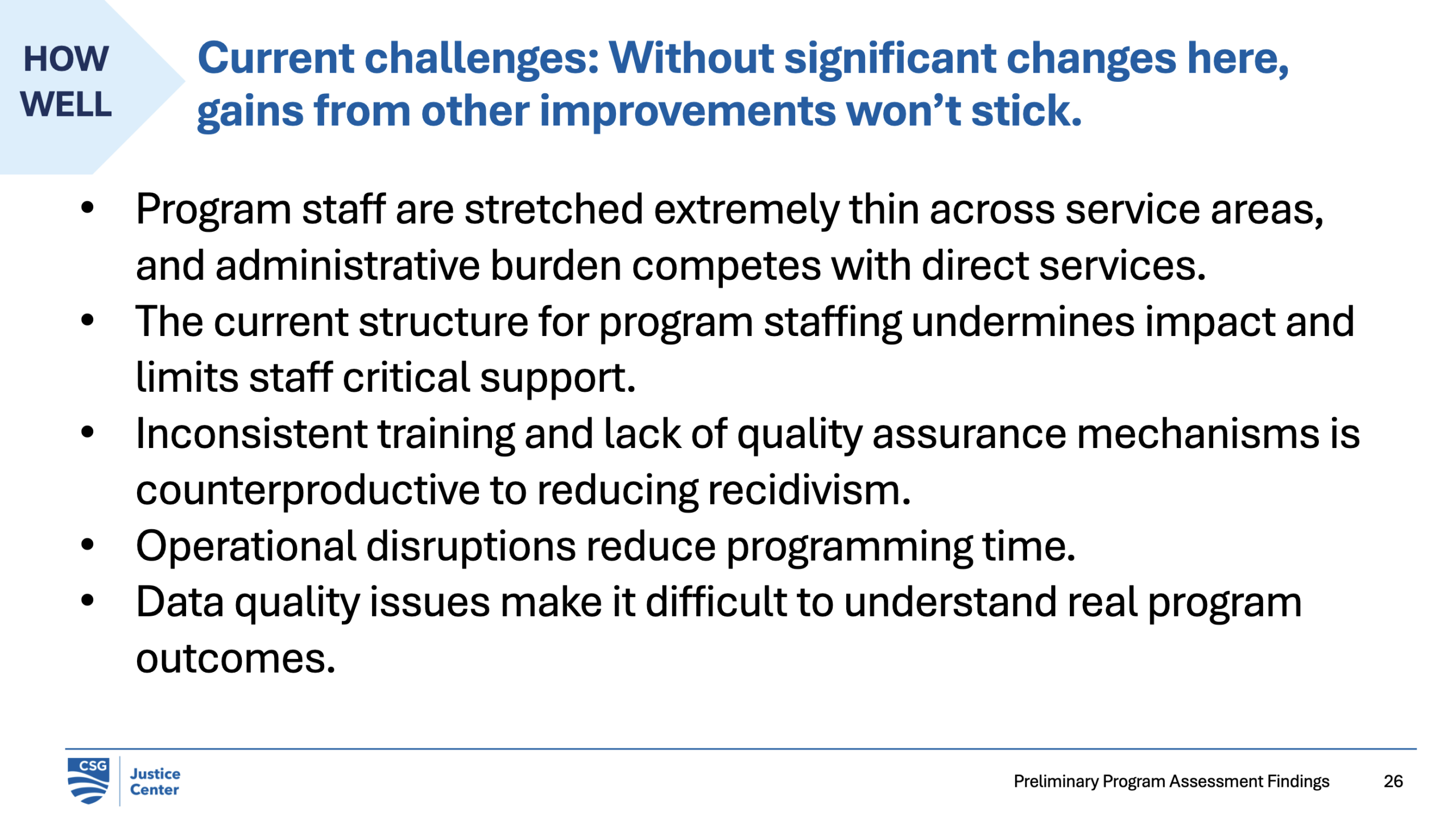
CSG Justice Center says [slide 20] that current rehab programming suffers from long wait lists and doesn’t address the distinct needs of women, inmates with serious mental illness, inmates with low literacy, and inmates serving long sentences. The DOC is offering good evidence-based curriculum [slide 22], but that curriculum is too broad [slide 23], stretching staff thin and leaving out some useful programs like pre-GED or English as a Second Language instruction, higher ed/post-GED coursework, and structured employment prep. The report emphasizes staff overstretch [slide 26] as a major obstacle to fully effective programming:
Getting rid of some current overlapping or less useful rehab programs while adding some missing items may balance out, but easing the waitlists and staff overstretch will require more staff [tucked into the recommendations on slide 30] will be the money item that will give legislators heartburn. But remember: spending more money to make prisoners wiser and more skilled is the investment we make to spend less money later to welcome those prisoners back to their cells after unsuccessful attempts to rejoin society.
CSG Justice Center roadmaps [slide 6] the work ahead of the task force. The consultants will continue visiting and observing our prisons and speaking with staff and inmates [slide 32]. The consultants plan to deliver a final assessment and refined recommendations for prison programming by June; an assessment of offender reëntry needs, policy options, and implementation priorities by August; and final recommendations by October.
We may not have heard much on prisoner rehabilitation during this year’s Session, but the Governor’s task force is drawing a full year’s worth of observations and recommendations for the next Legislature and Governor to act on.
Its easy to look up. California has a good system. If that’s too woke for you can go with South Carolina one of the two red states in the top nine. It’s not rocket science. Just adopt something from another successful state.
I have provided music at the prison, not a good place. I wonder if Trump were to reclassify POT, then, all those folks in prison for more than 1/4 LB should be able to get out, right? If so, we can build a small shed somewhere to hold the “real criminals” and get the decent POTHEADS back to making a living.
Amen Hank!
Yes, Hank. I’ve had good friends that have had their lives ruined because of an arrest. There for the grace of God is the saying that fits.
By the way I believe I saw you a gazillion times at Leos in my youth. Have a great day.
The other thing that would help is to give the volunteers the sort of trust and responsibility we had back before Wasko’s tenure. I volunteered at the prison for 12 years (Alternatives to Violence Project) and – AFTER TRAINING – we were allowed keys (so that we could use the bathroom without finding an officer, and access our supplies in the supply cabinet), could visit inmates at their cell door (really helpful when one was going through a hard time, like a death in the family), and did not require constant supervision by a staff member. The result was more volunteers, more access, more programs = better behavior and less write-ups.
Eve: I’ve yet to meet a person who worked for Wasko at the SDSP who has positive things to say about her tenure. Is this just sour grapes, or is there more to it?