Strong early voting numbers through last Friday made me think South Dakota was on pace for big turnout in the midterm general election. But the opposite happened: amidst heightened voter participation nationwide, South Dakota voters participated in Tuesday’s election at the lowest rate in most of our voting lifetimes:
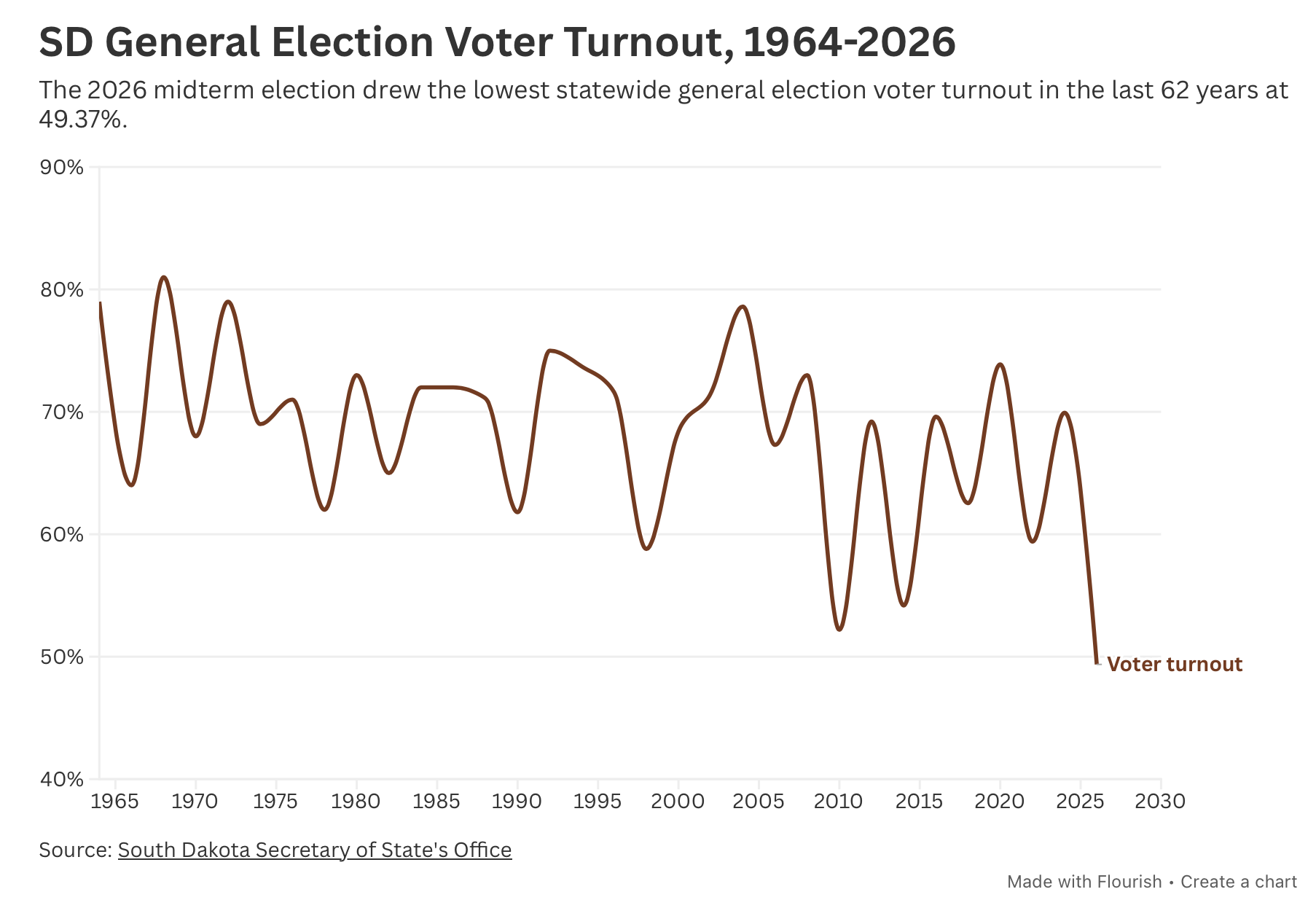
Midterms generally draw fewer voters than Presidential elections, but this year, when Americans in general appeared to recognize that a lot was at stake in who they picked for Congress and their state and local offices, and when the President whom South Dakota adores exhorted them to turn out as if he were on the ballot, a majority of registered South Dakota voters remained electorally silent:
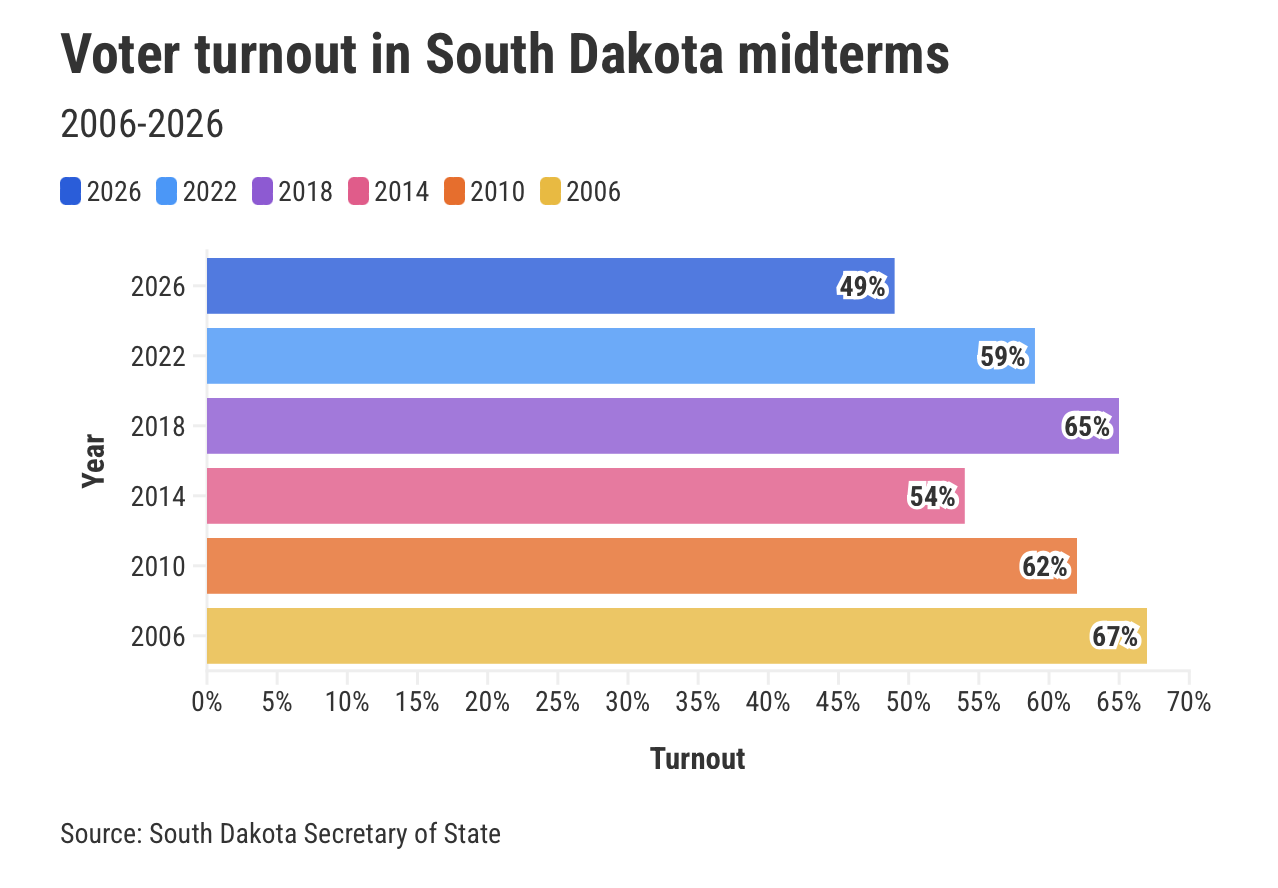
This stunning disinterest wasn’t a regional thing. Minnesota mustered remarkable midterm participation with over 64% voter turnout. Iowa’s 63.47% was the highest midterm turnout since 1990. Nebraska turnout reached 59%; Wyoming, over 68%; and Montana, over 60%.
Among our neighbors, only North Dakotans showed less interest in voting than South Dakotans, turning out at a meager 39.8%.
It’s tempting to blame both Dakotas’ lack of participation on the absence of competitive candidates, but that doesn’t explain South Dakota’s drop-off. The 2022 midterm contests were less competitive in South Dakota than this year’s campaigns. Brian Bengs only mustered 26% of the vote in his Democratic bid for U.S. Senate in 2022; this year, he won 39% running for Senate as an independent. 2022’s Democratic ticket of Jamie Smith and Jennifer Keintz fared worse against incumbent Kristi Noem and Larry Rhoden than Dan Ahlers and Steven McCleerey did this year against incumbent Larry Rhoden and Tony Venhuizen. Democrats left one top-tier race unchallenged this year, just like in 2022, but independent Bengs made more hay in his solo challenge to Senator Rounds than Libertarian Collin Duprel did going mano a mano with Representative Dusty Johnson. By percentages, this year’s midterm challengers in South Dakota seemed to have campaigned harder than 2022 challengers.
But overall, the number of ballots cast dropped from 354,670 in 2022 to 310,298 in this year’s election. That’s a net loss of over 44,000 participating voters, in a year when, in most of the rest of the country, voters flocked to the polls in unusually high midterm numbers.
44,000 votes wouldn’t have flipped any of this year’s statewide races. The closest margin was the Public Utilities Commission race, and powerhouse Frank Kloucek still fell 59,355 votes short of Don Haggar’s haul. Kloucek was the only challenger who stayed within 60,000 votes of his opponent. The average margin of victory for Republicans in all of the other races was 73,193; in the worst drubbing, Rhoden beat Ahlers 82,186.
And I suspect those 44,000 abstainers may well have consisted of more Republicans than Democrats. Perhaps this vast abstention was South Dakota’s wan expression of the blue tsunami. Maybe a fair number of Trump’s South Dakota erstwhile faithful have realized that Trump has betrayed his promises and made life harder for almost everyone in South Dakota. But with a distinct homesteader stubbornness, those disaffected South Dakotans couldn’t let their disappointment change their minds. Instead of reversing course and voting Republicans out of office, a lot of South Dakota voters just shut up and stayed home.
Excellent analysis, Cory. I’m looking forward to “who stayed home.” Though I assume many Republicans stayed home lacking ebullience for the foibles of the Trump administration, there remains a general lack of faith in Democrats’ ability to motivate votes on a statewide basis. The small gains in the House were seemingly due to strong leadership on the district and even the precinct levels. Perhaps a bellweather for future gains? But it’ll take years to claw back relevance.
Polling locations were changed here. They were posted in the local newspaper and on Facebook. They moved it from a central community owned location to a religious affiliated building on the edge of town. Just thought that was odd.
I call it voting by not voting. It’s sign of malaise, as Jimmy Carter might say or dissatisfaction with the whole system Maybe the Justice Department presence scared some folks away. Some of the righty candidates got beat in the primary. That could dampen enthusiasm in that part of the political spectrum Some people don’t think it’s important enough to make time and take the trouble to vote. People have complicated lives, especially in bad economic times.
It would be interesting to research why that dip happened. It so uncharacteristic of what I know of South Dakota elections.