People who get their health insurance through their employers will see higher premiums next year:
Employer-sponsored health insurance plans are poised to get more expensive next year.
Insurance broker Aon projected they’ll rise 9.5% to average more than $19,000 per employee. Companies typically shoulder about 80% of that burden, but workers will likely pay more, too [Nova Safo, “Health Plans Will Cost More in 2027, for Employers and Workers,” Marketplace, 2026.08.24].
Premium hikes will be worse for small businesses:
Small businesses that offer health insurance to their employees could see health costs rise in 2027, according to an analysis of preliminary rate filings from all 50 states and DC. Nearly 300 insurers offering small group coverage reported a median proposed premium increase of 14% for next year [Kaiser Family Foundation, “How Much and Why Premiums Are Going Up for Small Businesses in 2027,” 2026.08.06].
…and for individuals buying plans under the Affordable Care Act:
ACA marketplace insurers are proposing a median rate increase of 15% for 2027, the second consecutive year of double-digit premium hikes, according to a Peterson-KFF Health System Tracker analysis. For context, the median finalized ACA rate change last year was 20% [Jakob Emerson, “5 Forces Driving Up Health Insurance Costs in 2027,” Becker’s Payer Issues, 2026.08.17].
ACA plans are going up not because government health insurance doesn’t work but because this government is choosing not to make it work:
Federal policy shifts were also factors. Insurers more specifically attributed rising rates to the expiration of enhanced premium tax credits and greater morbidity in risk pools. As the expiration prompted an enrollment dip, healthier enrollees were more likely to let go of coverage. After subsidies, premium payments increased 58% on average in 2026 [Elizabeth Casolo, “ACA Insurers Propose 15% Premium Bump for 2027: 6 Notes,” Becker’s Payer Issues,2026.08.04].
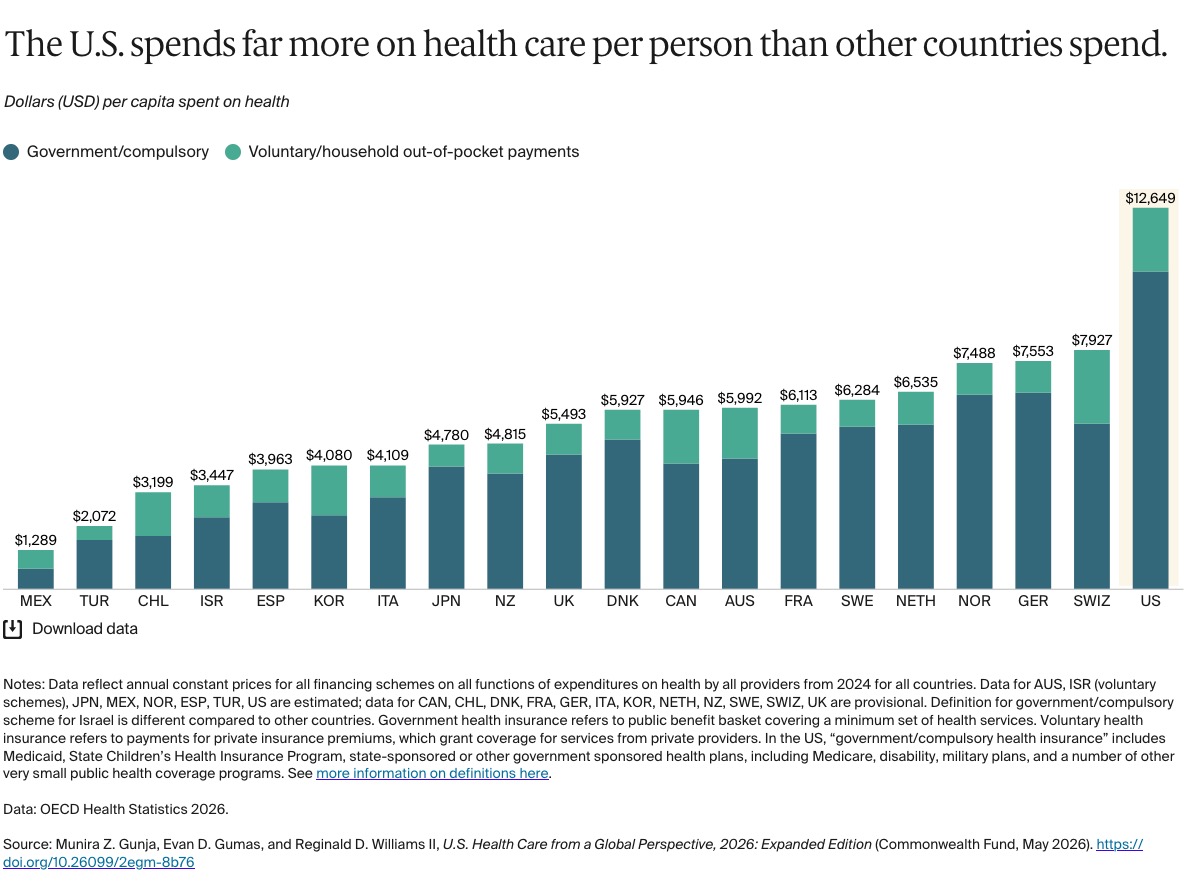
As has been the case for since before Dennis Kucinich explained to me that universal health insurance saves money and saves lives, countries that choose to make government health insurance available for everybody spend a lot less of their personal and national wealth on health care [click the following charts to embiggen!]:
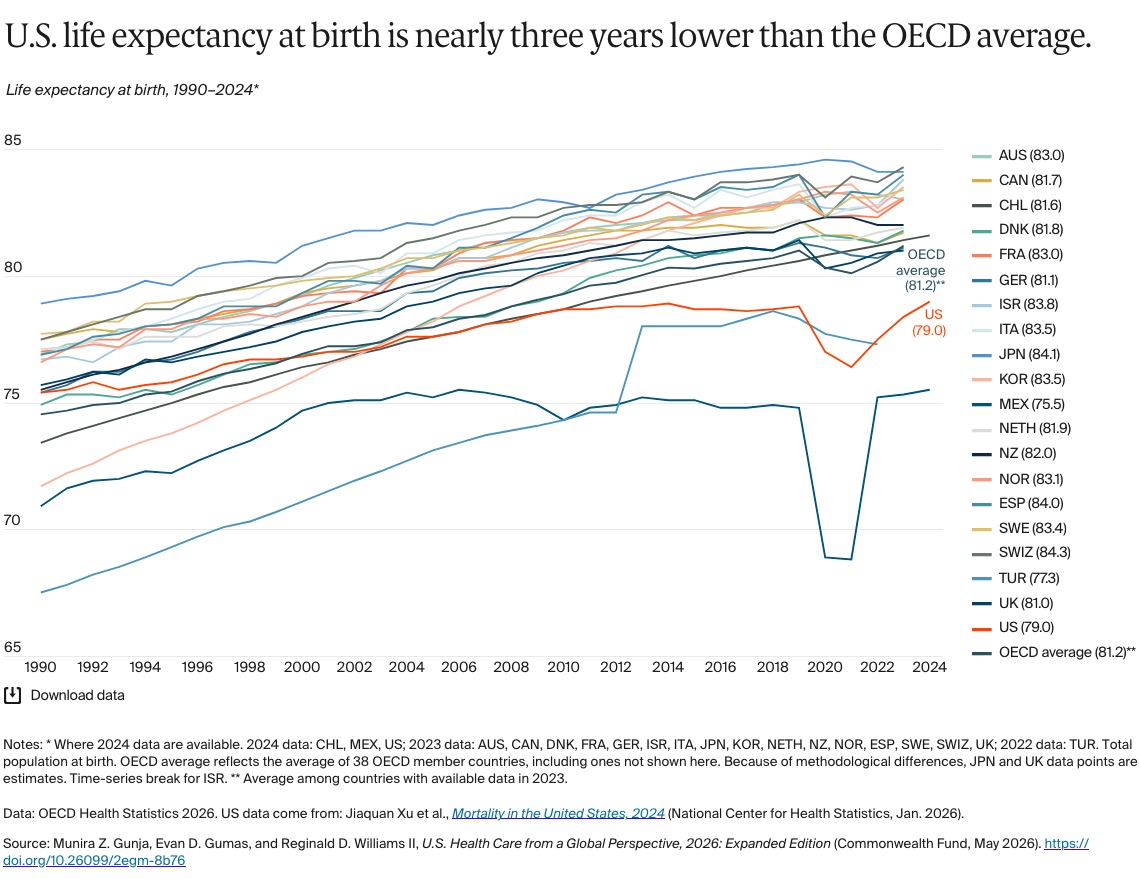
Folks in countries that cover health care primarily through tax dollars rather than through America’s hodgepodge insurance system generally live longer:
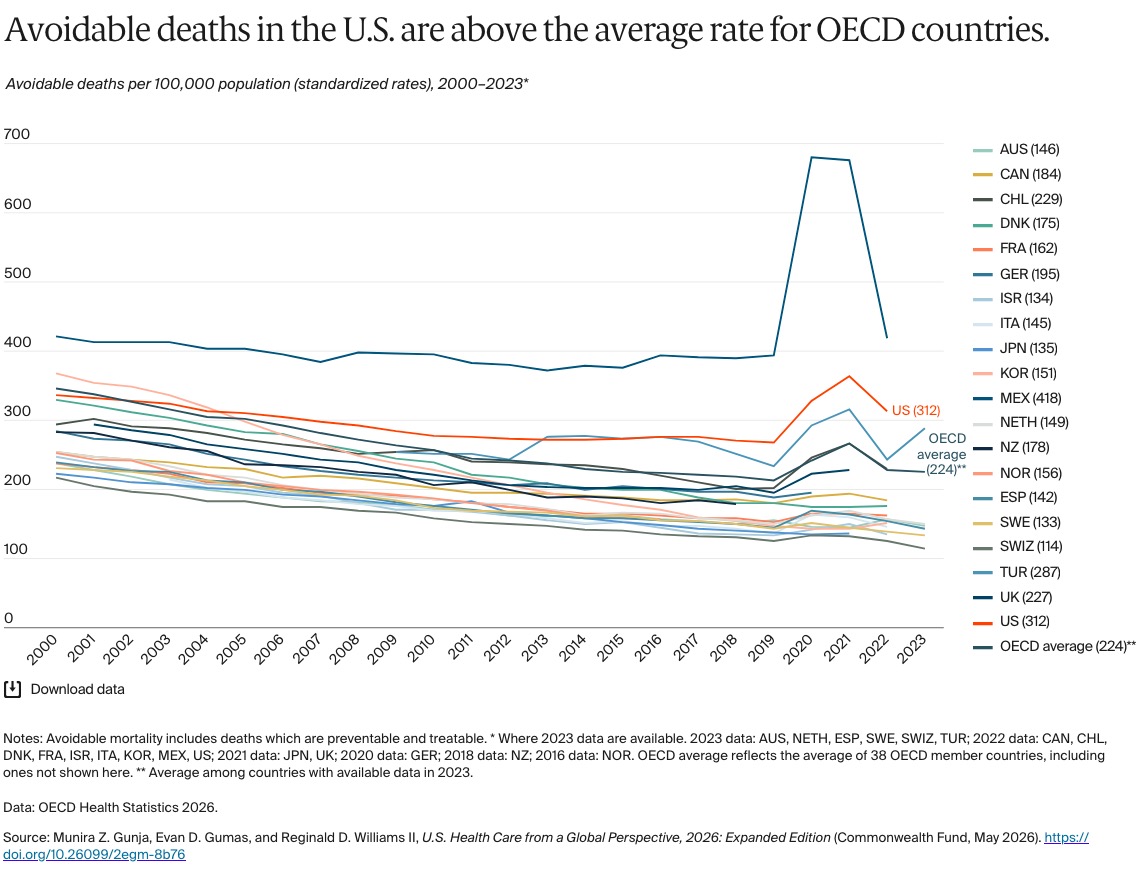
…and die less frequently of avoidable and preventable causes:
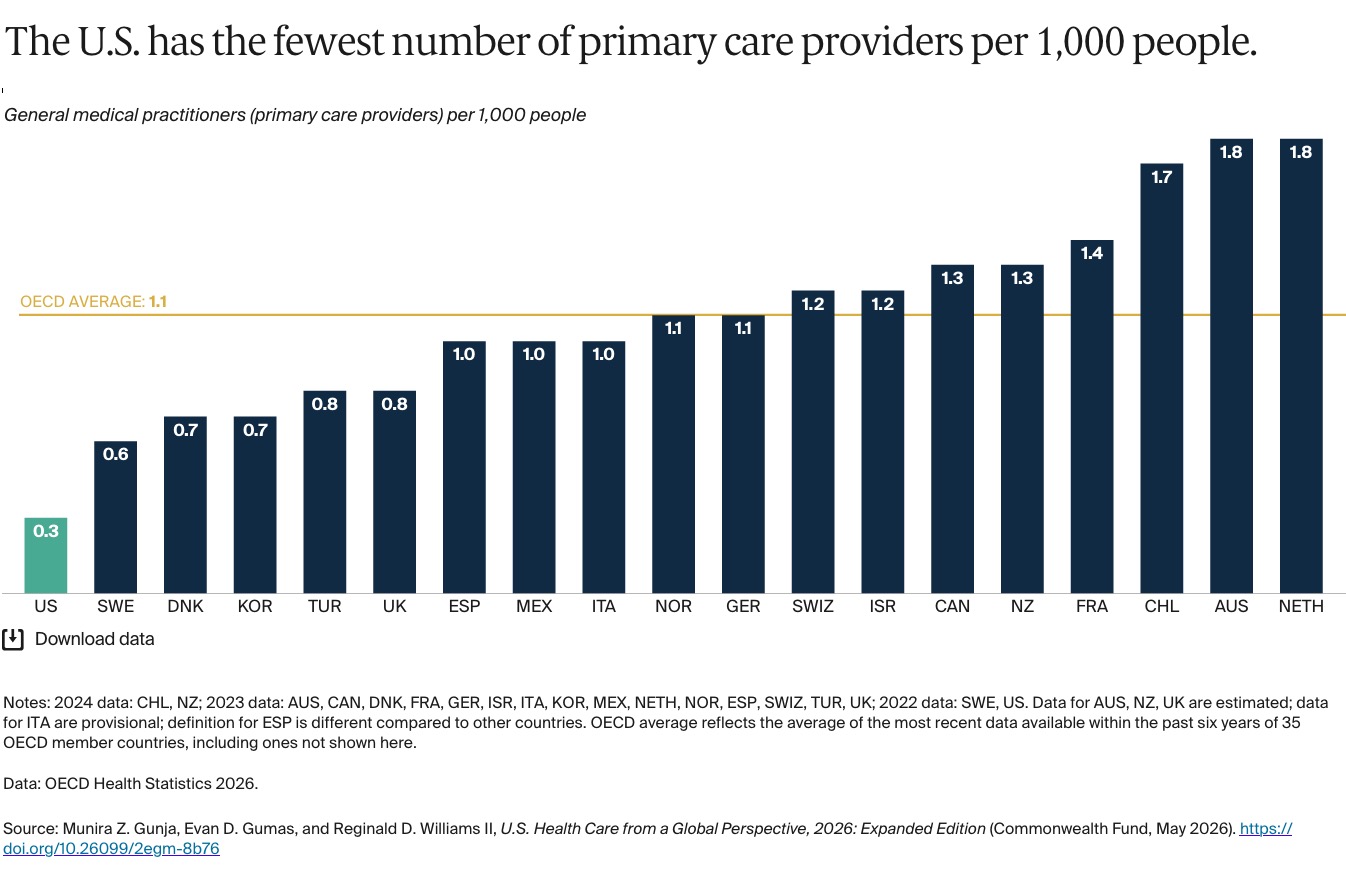
Socialized medicine doesn’t hamper other countries’ ability to make primary care providers available:
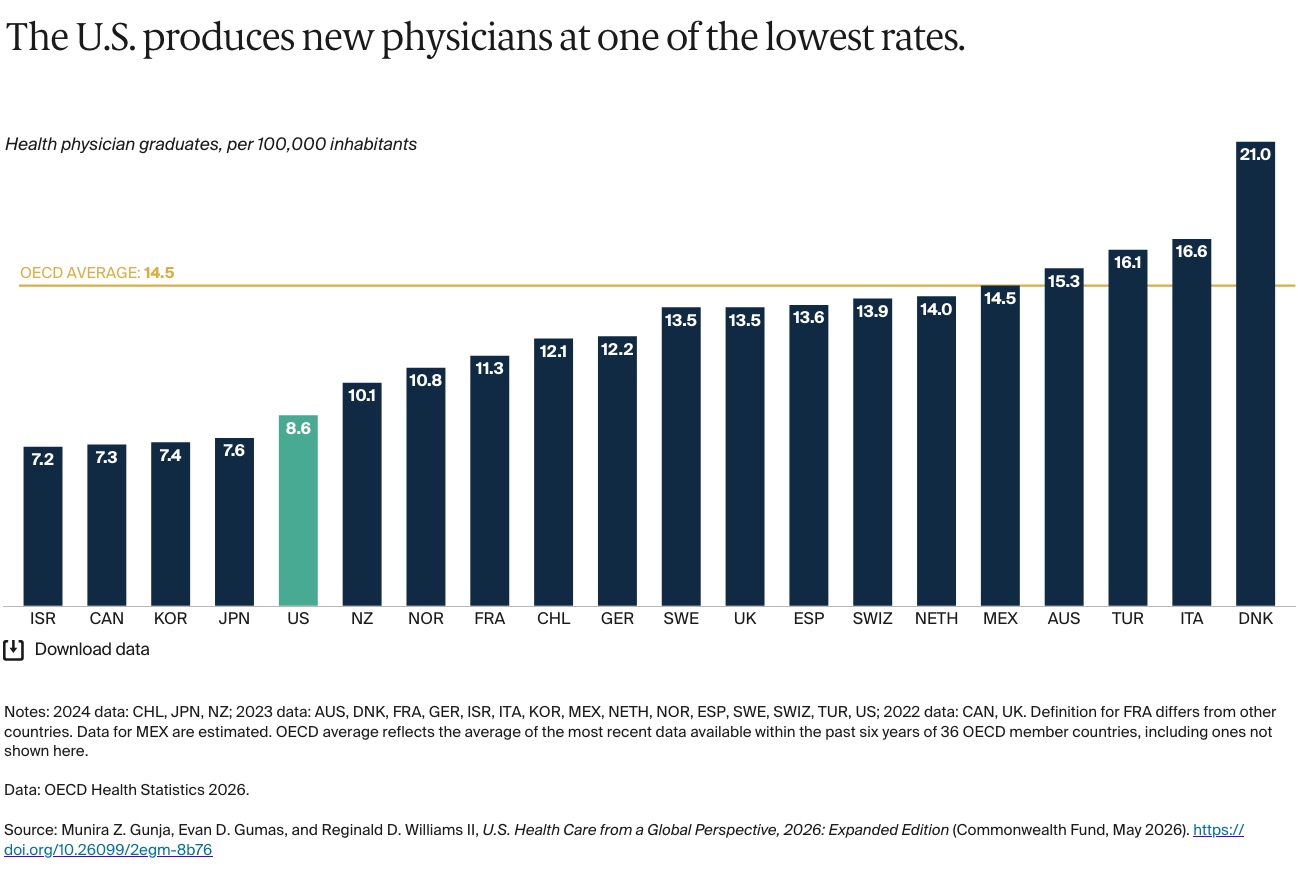
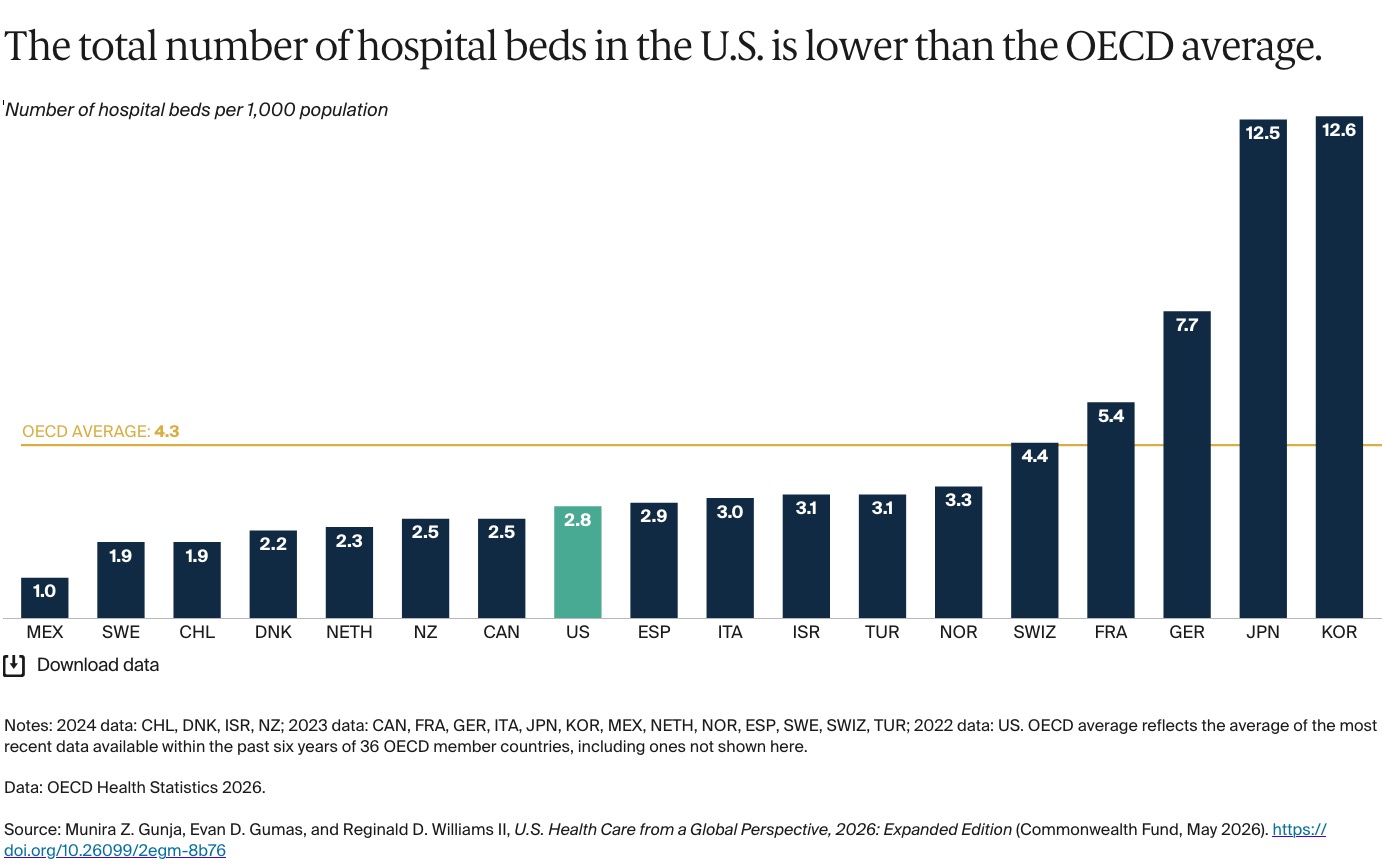
My fellow Americans, the solution to your high health insurance premiums is staring you in the face from all over the world. But your government continues to do the opposite of that solution:
Findings from this international comparison highlight a persistent failure of the U.S. health system: Americans pay more for health care, get less in return, and remain far more exposed to illness, debt, and insecurity than their peers. Recently enacted and proposed federal policies fail to address this contradiction head on. Instead, they sharpen it, leaving more Americans uninsured and exposed to costs they cannot afford. Over the next several years, it will be important to measure the impact of these policies against progress internationally. Yet comparison alone is insufficient: the U.S. must build a system that delivers care rather than financial ruin.
Other nations have made different choices. What’s remarkable is not that alternatives exist, but that the United States has failed to pursue them Gunja, Gumas, and Williams, 2026.05.28].
Adopt universal health care, or keep going broke and dying.
I totally agree. My wife and I are supposedly ok. However that is all upon approval from someone in our insurance company. How anyone could devise a system that makes its money on denying you care that your doctor orders is beyond me.
My wife has been put through hell for over a year because of pain. It will not save them money in the long run. First the doctor, then denial, then a specialist, then denial. It goes on on on. People wonder why Luigi Mangione was ce!ebrated. He killed a man who was in charge of a company that killed thousands every year!
Universal healthcare is needed but the details of that are important too.
Where are the right to life people? After Dobbs, they should be marshaling their forces to preserve life outside the womb.
This nation deciding that health care is a commodity for profit – not a basic human right must get addressed. Insurance providers and employers have become the death panels conservatives fear mongered during the ACA debate.
Put a fork in it. Obviously this country is on an unsustainable path. Almost $3000/month for family health insurance and it’s hard to convince me, all things considered, the Scandanavian socialism models are expensive…
I actually read most of the ACA when it was publdhed and none of this is a surprise.
The most ghastly thing in there was the Medical Loss Ratio Rebate provision.
The insurance companies can charge any high-priced premiums they want, but if they don’t spend enough on benefits, they have to rebate the difference. (I forget the percentage they are allowed to keep & how much they have to rebate,.I am thinking it was about 15%)
The only way the insurance companies can increase their bottom line is to increase the premiums, and then increase what they pay in benefits. If they charge a group plan $1 million dollars for premiums, they would have to spend $850,000 in benefits to keep the remaining $150,000. If they charge a group $2 million dollars in premiums, and they spend $1,700,000 in benefits, they can keep $300,000.
It took medical providers a hot second to figure out the insurance companies would be happy to pay more in benefits. This would offset the losses they would incur by Medicaid expansion.
The rebates, though, that was great, for employers, who administered the group plans. If they had a healthy work force, they’d get bigger rebate checks. The rebate money would not go to the employees who stayed healthy, they went to the employers.
There was this crazy idea the employers would either share the money with their employees, or they would spend it on smoking cessation programs and gym memberships.
As if.
The employers figured out the easiest way to get a bigger rebate was to get rid of chronically ill employees or not hire them in the first place.
When I read this, I thought “OMG, premiums and medical costs are going to skyrocket, and chronically ill people are going to be unemployable.”
As Pelosi said “we have to pass the bill do you can find out what’s in it.”
The ACA stinks. Told ya so
Algebra wrote, “ The ACA stinks.”
Are you of the mind the health care would be in a better place (for patients) without the ACA?
The ACA stinks because of politics of the right: first, wimpy Democrats didn’t use their majority to power through a better version, and second, the GOP refuses to adapt or ever repair problems so that even now, Democrats are denied a “win.”
Now that “fixing” the private insurance system has not worked to improve health outcomes and reduce costs, the next step HAS to be blow the WHOLE system up.
The ACA was a compromise with the right, supposedly. It should all be blown up BUT things will have to get even worse to make that politically possible.
The right believes in what? If they had anything they would have revealed that long ago.
Mark, I seem to remember MANY promises from our Republican friends about a replacement being just around the corner.