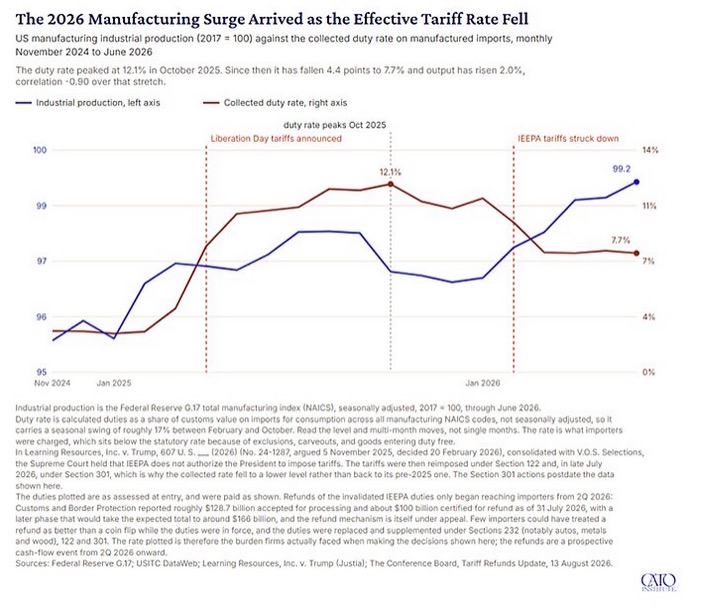
Cato Institute economist Scott Lincicome posts some charts busting White House propaganda about tariffs and manufacturing. Of particular interest is Lincicome’s finding that since November 2024 industrial production, still down from 2017 levels, surged to its highest level after the Supreme Court cancelled Trump’s Liberation Day round of illegal tariffs in February:
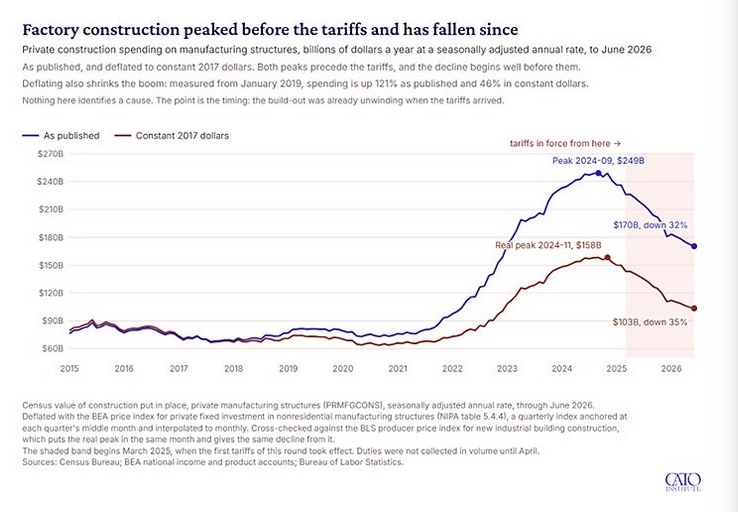
Lincicome also finds that real private spending on factory construction peaked in fall 2024 and has declined ever since. Tariffs did nothing to interrupt or temper that decline:
No boost in factory construction or output, no boost in factory jobs, no progress on closing the trade deficit—Trump’s tariffs haven’t delivered on any of his promises to American manufacturing or the American people.
Tariffs can only work as protectionism if there is domestic manufacturing to protect. Much of that ship has sailed for the US.
And CATO leans right. IMO
It’s illegal what the fat orange man is doing. The only reason he loves tarrifs is that he can apply them on a whim. He’s in charge of them. Its hard to live in the age of Trump stupidity. He has never believed in a win, win situation. Its all win or lose with the boy and he’s so stupid it always ends up a lose, lose. Just vote in November.
Creighton University’s Ernie Goss follows the economies of ten midwestern states including South Dakota’s where the manufacturing sector lost about 800 jobs over the last year or 1.8% of its manufacturing base, ag workers still face severe stressors and a mental health provider shortage affects at least 62 of South Dakota’s 66 counties.
https://www.creighton.edu/economicoutlook/mainstreeteconomy
And there is this tidbit…. Companies that told the felon/rapissed to take a hike on DEI policies outperformed those who capitulated, proving, once again, diverity is good for the U S. https://www.alternet.org/trump-corporations-micromanaging-dei/