The Game Fish and Parks Commission has killed the Nest Predator Bounty Program… at least in name. While the Nest Predator Bounty Program was only on the March 5–6 agenda as an informational item, the GF&P Commission decided to act on a resolution spurred by a recommendation from the Senate (transmitted last month when Senate Agriculture and Natural Resources declined to end the wasteful bounties themselves) to scale the program back to focus on youth trapping.
Since 2019, at Governor Kristi Noem’s bloodthirsty behest, GF&P has been spending $500,000 a year to pay folks to trap and kill raccoon, striped skunk, badger, opossum, and red fox and turn in the chopped-off tails during spring nesting, from March through June. Unable and unwilling to produce any science supporting the program’s original pretext that such slaughter would protect pheasant nests and give us more birds to shoot in the fall, the state slid toward marketing the program as a way to encourage kids to spend more time outdoors.
GF&P is sticking with the youth angle, renaming the bounty program the Youth Trapping Recruitment Program. They are targeting the same critters during the same nesting period but paying $10 bounties only to trappers under age 18 and reducing the total payout to $200,000.
As biologist Alexey Egorov points out in comment submitted to the commission, that money is still scientifically and morally mistargeted. We’ve been killing fox and friends where pheasants aren’t in the greatest numbers:
The NPBP is implemented statewide, with most program activity occurring outside core pheasant strongholds (Chamberlain local area). As a result, animals are being killed haphazardly, primarily near urban areas along the I-29 corridor (see attached map), leading to inefficient use of public funds where measurable population-level benefit is unlikely. If the stated objective is to increase pheasant production, predator management should be focused in high-density brood areas, not statewide. Attempting to protect nests where they are rare is unlikely to produce measurable benefits, as predators in such areas primarily rely on alternative food sources [Dr. Alexey Egorov, letter to Game Fish and Parks Commission, 2026.03.01, in meeting agenda packet, 2026.03.05–06, p. 213].
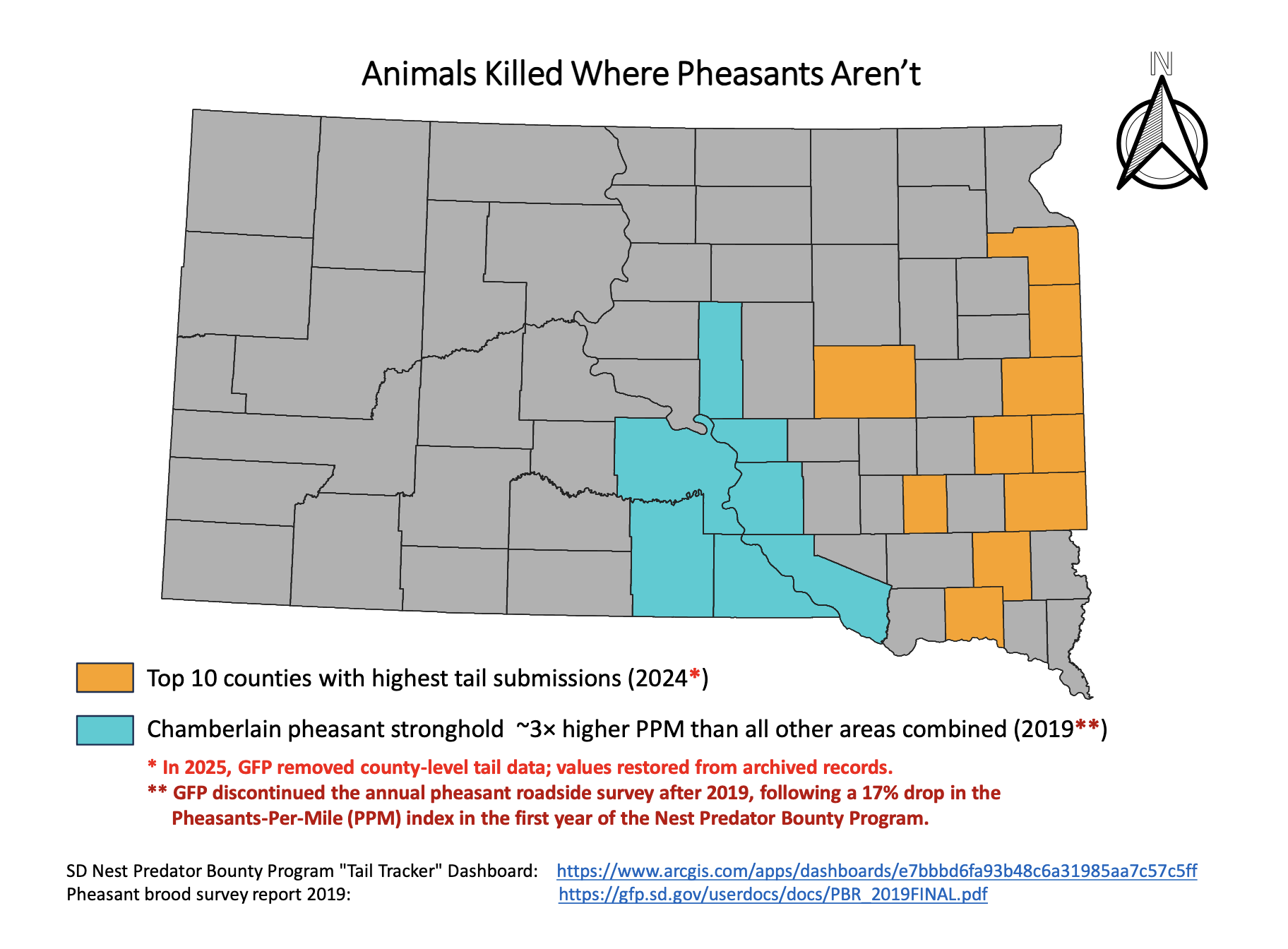
That mistargeting, says Dr. Egorov, exacerbates the moral ill of encouraging children to kill:
7. By limiting participation to youth, the program will miseducate children by portraying the activity as conservation. Encouraging minors to kill indigenous wildlife as a form of outdoor recreation during the peak of gestation and nursing seasons raises serious ethical and educational concerns. The bounty program does not constitute conservation or education. It is a chaotic killing for sake of killing [Egorov, 2026.03.01, GF&P Commission agenda packet, p. 213].
We don’t even get the fiscal satisfaction of saving $300,000. GF&P is diverting the rest of the old nest predator bounty funding to a new coyote bounty program:
The Coyote Bounty Program will be open for all South Dakota residents. Tails from coyotes will be worth $30.
The program will run from April 1-July 1, unless the $300,000 limit is reached first.
“Controlling the coyote population is critical for both our agricultural industry and wildlife populations,” stated Robling. “The newly created Coyote Bounty Program will assist in the management of these predators to help protect newborn calves and lambs for agricultural producers and enhance fawn survival for deer and antelope” [Game Fish and Parks Department, press release, 2026.03.06].
Coyote bounties smell a bit like the state’s economic development handouts: we’re providing an incentive for something people are already inclined to do. South Dakotans can shoot or trap coyote all year long. Farmers and ranchers already have a much larger financial incentive—the market value of their calves and lambs—to eliminate coyotes in their neighborhood.
And, as with the nest predator bounties, science doesn’t show coyote bounties work. Check Utah’s experience:
Bounties are designed to encourage hunters to go afield and kill coyotes in an attempt to reduce populations. Based on Utah’s results, they certainly can encourage hunters to hunt more. According to Utah Department of Natural Resources surveys, hunters spent 35 percent more time hunting coyotes due to the bounty. Since it was adopted the average annual coyote harvest, including recreational hunting and trapping and kills by federal wildlife agents, has been about 15,000 per year. Prior to the implementation of the bounty program, average annual harvest was about 9,300.
While the coyote kill may be up, the results of that additional harvest are muddy, at best. Based on kill locations, about 20 percent of the Utah’s coyote harvest takes place on mule deer summer range, which is where fawns are born and raised. Coyotes are a significant source of mule deer fawn mortality. So far, though, fawn-to-doe ratios have actually decreased over the course of the bounty program. The state’s deer herd has grown slightly. Biologists think that may have to do with favorable weather conditions more than any reduction in coyotes. Drought, in particular, can take a heavy toll on fawn recruitment. Severe winters can also play a role in population trends [David Hart, “Cash for Coyotes: Do Bounties Work?” Grand View Outdoors, 2019.08.14].
I’d like to take comfort in the notion that Game Fish and Parks is at least scrubbing from the books one more of the stains Kristi Noem put on our fair state. But Noem’s fundamental ignorance and cruelty remain in GF&P’s new split program of unnecessary and likely ineffective bounties.
They should dump the coyote program and set up a massive jackrabbit program.
Apart from that, South Dakota youth are brought up to be killers. Before I was 18 I killed hundreds of animals with my peep site twenty two.Hollow points worked the best, they were lethal. Eventually gave it up. Never trapped either, way too cruel. Its a conundrum but people will come to their senses. As the pubs love to say their common sense will prevail. Left all my guns when we left the state.
What a horrible state.
Republican is simply another word for Earth hater. The introduction of the Chinese ring-necked pheasant to South Dakota is one of most destructive examples of ecoterrorism in US history and has heralded the near eradication of habitat for native wild turkeys and grouse. Now, the extermination of native species to prop up the pheasant industry is in full force after another Earth hating Republican governor and legislature continue attacks on raccoons and skunks known to feed on prolific invasive zebra mussels.
It is a horrible state to have such a horrible program and yes for a nonindigenous bird….our state bird.
Killer Kristi started this program for kids to go shootin and torture trappin after church. With kids killing their parents and siblings on the rise, I’d wait until they’re in formal operational thought and post pubescence before teaching them how to kill just for the hell of it.
They may find shootin hoops or photographs to be a more positive lifelong recreation. Or perhaps strapping the ankles with Velcro bands and bicycling along the river may chill others out.
Once upone a time Texas had a bounty on coyotes, soon they discovered in the counties where coyote population went down so the ferreal hog population went up. Once they stoped killing the coyotes and in the counties where their population increased the ferreal hog population decreases. Seems the coyotes developed a straigy of targeting young piglets in the early morning before daybreak. While I am relitivly certian that South Dakota’s weather is to cold for the ferreal hogs it is a prime example where letting nature take care of itself would be the best policy.
Just saying.